


What Does It Mean to Be Educated in an AI World?
Why human judgment, curiosity, and creativity matter more than ever — not less — now that answers are cheap.
In This Article
- From Information Scarcity to Information Abundance
- Knowledge Has Become Easy. Wisdom Has Not.
- Why Memorization Still Matters
- The New Literacy: AI Literacy
- Curiosity, Creativity, and Judgment
- Judgment Is Becoming the Ultimate Skill
- Communication and Collaboration in an AI World
- Adaptability and Lifelong Learning
- A Short Action Plan
- Series Conclusion: What Comes Next
From Information Scarcity to Information Abundance
For most of human history, knowledge was scarce, expensive, and guarded by gatekeepers — scribes, printers, universities, librarians. Access itself was the bottleneck. Today an AI model puts an enormous fraction of recorded human knowledge one prompt away. But access to information was never the same thing as understanding, and it was never the same thing as wisdom.
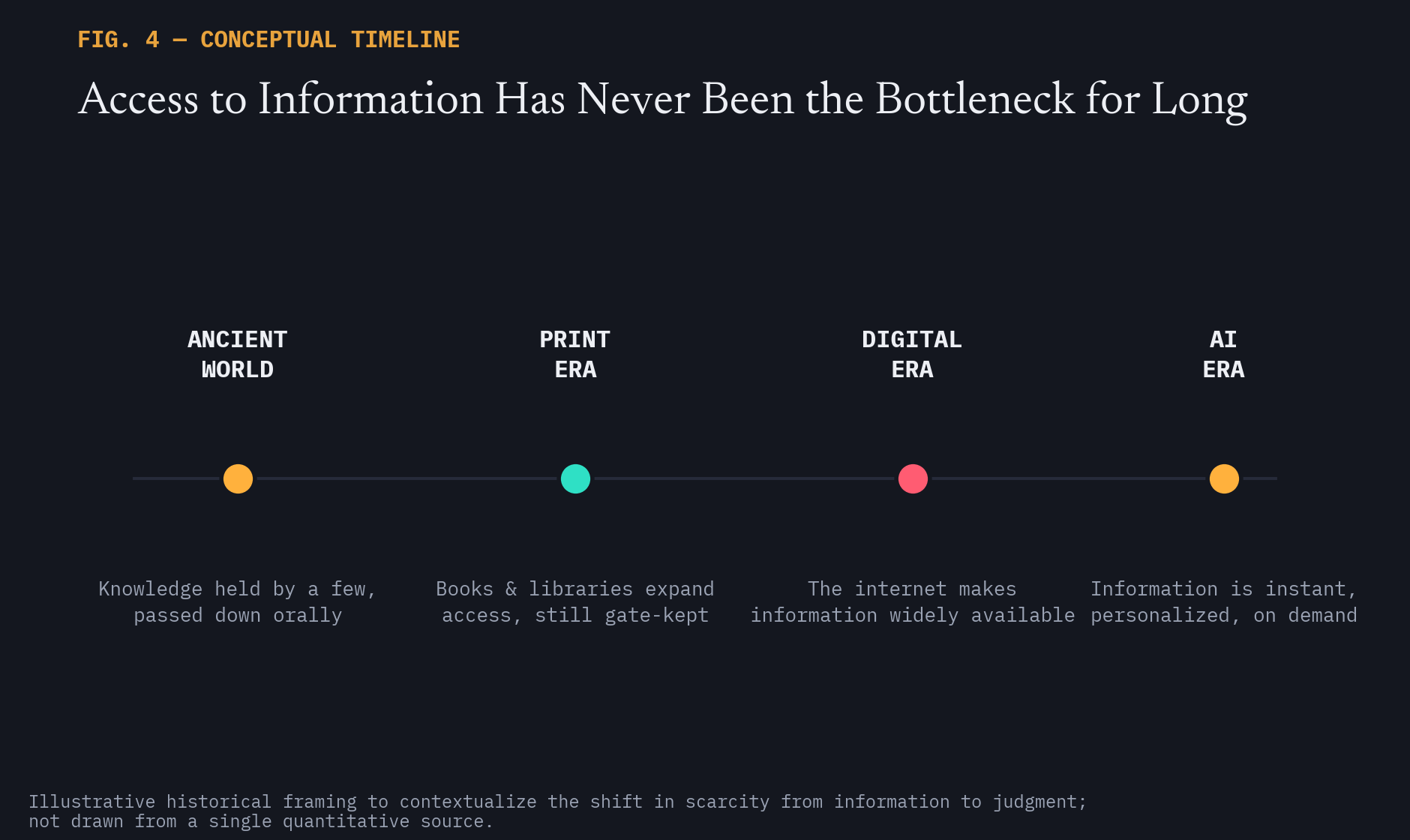
That shift matters because it changes what “being educated” should mean. When information was scarce, simply having it was valuable. When information is abundant and instant, the valuable thing is what you do with it: which patterns you notice, which claims you question, which decisions you make.
Knowledge Has Become Easy. Wisdom Has Not.
Two people can read the same article, watch the same lecture, or ask the same AI assistant the same question — and walk away with very different levels of understanding. Classic research on expertise found that experts and novices don’t just know more; they organize what they know differently.
Studies of how experts and novices represent physics problems found that they begin from specifiably different problem categories, and that completing a problem’s representation depends on the knowledge organized around those categories. Experts don’t just have more facts stored — they have a richer structure connecting those facts, which is what lets them recognize a new problem as a familiar type and reason about it quickly. AI can hand anyone the facts. It can’t hand anyone that structure.
Aristotle drew a related distinction more than two thousand years ago, between episteme (knowing facts) and phronesis (practical wisdom — knowing what to do with them in a specific, uncertain situation). That distinction is more relevant now than it has been in decades.
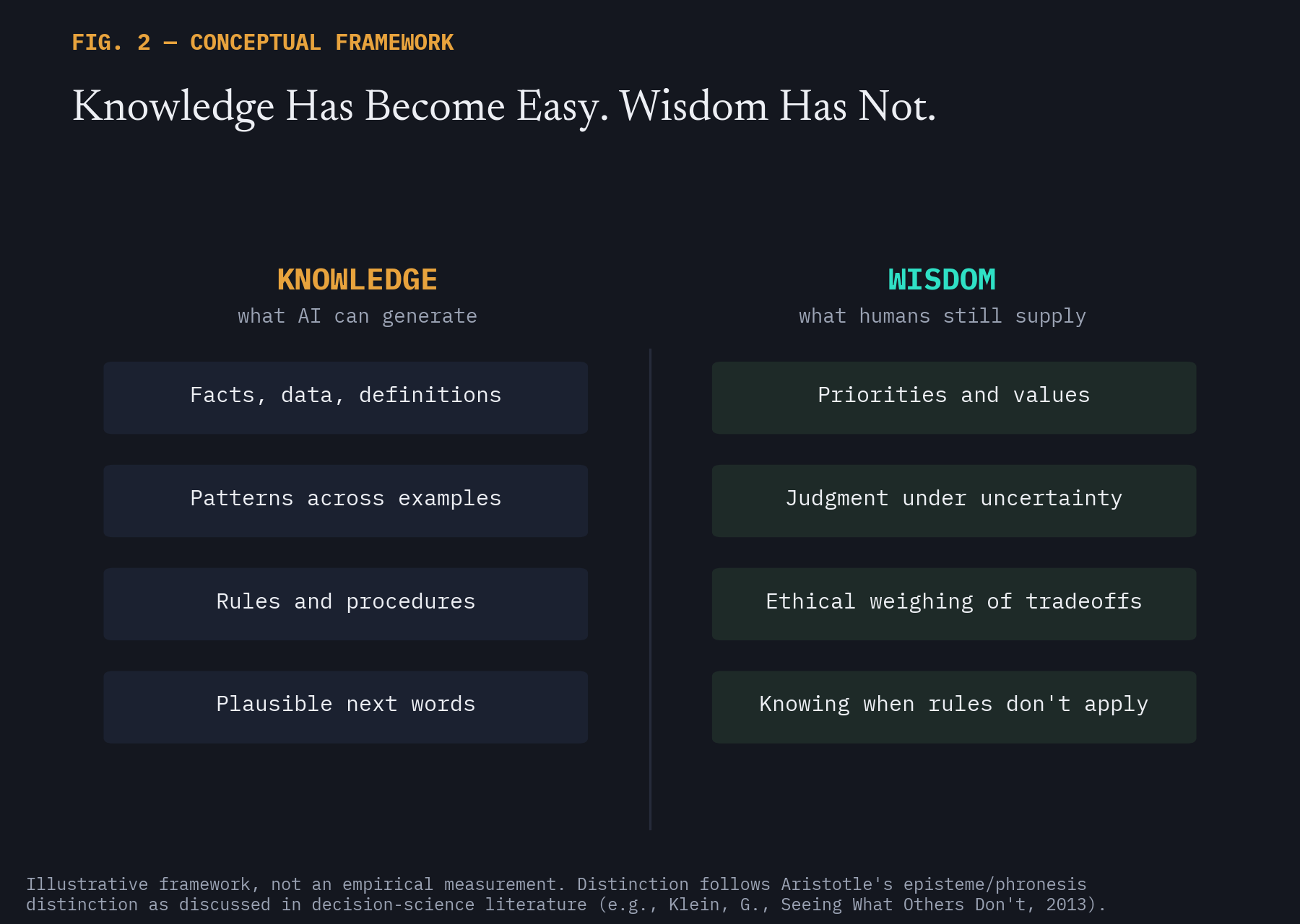
Research on naturalistic decision-making backs this up from a different angle. Gary Klein’s decades of field studies with firefighters, nurses, and military commanders describe how experienced professionals reach good decisions under real-world uncertainty: not by running exhaustive calculations, but by recognizing situations against a deep well of lived experience and adjusting rapidly when something doesn’t fit the expected pattern. That kind of judgment — built from context, consequence, and values — is exactly what a model trained to predict plausible text does not have. It can describe wisdom. It cannot exercise it on your behalf.
If anyone can access information instantly, what actually sets you apart — in your career, and in your life?
Why Memorization Still Matters
It’s tempting to believe memorization is obsolete now that AI can look anything up instantly. But as we covered in Part 1, working memory and long-term memory aren’t just storage — they’re the raw material thinking runs on. Experts think faster not because they’re smarter in some abstract sense, but because they’ve stored more organized knowledge in long-term memory, which frees up scarce working-memory capacity for the genuinely new parts of a problem. Someone with no foundational knowledge in a subject can’t quickly tell whether an AI-generated answer about that subject is right, subtly wrong, or confidently fabricated — because evaluating an answer requires the same stored knowledge that generating one from scratch would.
The New Literacy: AI Literacy
Being educated in an AI world increasingly means being able to work with AI responsibly and effectively — a skill set separate from, and more durable than, knowing how to phrase a clever prompt.
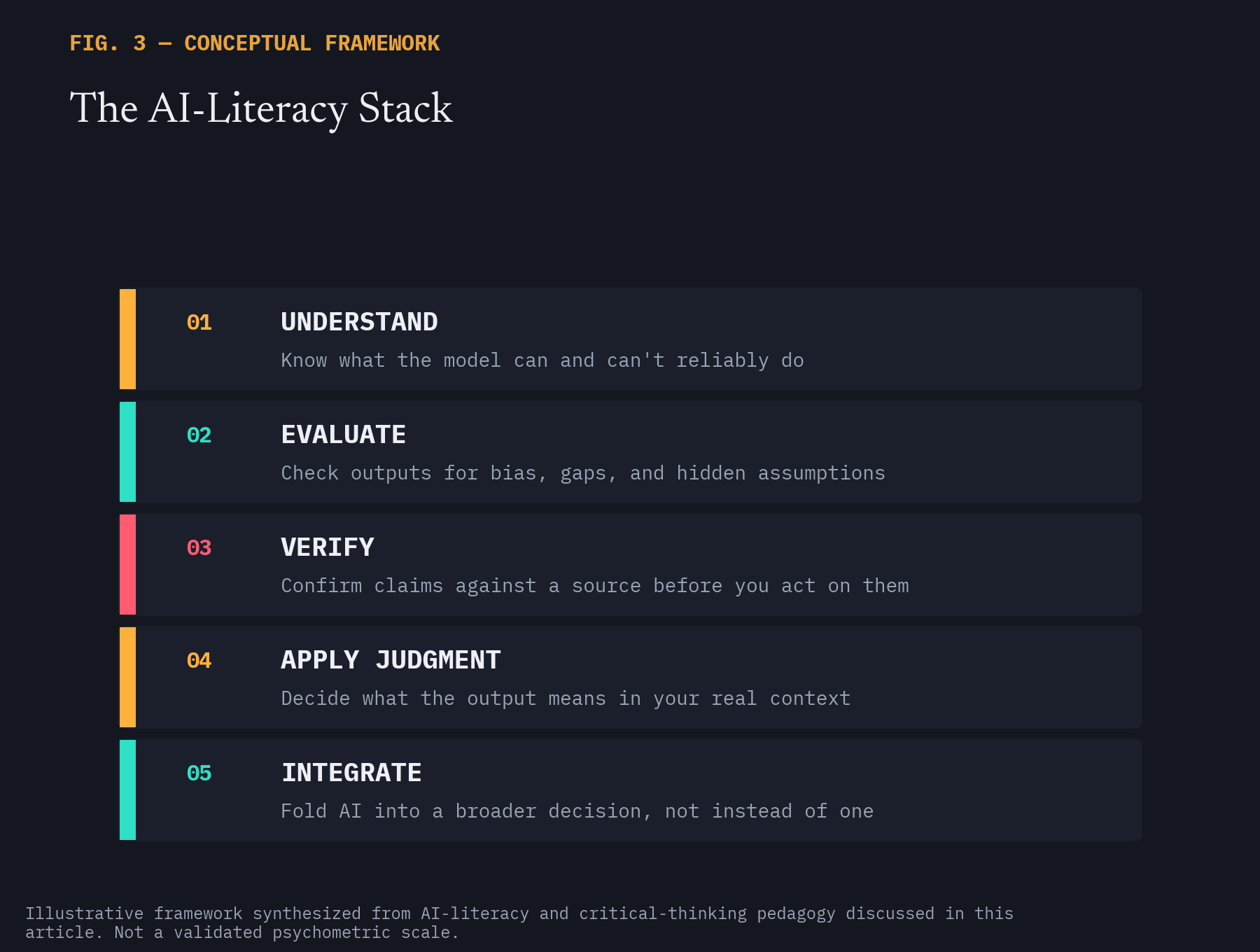
Notice what’s absent from that stack: “write better prompts.” Prompting is a shallow, fast-decaying skill — interfaces change every few months. Understanding what a model can and can’t do reliably, catching bias and gaps in its output, verifying claims against a real source, and deciding what an answer means in your specific context are durable skills that transfer across every new model that ships.
Would you know if an AI’s response to you today was wrong, biased, or incomplete? What would tip you off?
Curiosity, Creativity, and Judgment
AI is very good at generating answers. It is not the thing that decides which questions are worth asking, which options actually matter, or what’s true, valuable, and wise once the options are on the table. That’s still squarely human work, and the labor market is already pricing it that way.
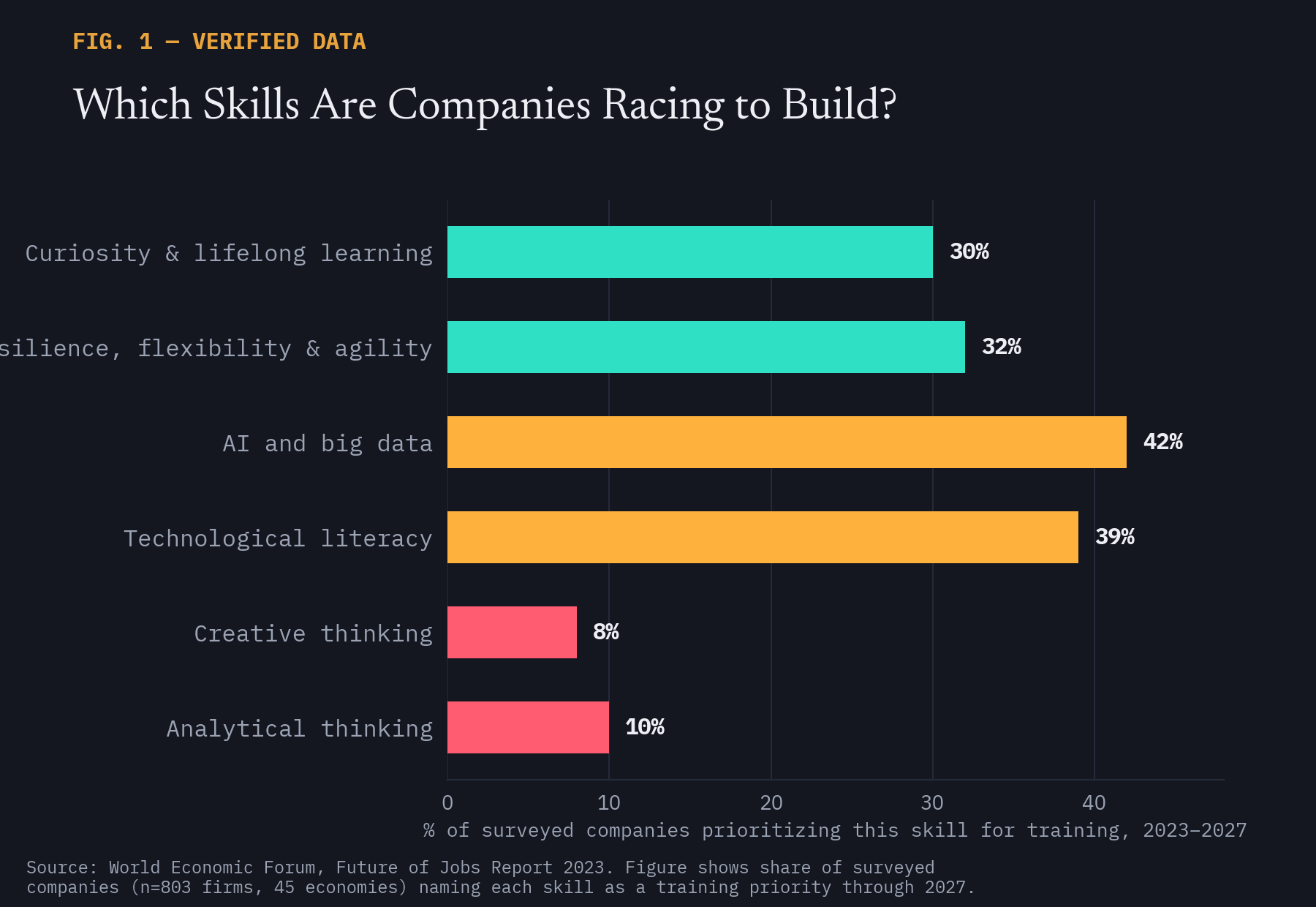
The World Economic Forum’s 2023 Future of Jobs Report found that AI and big data ranked third among companies’ skills-training priorities over the following five years, prioritized by 42% of surveyed companies, alongside leadership and social influence (40%), resilience, flexibility and agility (32%), and curiosity and lifelong learning (30%). And when it comes to the core skills companies say matter most right now, analytical thinking and creative thinking rank first and second, ahead of self-efficacy skills like resilience and curiosity and lifelong learning — with cognitive skills growing in importance faster than almost any other category, and businesses reporting that creative thinking is growing in importance slightly more rapidly than analytical thinking. Employers are not asking for people who can out-recall a database. They’re asking for people who can out-think, out-question, and out-judge one.
Judgment Is Becoming the Ultimate Skill
In a world where information is abundant, good judgment is the thing that stays scarce. Judgment shows up as a specific, learnable set of moves: evaluating evidence on its merits, recognizing your own assumptions, noticing bias — in a source, a dataset, or a model’s output — communicating your reasoning so others can check it, sitting with genuine uncertainty instead of forcing false confidence, and ultimately making the ethical call. In fields like healthcare, law, education, and leadership, AI can inform a decision. Humans still own the consequences of it.
When you’re faced with a difficult decision, are you looking for comfort — or for clarity? What would better judgment look like in your life right now?
Communication and Collaboration in an AI World
None of this happens in isolation. Judgment and creativity only compound when they’re shared — explained clearly enough that someone else can build on them, challenged productively enough that weak ideas get caught early, and coordinated across a team that’s now collaborating with AI tools as well as with each other. That’s not a soft add-on to the “real” skills. The same WEF analysis that ranks analytical and creative thinking at the top of the skills list also places empathy and active listening, and leadership and social influence, in its top ten — attitudes about working effectively with other people, right alongside the cognitive skills AI is often assumed to be replacing.
In practice, that means the educated response to AI isn’t “let the model draft it and move on.” It’s using AI to remove the friction of production — the blank page, the first rough pass, the tedious reformatting — while a human still does the parts that require shared context: explaining why a recommendation makes sense to a specific person, adjusting the message for what a colleague already knows, and catching the places where a technically correct answer would still land badly.
Adaptability and Lifelong Learning
The tools will keep changing. The interface you learn this year will look different next year. What holds steady is the underlying habit of learning itself — the willingness to treat your own understanding as a draft that keeps getting revised rather than a finished product. Employers already rank curiosity and lifelong learning among their top training priorities for the 2023–2027 period, not because it’s a nice-to-have, but because it’s the one skill that makes every other skill re-learnable when the tools underneath it shift again.
Practically, that looks like building small habits of re-checking your assumptions: revisiting a workflow every few months to ask whether the AI-assisted version is actually still the fastest way, or just the most familiar one; staying willing to be a beginner again at something adjacent to your expertise; and treating “I don’t know how this new tool works yet” as a temporary and ordinary state, not a threat.
A Short Action Plan
Keep building foundational knowledge in your field, even when AI can answer the surface-level questions — you need it to evaluate the answers.
Practice AI literacy deliberately: before accepting an AI output, ask what it might be missing, biased about, or simply wrong about.
Protect time for genuinely hard thinking — the kind Part 3 called deep work — where judgment, not retrieval, is the bottleneck.
Practice explaining your reasoning out loud to another person, not just producing a conclusion — it’s how judgment gets sharper and how collaboration actually works.
Revisit your habits on a schedule. The tools will change again. Make “re-learning this” a routine, not an emergency.
Series Conclusion: What Comes Next
Over four parts, we’ve traced a single argument from different angles. Your brain wasn’t built for infinite information (Part 1), so offloading memory to AI has to be done deliberately, not by default (Part 2). Attention is a finite, biological resource that constant AI-enabled interruption quietly erodes (Part 3). And now, in Part 4: being educated in an AI world was never really about what you know. It’s about what you can still do that a model can’t — ask a better question, weigh a harder tradeoff, and own the outcome.
What to remember
- Information is abundant now; wisdom and judgment remain scarce — and scarcity is what determines value.
- Memorization still matters, because evaluating an AI’s answer requires the same stored knowledge that generating one from scratch would.
- AI literacy is the new essential literacy — and it’s mostly not about prompting.
- Curiosity, creativity, and judgment are rising in measurable demand, not falling, as AI takes over routine information tasks.
- Education is shifting from memorizing facts to deliberately building the human capabilities AI cannot supply: judgment, values, and care for consequences.
References
- Chi, M.T.H., Feltovich, P.J., & Glaser, R. (1981). Categorization and Representation of Physics Problems by Experts and Novices. Cognitive Science, 5(2), 121–152.
- Klein, G. (2013). Seeing What Others Don’t: The Remarkable Ways We Gain Insights. New York: PublicAffairs.
- World Economic Forum. (2023). Future of Jobs Report 2023.
Additional Reading
- Part 1: Your Brain Wasn’t Built for AI — working memory, cognitive load, and productive struggle.
- Part 3: The Myth of Multitasking — the neuroscience of attention and task-switching costs.
Additional Resources
- WEF Future of Jobs Report 2023 — Skills Outlook — the full skills-training data referenced in this article.
- Chi, Feltovich & Glaser (1981), Cognitive Science — the original expert/novice physics-problem study.

Leave a Reply