



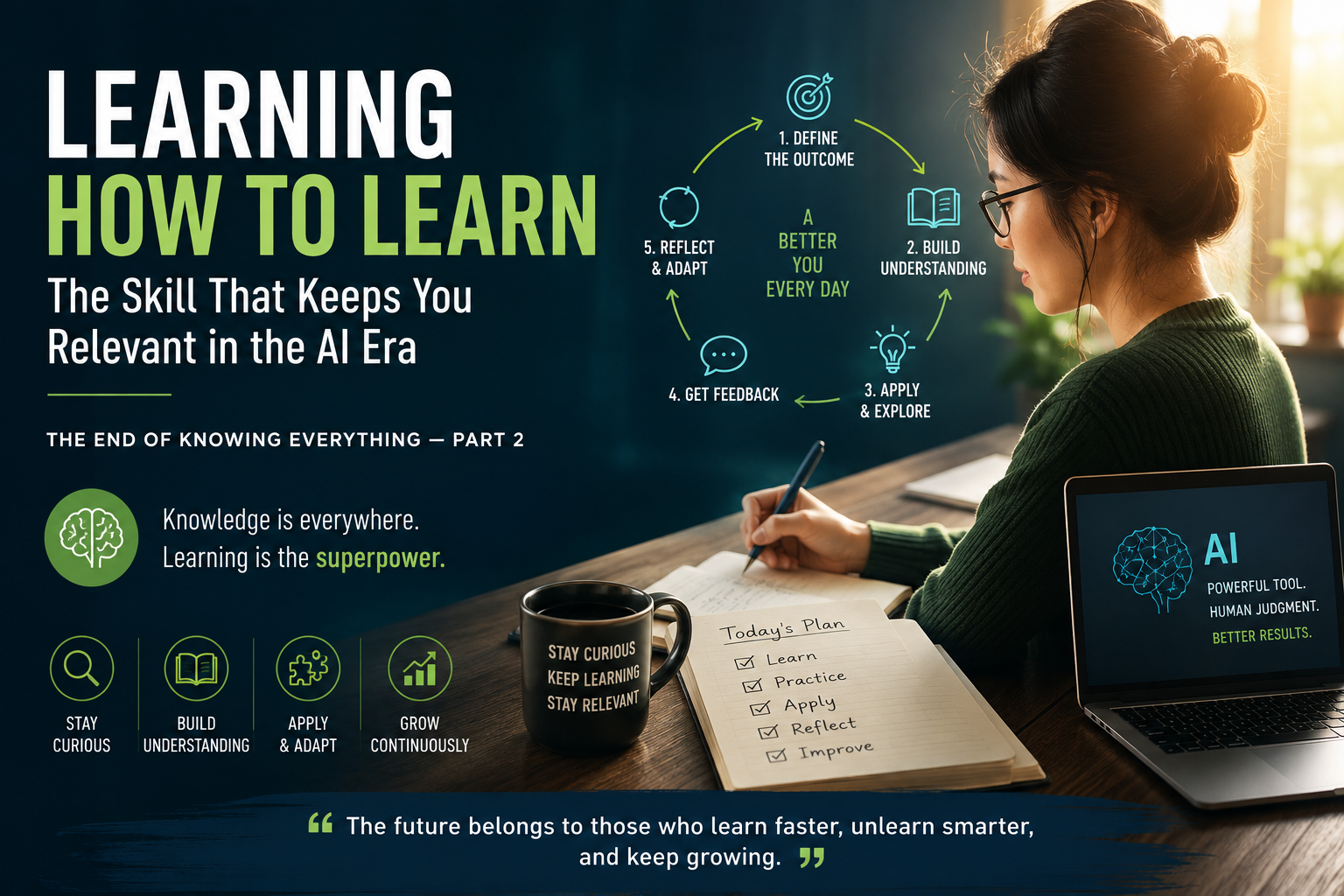
Learning How to Learn: The Skill That Keeps You Relevant in the AI Era
If careers constantly change, how do people stay relevant? The answer is not knowing everything. It is building a repeatable ability to learn, test, adapt, and exercise judgment.
From knowing everything to learning continuously
Part 1 of this series, “The Knowledge Revolution Is Over,” began with a provocative reality: information is no longer scarce. Search engines, digital libraries, and now generative AI can surface explanations, examples, and drafts in seconds. That does not make knowledge unimportant. It changes the work we must do with knowledge. When answers are easy to retrieve, the differentiators become understanding, context, judgment, creativity, ethical reasoning, and the curiosity to ask what an answer leaves out.
That first conversation was not an argument for abandoning memory or foundational knowledge. Facts, vocabulary, concepts, and mental models still matter because they help us recognize errors, make connections, and ask informed questions. But access alone is not mastery. A person who can call up an answer but cannot explain it, apply it to a new problem, or recognize its limits has encountered information—not yet learned it.
Part 2 builds from that distinction. If knowledge is increasingly available on demand, learning itself becomes a durable capability: the ability to identify a gap, acquire trustworthy understanding, test it in context, seek feedback, and revise one’s approach. This is not merely a workplace tactic. It is a civic, educational, and personal skill in a world where tools, claims, and roles can shift quickly.
Why this matters now
The case for learning agility is not based on a prediction that every job will disappear. It is based on the continuing change in what work requires. In its 2025 Future of Jobs Report, the World Economic Forum reports that surveyed employers expect 39% of workers’ core skills to change by 2030. The report identifies analytical thinking as the most frequently named core skill, with resilience, flexibility, and agility close behind; it also lists curiosity and lifelong learning among the skills rising in importance. [1]
The durable advantage is not predicting every change. It is being able to learn through it.
Analytical thinking, resilience, flexibility, agility, curiosity, and lifelong learning all sit near the center of the skills conversation—not as buzzwords, but as capabilities for navigating change.
Those findings are employer expectations, not a guarantee about any individual role or country. Still, they point to a useful response: do not wait for a perfect forecast of the future. Build a repeatable process for learning. The goal is not to chase every new platform or become an expert in every trend. It is to be able to move from uncertainty to informed action without surrendering your judgment to the loudest headline or most fluent AI output.
AI makes this need more visible. It can help draft, summarize, translate, classify, and generate possible solutions. It can also produce mistakes, omit context, or present a plausible answer without showing why it is sound. The same World Economic Forum report notes that human-centred capabilities remain important and frames much of generative AI’s near-term value as augmentation through human–machine collaboration rather than wholesale replacement. [1] The practical question, then, is not “Can the tool do this?” It is “What must I understand well enough to use, check, and improve this responsibly?”
Metacognition: managing your learning
Metacognition is the habit of noticing and managing your own learning. In plain language, it means asking: What do I already know? What do I only recognize? What am I assuming? What strategy should I use next? Am I making progress? It is the difference between passively consuming a tutorial and deliberately deciding how to learn from it.
This is especially valuable when AI can make an explanation feel complete. A polished response may create familiarity, but familiarity can be misleading. Try a simple check after reading or prompting: close the tab. Can you explain the idea in your own words? Can you solve a related problem without the tool? Can you identify a circumstance in which the answer may not work? If the answer is no, you have found the next learning task.
“That explanation looks familiar. I understand it while I am reading it.”
“I can explain it, apply it without the tool, test its limits, and recognize when it might fail.”
The Education Endowment Foundation’s guidance on metacognition and self-regulated learning describes metacognitive strategies as approaches that get pupils to think about their own learning. It cautions that these strategies should be taught alongside specific subject content, rather than as detached “learning to learn” exercises, because learners can struggle to transfer generic tips into a new task. [2] That principle travels well beyond school: learn reflection inside the actual work, decision, or problem you need to handle.
A practical learning loop
Use this five-step loop whenever you need to develop a capability. It is intentionally modest. A reliable loop practiced repeatedly is more useful than an ambitious plan that never reaches application.
1. Name the outcome
Replace “I need to learn AI” with a useful, observable goal: “I want to turn customer-call notes into a reviewed follow-up draft while protecting confidential information.” A clear outcome tells you what to practice and what responsible use looks like.
2. Surface the gap
Before searching, write what you think is true, what you can already do, and what you cannot explain. This prevents the tool from becoming a substitute for your own thinking and makes later improvement visible.
3. Learn from credible material
Start with a primary source, an official guide, a recognized professional body, or a well-supported research summary when available. Ask AI to explain, compare, or quiz you, but verify important claims against the original source.
4. Retrieve and apply
Put the source away. Explain the idea aloud, create a short checklist, solve a case, or perform a small task. Retrieval exposes weak spots more honestly than rereading does.
5. Review and revise
Compare the result with the goal. What worked? What was inaccurate or inefficient? What feedback did you receive? What will you change on the next attempt? This review turns an isolated attempt into learning.
Curiosity with direction
Curiosity is sometimes mistaken for distraction: the impulse to click everything new. Productive curiosity is more disciplined. It is the willingness to notice a friction, ask a better question, investigate the evidence, and stay with the question long enough to test an answer. It helps a student look beyond the first explanation, a parent ask how a recommendation system affects a child, and a professional spot a workflow that no longer serves customers or colleagues.
The World Economic Forum’s 2025 survey places curiosity and lifelong learning among the skills expected to rise in importance, alongside technological literacy and creative thinking. [1] That does not mean curiosity alone earns an outcome. It needs a direction, a standard of evidence, and a moment of application. In practice, curiosity becomes valuable when it leads to a clearer decision, a safer process, a better question, or a new capability shared with others.
Record recurring problems, surprising results, and points of confusion. At the end of the week, choose one question that matters to your role or community. Spend 30 focused minutes investigating it. Ask a colleague how they see the issue. Then create one small artifact—a checklist, one-page explanation, test prompt, or revised process—that makes your learning usable.
Growth mindset without the slogan
A growth mindset is often reduced to a motivational slogan. A more useful interpretation is practical: abilities can improve when people use effective strategies, get feedback, practice, and have support. It is not the claim that anyone can master anything instantly, nor the denial that time, access, disability, prior preparation, and opportunity shape learning. It is an invitation to replace a fixed identity statement with a learning question.
“I am not technical” can become “Which technical concept would help me do this one task better?” “AI will replace my role” can become “Which parts of this role require domain knowledge, relationship-building, accountability, or judgment—and how can I strengthen them?” The reframe does not eliminate risk. It restores agency.
The OECD Learning Compass 2030 describes student agency as the capacity to set a goal, reflect, and act responsibly to effect change. It places agency within relationships with peers, teachers, parents, and communities—what it calls co-agency—rather than treating learning as a solitary act. [3] Adults need that same ecosystem: a peer who will review the draft, a manager who makes room for practice, a mentor who can explain context, or a community that can challenge a weak assumption.
The Future Learner Framework
The Future Learner Framework below turns lifelong learning into a practice. It is not a scientific instrument or a replacement for formal education. It is a usable structure for students, educators, parents, and professionals who want to turn change into purposeful action.
Scan
Notice what is changing in your field, school, or community. Look for a repeated problem, a new expectation, a risk, or a task that is becoming easier to automate. Do not confuse novelty with importance; scan for changes connected to real outcomes.
Select
Choose one capability with a clear use case. “Learn data analysis” is broad. “Interpret the weekly service dashboard well enough to identify a trend and ask a better follow-up question” is a learnable target.
Study
Use credible sources, examples, and a manageable plan. AI can help turn a long document into questions or contrast two approaches. It should not be the only authority for a consequential decision. Keep a record of the sources and the uncertainties you find.
Stretch
Practice just beyond what feels automatic. Build a small project, run a simulation, teach the concept, or solve a case that resembles the real work. Practice converts abstract information into an ability you can inspect.
Share
Explain what you learned to a peer or team. Teaching makes hidden gaps visible and prevents learning from becoming private accumulation. Invite a colleague to challenge the example or test the process.
Steward
Consider the consequences of applying the new skill. Check accuracy, privacy, security, bias, accessibility, authorship, and who may be affected by an error. Responsible learning is part of competence, not an optional step after the work is done.
Three examples of learning in action
Healthcare
A clinician or administrator using an AI documentation tool needs more than prompt-writing skill. They need to understand the workflow, recognize inaccurate or incomplete output, protect patient information, and know when human review is essential. The learning goal is not “use the tool.” It is “use the tool in a way that supports accurate, accountable care.” Local policies, privacy rules, and clinical governance should guide the process.
Marketing
A manager may ask AI for campaign variations. The valuable learning is not simply how to generate ten headlines. It is how to assess those headlines against audience context, brand voice, accessibility, evidence for claims, and actual performance data. AI can widen the option set; the manager’s learning and judgment determine which option should be used.
Manufacturing & operations
A supervisor may be introduced to a predictive-maintenance dashboard. A future learner does not treat the dashboard as an oracle. They learn what the measures represent, compare the signal with frontline observation, ask which failure modes the model may miss, and bring technicians into the feedback loop. That combination of data literacy, domain expertise, and collaboration is more resilient than either tool use or experience alone.
A 30-minute weekly practice
Set aside 30 minutes each week. Choose one changing task. Write one question that would help you handle it better. Consult a credible source, then use an AI tool to generate practice questions, counterarguments, or a plain-language explanation. Create one small artifact and test it in a low-risk setting. End with three sentences: What did I learn? What do I still doubt? What will I try next?
This practice deliberately connects anticipation, action, and reflection. The OECD Learning Compass uses an Anticipation–Action–Reflection cycle to describe iterative learning: learners consider possible consequences, act with intention, then improve their thinking through reflection. [3] Whether you are 14 or 54, that is a practical rhythm for staying engaged with change without being overwhelmed by it.
The point is not speed alone
Learning quickly is useful, but speed is not the only measure. A rushed answer can be wrong, unfair, unsafe, or unsuitable for the people affected by it. The aim is learning with discernment: asking good questions, checking evidence, applying ideas in context, collaborating with others, and taking responsibility for outcomes. Those are the habits that help people use abundant information without being ruled by it.
Part 1 argued that the value of education cannot be reduced to storing facts when information is instantly available. Part 2 takes the next step: education must help people become active learners who can navigate uncertainty, develop capability, and exercise judgment. AI can accelerate access. It cannot relieve us of the responsibility to understand what we are doing.
Sources and verification notes
- World Economic Forum, “Future of Jobs Report 2025,” Skills Outlook. Employer-survey findings on skills change, training, and expected skill demand. View source.
- Education Endowment Foundation, “Metacognition and Self-regulated Learning.” Evidence guidance for primary and secondary education. View source.
- OECD, “OECD Learning Compass 2030: A Series of Concept Notes” (2019). Framework discussion of agency, co-agency, competencies, and the Anticipation–Action–Reflection cycle. View source.
Editorial note: Sources [1]–[3] support the factual statements attributed to them. The Future Learner Framework and the examples are editorial guidance and illustrative scenarios, not findings claimed from those sources.


Leave a Reply