



The Knowledge Revolution is Over: Part 1 – What AI Changes About Learning
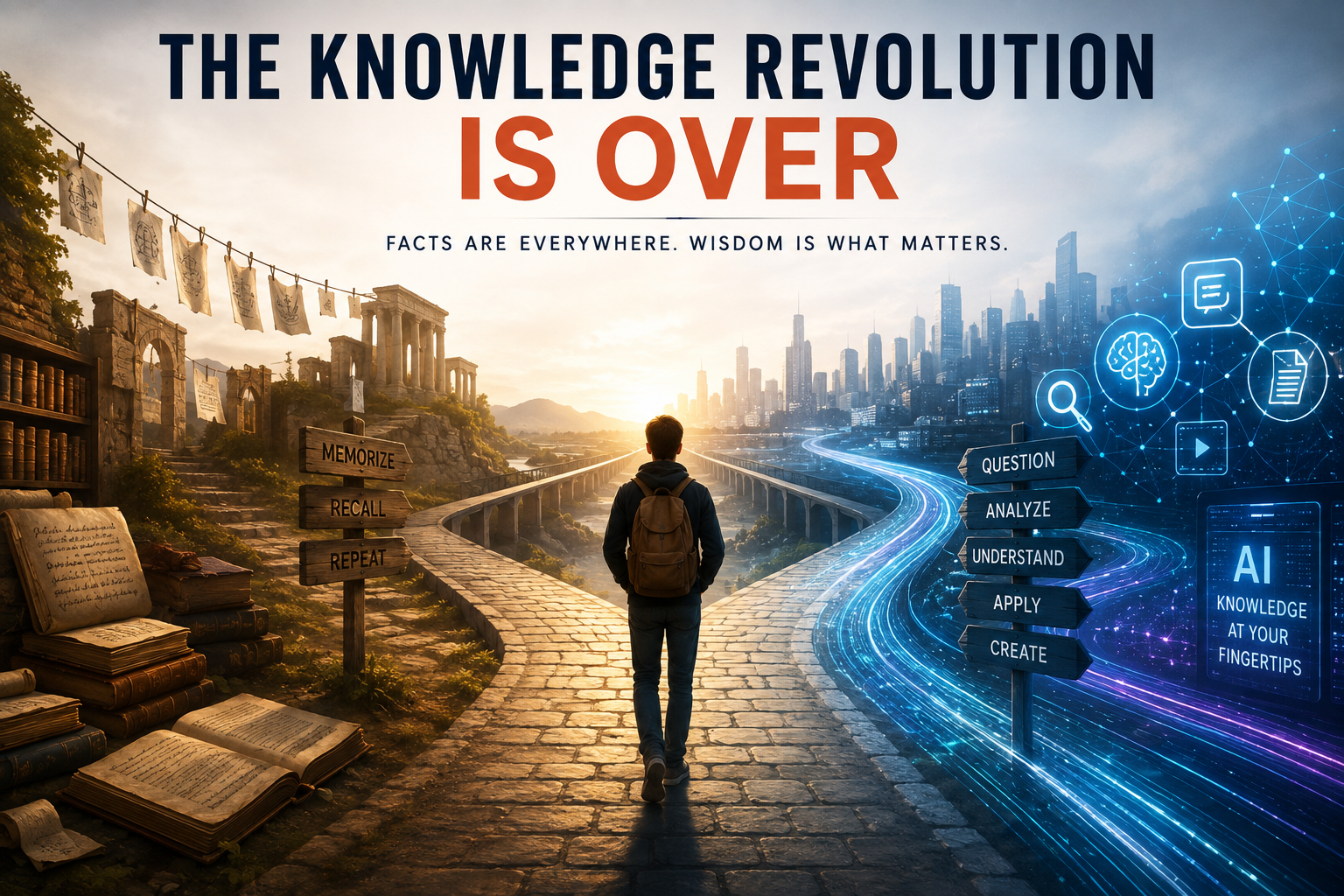
The Knowledge Revolution Is Over
Information is no longer scarce. The advantage now belongs to people who can question, verify, synthesize, and turn abundant information into genuine understanding.
In This Article
For centuries, education rewarded people who could store and recall information. Memorization was treated as a mark of intelligence, and for a long time that made sense. Books were expensive, libraries were limited, and experts were not always available, so people who remembered more often had a real advantage. In the age of AI, that bargain is changing fast: facts are abundant, but judgment, synthesis, and curiosity are becoming the real advantages. x
AI has not made knowledge useless. It has made knowledge easier to access, which means the old advantage of memorization is shrinking while the value of understanding is growing. When a machine can generate an answer in seconds, human value shifts toward asking better questions, spotting weak reasoning, and deciding what should be trusted. The challenge for students, educators, and professionals is no longer just what to know, but how to think, verify, and adapt. unesco
The old bargain
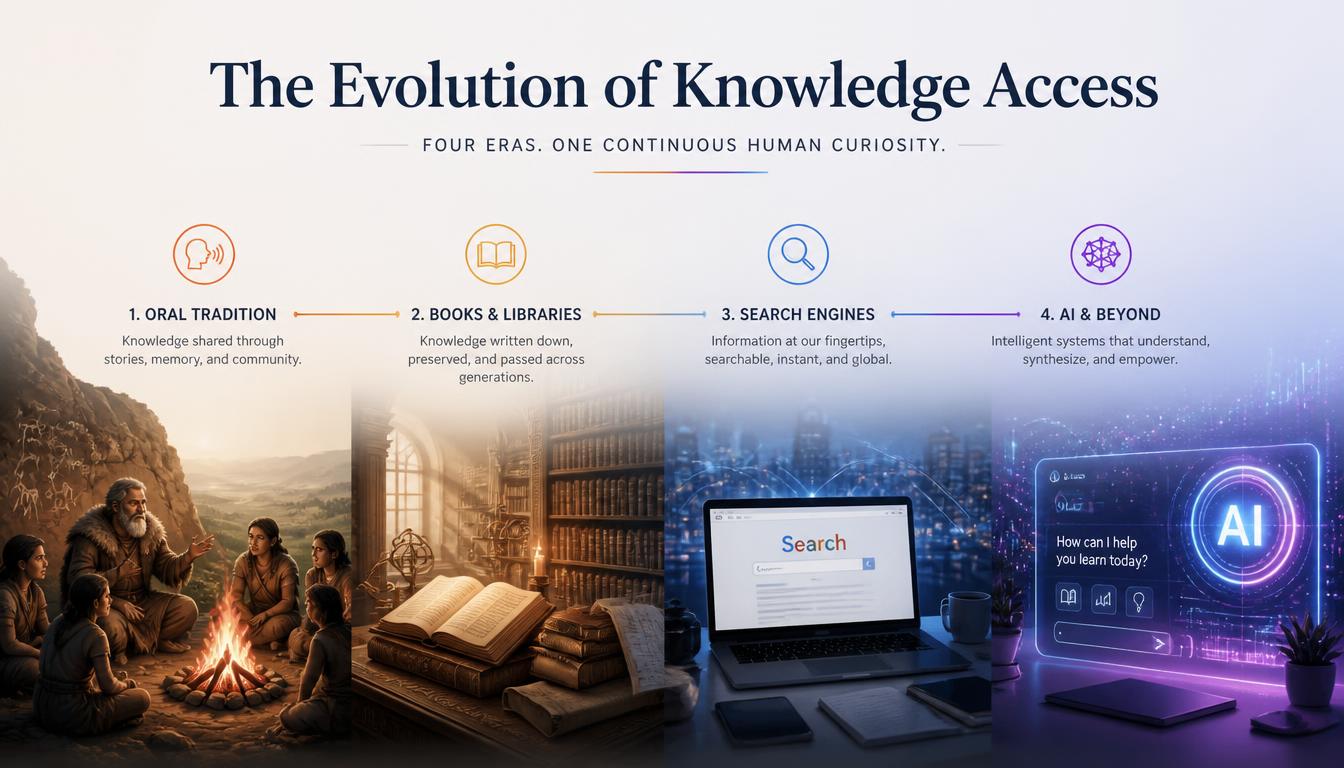
For most of human history, knowledge was scarce, slow to move, and hard to access. If you wanted information, you relied on memory, books, teachers, libraries, or experts, and each of those channels had limits. A student might spend hours copying notes, a researcher might wait days to locate a source, and a worker might rely on a supervisor or specialist to explain something that felt out of reach. Knowledge itself was valuable because access to it was limited.
That reality shaped education. Schools rewarded recall because recall was useful. The person who remembered formulas, dates, definitions, or procedures had an edge over the person who did not. But the original purpose of education was never supposed to end at recall. Facts were supposed to support reasoning, judgment, and action. The problem is that over time, the system often elevated memorization as the goal instead of the foundation.
AI changes that equation by making large amounts of information instantly available. A student can get a summary, a definition, a comparison, or a draft explanation in moments. That means recall alone is no longer the strongest measure of intelligence or preparedness. It is still useful, but it is no longer enough on its own.
This does not mean knowledge no longer matters. It means knowledge is becoming a starting point rather than the finish line. In a world where a machine can produce an answer in moments, the human value shifts toward asking better questions, spotting weak reasoning, and deciding what should be trusted.
Why abundance creates a new problem
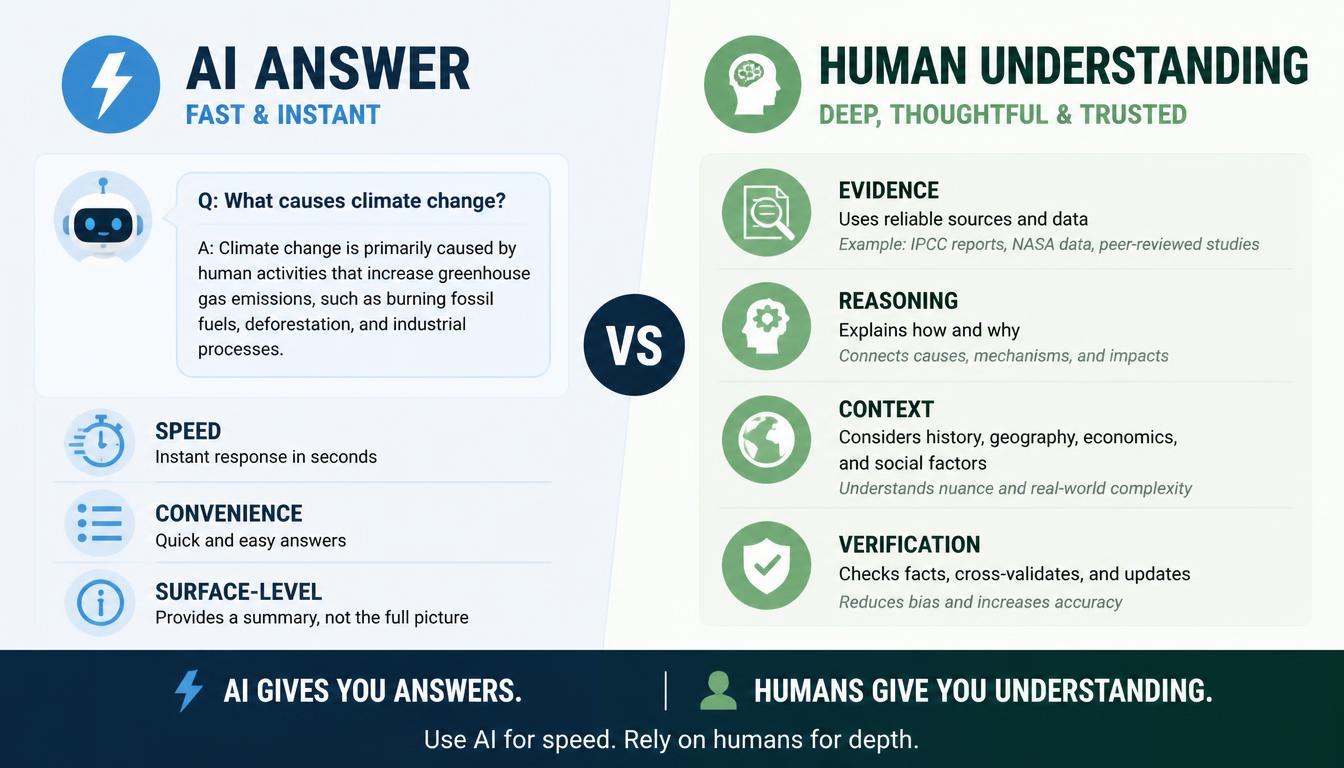
When information becomes easy to find, the new bottleneck is understanding. AI can summarize, draft, translate, and organize quickly, but speed does not guarantee accuracy, relevance, or wisdom. A polished response can sound confident even when it is shallow, incomplete, or wrong. That creates a new kind of learning challenge: people may feel informed without actually becoming more capable.
This is why the modern learning problem is not information scarcity; it is discernment scarcity. A learner can now generate an answer in moments, yet still fail to explain why it is correct, what evidence supports it, or how it compares with other possibilities. That gap between output and understanding is where education has to evolve.
The risk is subtle. If AI does too much of the cognitive work, people may start to outsource not just writing or summarizing, but also thinking. They may accept the first answer that sounds good, stop checking sources, or avoid wrestling with complexity because the machine offers an easier path. That can make learning faster in the short term while making it weaker in the long run.
Educators and learning scientists have increasingly emphasized that students need verification habits, source checking, and critical questioning to avoid overtrusting AI-generated responses. Guidance in 2026 continues to point toward skepticism, triangulation, and human review as essential parts of AI literacy. govtech
Education has always involved some friction. You read, struggle, compare, revise, and try again. That struggle is not a flaw in the system; it is often the mechanism by which understanding deepens. The danger of overly relying on AI is that it can remove just enough friction to make learning feel productive while quietly weakening the parts that actually matter most.
The human edge
AI is powerful at pattern recognition and text generation, but it does not possess human judgment, moral responsibility, or lived experience. It can assemble ideas quickly, but it cannot truly care about the consequences of those ideas. The real human advantages are judgment, wisdom, creativity, ethics, and curiosity. Those are the capabilities that matter more when technology can handle routine recall.
Critical thinking sits at the center of that human edge. The best learners do not accept AI output at face value; they evaluate it for accuracy, logic, bias, and relevance, then compare it with credible sources. They ask whether the answer makes sense, whether the evidence is sound, whether the framing is fair, and whether important context is missing. That is a more advanced skill than simply repeating a correct answer.
Curiosity matters too. The most adaptable learners are not the ones who memorize the most facts; they are the ones who keep asking what they do not yet understand, what assumptions are hidden, and what evidence is missing. Curiosity pushes people past passive consumption and into active learning. In an AI-rich environment, that makes curiosity a practical skill, not just a personality trait.
Creativity also rises in value. When basic content generation becomes easy, the real creative work shifts toward framing problems, connecting ideas, and imagining better solutions. AI can offer variations, but humans decide which direction matters. Humans can also sense tone, nuance, and purpose in ways machines still struggle to replicate.
Memorization still matters
It would be a mistake to conclude that memory is obsolete. Memorization still supports fluency, pattern recognition, vocabulary, mental math, and domain intuition. Without some stored knowledge, people struggle to judge whether an AI output even sounds plausible. If you do not know enough about a subject, you cannot easily tell whether the machine is helping you or misleading you.
That matters in school, but it matters just as much in daily life. A person who understands grammar can spot awkward wording. A person who knows enough history can recognize an anachronism. A person with basic science literacy can catch claims that violate common sense. A person who has learned the foundations of a field is better equipped to use AI well because they are not starting from zero.
The difference is that memorization should now serve understanding, not replace it. Students should still learn foundational facts, but education should spend less energy on treating recall as the final goal and more energy on using knowledge in analysis, application, and argument. Memory is the toolkit, not the whole job.
This also changes how people should study. Instead of memorizing isolated facts for a test and forgetting them the next day, learners should organize knowledge into patterns, concepts, and relationships. The goal is not just to remember information but to retain enough structure to reason through new situations. That is what makes knowledge useful in a world that changes quickly.
What schools must teach
If AI makes information cheap, schools have to make understanding valuable again. That means putting more emphasis on source verification, reasoning, media literacy, and authentic problem solving. It also means teaching students how AI works, where it fails, and why a polished answer can still be wrong.
Recent guidance and education discussions around AI in 2026 consistently stress the same point: students need skepticism and verification habits, not just tool fluency. Techniques like lateral reading, tracing claims back to original sources, and checking whether cited sources actually exist are becoming central parts of responsible AI use. facebook
Educators are increasingly encouraged to make students compare AI-generated claims with authoritative sources, explain their reasoning, and identify bias or gaps in the model’s response. Those habits do more than protect against misinformation; they train the habits of mind that will matter in college, careers, and civic life. UNESCO’s education guidance continues to center human agency, critical thinking, creativity, and ethical use of AI. x
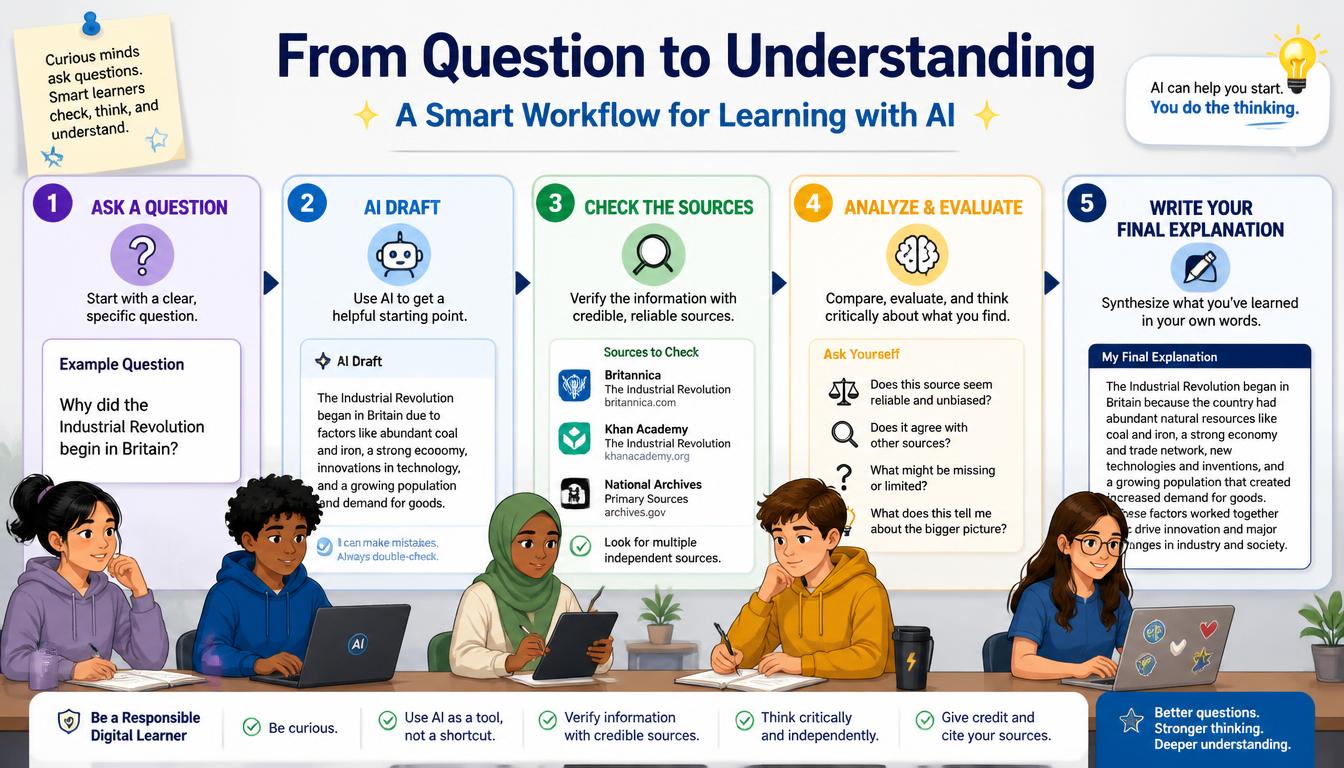
One strong model is to start with a question, let AI produce a draft answer, and then require students to verify each major claim with independent evidence. The student’s grade should reflect not just the answer, but the quality of the reasoning, the reliability of the sources, and the ability to explain where AI helped and where it misled. That approach keeps the technology in the loop without letting it replace learning.
Schools should also teach students how to use AI as a partner rather than a shortcut. That means prompting for alternatives, asking for counterarguments, and using AI to generate study questions instead of final answers. It also means making room for assignments that require original thought, reflection, and synthesis. AI can support learning, but students still need to do the intellectual lifting that turns information into understanding.
Why this matters beyond school
This is not just an education story. In business, public life, and everyday decision-making, people now rely on AI for drafting emails, summarizing research, writing reports, and brainstorming strategy. That can save time, but it can also create a false sense of confidence if users do not verify outputs or consider what context the model missed.
The workplace consequence is clear: people who can evaluate information, adapt quickly, and make sound judgments will be more valuable than people who simply know more facts than their peers. AI can assist with knowledge work, but it cannot take responsibility for consequences, tradeoffs, or ethics. In many situations, the person who knows how to use AI well will outperform the person who knows a little more theory but cannot apply it.
That makes lifelong learning essential. As technologies, industries, and roles shift, staying relevant will depend less on what you learned once and more on whether you can keep learning well. AI can support personalized and adaptive learning, but only if learners remain active participants in the process. 2026 guidance around AI-powered learning continues to highlight personalization, adaptive paths, and skills-based recommendation systems as major uses of AI in education and workforce learning. 360learning
This shift affects parents, too. Parents are not just helping children memorize school content anymore. They are helping them build habits: how to verify, how to question, how to persist, and how to evaluate what they see online. Those habits will matter far beyond homework.
The real question
If everyone has instant access to information, what becomes valuable? The answer is not nothing, and it is not “memorize less and trust the machine more.” The answer is that human qualities—judgment, ethics, creativity, curiosity, and disciplined thinking—become more important because they are harder to automate and more necessary than ever.
That means education should stop pretending that the goal is to out-recall machines. The goal now is to help people become the kind of thinkers who can work with machines without becoming dependent on them. When AI handles the retrieval, humans have the chance to focus on meaning. That is a much higher standard, and a much more valuable one.
The good news is that this shift can make learning more interesting, not less. If students are not spending all their energy on memorizing disconnected facts, they can spend more time solving real problems, exploring ideas, and building confidence as thinkers. AI does not have to diminish education. Used well, it can force education to become more honest about what actually matters.
Additional resources
- UNESCO: AI and technologies in education. unesco
- UNESCO: Education in the age of AI: Facts, frictions, frontiers. unesco
- UNESCO: Lifelong learning in the age of AI. blogs.uoc
- UNESCO: guidance emphasizing human agency, critical thinking, creativity, and ethical AI use. x
- ISTE: Critical thinking in an AI-driven information landscape. govtech
- Guidance on verifying AI-generated content, checking sources, and asking better questions. facebook
References
Clark, K. R. (2026). Verifying outputs in Scopus AI to promote critical AI literacy. [Journal title not provided in source snippet]. pubmed.ncbi.nlm.nih
Christodoulou, E., et al. (2026). Artificial intelligence as a site of global educational governance: UNESCO and the politics of AI in education. [Journal title not provided in source snippet]. tandfonline
Digital Learning Week. (2026, June 30). Education in the age of AI: Facts, frictions, frontiers. UNESCO. unesco
UNESCO. (2025, October 15). UNESCO just recognized four AI education programs that prepare learners and teachers for ethical and responsible AI. linkedin
UNESCO. (2026, May 27). UNESCO and artificial intelligence in education: Strengthening critical thinking, creativity, and human agency. x
UNESCO. (2026, July 14). AI and technologies in education. unesco
UNESCO Institute for Lifelong Learning. (2025, January 6). Lifelong learning in the age of AI. blogs.uoc
What to remember
- Learn the facts, but do not confuse facts with understanding.
- Use AI to accelerate research, then verify its claims with credible sources.
- Keep memorization focused on foundational knowledge that improves judgment and fluency.
- Treat curiosity, ethics, and critical thinking as core academic and professional skills.
- Measure learning by the quality of reasoning, not just the speed of the answer.

Leave a Reply