


Blog Post · May 2026
Capstones & Mini-Capstones:
AI Projects to End (and Start) Strong
From classroom radio shows to career roadmaps — how AI turns the year’s final weeks into a genuine launchpad.
“The end of the school year is not an ending.
It is a portfolio. A launchpad. A mirror.”
There is a particular kind of educational anxiety that descends in May. Teachers are exhausted. Students are oscillating between nostalgia and senioritis. Administrators are watching the clock. And somewhere in that fog, an important question quietly gets skipped: What have we actually built here?
This week we are talking about capstone projects — and their scrappier, more agile cousins, the mini-capstone. Both are opportunities to synthesize learning into something real. And both, it turns out, are exactly the kind of creative, student-directed work that AI tools were designed to support — not replace.
What Everyone Is Saying About End-of-Year AI Use
Ask a teacher what students are doing with AI in the final weeks of school and you will hear a version of the same story: GPT-polished essays submitted after years of avoiding them, Canva decks assembled in fifteen minutes, science fair boards that feel suspiciously eloquent for a fifth grader. The dominant narrative in teacher lounges, parent Facebook groups, and homeschool co-ops sounds a lot like grievance: AI is making it easier to fake learning, and nobody knows what authentic end-of-year evidence actually looks like anymore.
Media coverage has reinforced this framing. Headlines from major education outlets in 2024 and early 2025 consistently foregrounded the academic-integrity angle, often pairing the phrase “AI cheating” with end-of-semester reporting. EdWeek, The Atlantic, and Chalkbeat have all published thoughtful investigations into how teachers are navigating submissions that blur the line between student and machine. The concern is legitimate. But the conversation has crowded out a different, quieter story: the classrooms where AI is being used to make the end of the year more meaningful, not less.
Parent groups — including a growing cohort of homeschoolers who are often early adopters of ed-tech — have started asking a pointed question: if AI is going to be present in every career and college setting my child enters, shouldn’t we be teaching them to use it intentionally, especially on the kinds of reflective, integrative projects that capstones are supposed to be? That question, largely unanswered in formal policy, is where this week’s episode lives.
The Pedagogy Behind the Hype
Project-based learning (PBL) has a longer research track record than most people realize, and the news is good. In a series of rigorous studies commissioned through Lucas Education Research — a team backed by the Bill & Melinda Gates Foundation — RAND Corporation researchers found that students in high-quality PBL classrooms outperformed comparison groups on standardized assessments in both social studies and English Language Arts (Lucas Education Research, 2021). Effect sizes were meaningful. More importantly, teachers in those classrooms reported higher student engagement and stronger retention of core content (Krajcik et al., 2021). PBL isn’t a soft concession to student preference — it’s a pedagogically defensible choice backed by controlled research.
Now layer AI into that framework. What changes? In the best implementations, almost nothing about the intellectual demand changes — but the logistics of production change dramatically. A student who had an original idea for an illustrated storybook but struggled with illustration now has a path. A recent graduate who knows she needs to improve her interview skills but can’t afford a career coach now has a tool. A high schooler whose chemistry capstone relies on data analysis he hasn’t fully mastered yet can use AI to check his reasoning process, not just produce an output. The distinction — and it is everything — is whether AI lowers the cognitive floor or raises the creative ceiling.
Sal Khan, founder and CEO of Khan Academy and one of the most prominent voices on AI’s role in learning, has consistently argued that AI’s highest potential in education is not to provide answers but to serve as an interactive thinking partner — pushing students to explain their reasoning, identify gaps, and go deeper than a static curriculum would allow (Khan, 2023). His nonprofit’s AI tutor, Khanmigo, is explicitly designed around this Socratic model, guiding rather than telling. That distinction maps directly onto what good capstone design should look like.
We’re at the cusp of using AI for probably the biggest positive transformation that education has ever seen. The way we’re going to do that is by giving every student on the planet an artificially intelligent, but amazing, personal tutor.
TED Talk: “How AI Could Save (Not Destroy) Education,” April 2023
The evidence is clear: when project-based learning is implemented with fidelity, it consistently outperforms traditional instruction on standardized measures. Students aren’t just learning content — they’re learning how to learn.
Characterizing conclusions from Lucas Education Research / RAND PBL Efficacy Studies, 2021
Let’s be honest about what end-of-year projects often look like at the elementary and middle school level: a tri-fold poster, a book report in Comic Sans, or a slideshow assembled forty-five minutes before the bell rings. These aren’t failures of student motivation — they’re failures of authentic purpose. Students don’t invest deeply in work that disappears into a filing cabinet.
The most powerful shift AI enables at this level is making real audience projects accessible to kids who would otherwise be stymied by production barriers. Consider a class radio show. The concept is not new — but producing one used to require audio equipment, editing software, and a teacher willing to spend evenings on GarageBand. Now, a fifth-grade class can use AI to help draft interview questions, clean up audio, generate background music, and write a short episode script — while students focus entirely on the research, the voice work, and the editorial decisions. The content belongs to the students. The production barriers largely vanish.
AI-aided storybooks follow the same logic. Platforms like Book Creator have integrated AI image generation directly into a tool millions of students already use. A third-grader writing about what her class learned this year can now illustrate that story in a visual style she actually likes, rather than struggling to draw scenes she can see clearly in her mind but can’t yet render. Adobe Express and Canva’s school-tier AI features offer similar capabilities for posters, short videos, and family-facing presentations.
End-of-year video messages — where students speak directly to next year’s students, their families, or the wider school community — are particularly powerful because they require genuine reflection. AI can help with scripts, titles, and narration cleanup, but the core intellectual work is entirely the student’s: What did I learn? What do I wish I had known? What do I want to pass forward? Those are not trivial questions. For many elementary students, being asked to answer them in a real, produced format is the most authentically challenging academic experience of the year.
The pedagogical principle here aligns tightly with what researchers call authentic audience effect — the well-documented finding that students produce higher-quality, more carefully considered work when it is intended for a genuine external audience rather than just a teacher (Authentic Education, Buck Institute for Education, 2019). AI doesn’t create the audience; it removes the production friction that used to prevent many students from reaching one.
“Your job is to make something a student who has never met you could learn from next September. What three things do you most want them to know about this class — and what’s the best format for saying it?”
High school is the level at which the capstone conversation gets complicated fast. Advanced Placement deadlines, graduation requirements, state assessments — the calendar is already brutalized before a teacher even considers adding a reflective synthesis project. Which is exactly why the concept of the mini-capstone matters so much here.
A mini-capstone is not a second senior thesis. It is a contained, two-to-four-week project that asks students to use what they have learned — from a single course, a semester, or even a year-long sequence — to produce something genuinely new. AI participation is not just permitted; it is the point. The pedagogical question shifts from “Did the student know the content?” to “Can the student use what they know to direct AI toward a real outcome?”
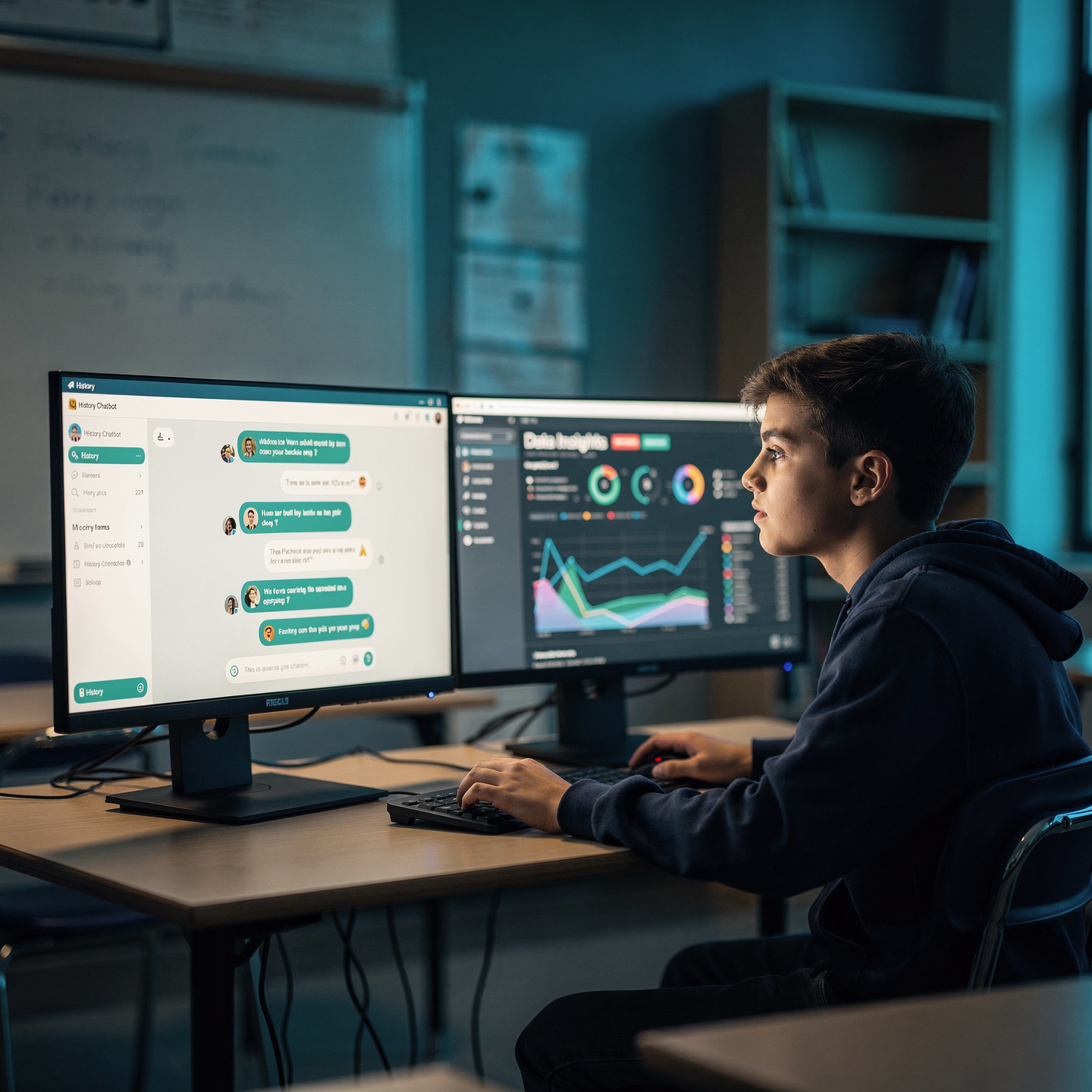
Simple chatbots about course content are a surprisingly rich mini-capstone format. Using accessible platforms like Voiceflow, Botpress, or even a prompted session of Claude or ChatGPT, students can design a conversational guide to a unit they mastered. A student who deeply understood the French Revolution can build a chatbot that answers questions about it — which requires her to anticipate what someone else wouldn’t know, categorize information, write in plain language, and test whether her bot’s answers actually hold up. That is not less rigorous than an essay. It may be more.
AI-assisted data stories work especially well in science, economics, and social studies. Students choose a dataset they care about — local housing trends, climate data, school athletic performance — use AI to help clean and visualize it, and then write the story behind the numbers. The AI does not write the story. The student does. AI is the data analyst’s assistant, not the journalist.
Design projects tied back to core subjects extend this logic: an art student designs a visual identity for a fictional company, using AI generation to iterate on concepts faster than hand-drawing would allow, then makes final aesthetic and strategic choices herself. An AP Government student designs a campaign infographic, using AI to research policy positions and generate layout options, then decides what to emphasize and why. In both cases, the AI amplifies the student’s own judgment — it doesn’t substitute for it.
The right question when grading an AI-assisted capstone is not “How polished is the product?” It is “How clearly can the student explain every choice that was made — and defend the ones that were theirs?”
That reframe is not just practical — it is pedagogically sound. Research on metacognition consistently shows that students who can articulate their thinking process retain content longer, transfer it more broadly, and perform better on subsequent assessments than students who produced correct answers they cannot explain (Hattie & Timperley, 2007). An AI-assisted product with a student who can explain everything is worth more than a pristine product the student has already forgotten.
A rubric for AI-assisted capstones should evaluate: (1) clarity of the original question or goal, (2) quality of the student’s direction and decision-making throughout the process, (3) accuracy and depth of the content knowledge embedded in the output, and (4) critical reflection on what the AI contributed and what the student contributed. That fourth dimension is new — and it is exactly the skill today’s graduates will need in every workplace they enter.
Here is the particular cruelty of graduation: it arrives at the exact moment when the structure that has organized your entire life disappears. No bell. No roster. No one tracking whether you showed up. For students transitioning to college or the workforce, the summer after graduation is often the first sustained experience of self-direction they have ever had — and most institutions do almost nothing to help them prepare for it.
The “transition project” is a concept borrowed from career coaching and executive development: a structured, personal planning document — part roadmap, part commitment device — that covers the next six to twelve months in enough detail to be actionable. Applied to recent graduates, it means answering a set of questions that are genuinely hard: What skills do I need that I don’t have? What habits do I want to build before the semester starts? What are my financial realities and what logistics do I need to handle? What does success look like in November?
AI does not answer these questions for a student. But it can help a student think through them far more thoroughly than they would on their own. A well-prompted AI conversation can surface considerations a 17-year-old would never think to raise — student loan repayment timelines, health insurance coverage gaps during summer, how to negotiate a first paycheck withholding, how to build a study schedule that actually accounts for college’s non-linear demands. AI as a planning partner is not the same as AI as an answer machine, and graduates who understand the difference have a genuine advantage.
AI-coached mock interviews are one of the highest-value applications in this segment. Tools like Interview Warmup (Google, free), Yoodli, and even a well-prompted session with Claude or ChatGPT can give recent graduates dozens of practice reps before a real interview — something that used to require a guidance counselor’s limited calendar or the expensive intervention of a career coach. Research from LinkedIn’s 2024 Workplace Learning Report found that interview preparation and professional communication are among the highest-demand skill-building activities among early-career learners (LinkedIn Learning, 2024). Access to AI practice tools democratizes that preparation.
Career exploration chatbots are a growing category worth knowing about. The COACH tool, developed with support from Credential Engine and various workforce partners, uses AI to help users map their existing credentials and experiences to career pathways they may not have known were open to them. For first-generation college students especially — who are statistically less likely to have family networks that can provide informal career guidance — tools like COACH represent a genuine equity intervention.
The Honest Conversation About Capstones + AI
None of the above works if the fundamental question — Who is actually doing the thinking here? — doesn’t get answered honestly. Capstone projects are already vulnerable to academic-integrity problems without AI. Add AI to the mix and the surface area of that vulnerability expands considerably.
Practical Moves for the Last Weeks of School
You do not need a district policy or a curriculum committee to do any of the following. These are classroom-level choices available today, this week, before the final bell rings.
- Reframe the deliverable. Instead of asking for a finished product, ask for a process journal alongside the product. Five entries, one per work session, documenting decisions made, AI used, ideas rejected. This is not extra work — it replaces the traditional rubric and produces far richer insight into what the student actually learned.
- Assign the “explain-back” defense. Any student who used AI significantly should be able to sit for a five-minute conversation with you about what the AI contributed and what they decided. This doesn’t have to be adversarial — it can be a genuine celebration of the choices they made. It just has to happen.
- Give students a real audience. Post the elementary radio show on the school website. Share the high schooler’s data story with the relevant community organization. Send the AI storybook home with families. Authenticity of audience is the single most powerful motivator in project work, and AI makes production quality accessible enough to clear that bar.
- Model AI use transparently. Use AI yourself, in front of students, to help plan a lesson or draft a rubric — and narrate your thinking as you do. Students learn what honest AI collaboration looks like by seeing it, not by reading a policy about it.
- Lower the technical barrier deliberately. Choose one tool per segment level. One. Book Creator for elementary. Voiceflow or a prompted chatbot session for high school. One well-chosen tool taught thoroughly beats five tools introduced superficially.
Strategic Priorities for Administrators
The end of the school year is a natural evaluation moment. Districts that are serious about AI integration should treat capstone season as a data collection opportunity: Where did AI use produce genuine learning gains? Where did it produce the appearance of learning? What did assessment look like across buildings, and how consistent was it? These are answerable questions — but only if school leaders are asking them actively, not after the fact.
The World Economic Forum’s 2023 Future of Jobs Report projects that 44% of workers’ core skills will change in the next five years (WEF, 2023). That number has profound implications for what a high school graduate needs to know — not just about subjects, but about how to learn, adapt, and collaborate with AI tools. Capstone projects, designed well, are among the most powerful mechanisms schools have for building that adaptive capacity. They are worth protecting, refining, and resourcing deliberately.
Leaders should specifically consider: building a districtwide library of approved AI tools (with clear COPPA and FERPA compliance vetting), developing shared rubric language for AI-assisted work, and creating professional development time in summer 2026 so teachers enter next year with a shared vocabulary for this work — not just a policy they were handed.
The Question That Will Define the Next Decade
There is a quiet philosophical question running beneath all of this week’s content: What are schools actually for? If the answer is credential production — grades, transcripts, diplomas — then AI is mostly a threat, because it is very good at producing those artifacts without producing the learning behind them. But if the answer is genuine human development — curiosity, judgment, the capacity to direct powerful tools toward meaningful ends — then AI is an extraordinary opportunity, because it makes authentic, ambitious work accessible to students who would have been stymied by production barriers a decade ago.
Capstone projects, at every level, sit exactly at that fault line. They are the moment in a student’s education where the scaffolding pulls back and something real is asked of them. AI, used thoughtfully, doesn’t weaken that moment. It raises the ceiling of what’s possible inside it — which means the adults in the room need to raise their expectations accordingly.
Next week — Week 4, our final episode in this series — we turn to planning forward: what AI literacy looks like as a summer project for teachers, what schools should be building into their fall curriculum now, and how the habits formed in these last weeks can set the tone for everything that follows. You built something this year. What do you want to do with it?
Enjoying AI Innovations Unleashed?
Subscribe so you never miss an episode — and if this week’s content helped you, a review makes a real difference in helping other educators and families find the show.
Help us grow: Subscribe · Leave a review · Share this episode with a teacher, parent, or recent grad who needs it.
Tag us #AIInnovationsUnleashed when you share your own end-of-year AI projects. We feature listener highlights every week.
Sources & Citations
- Buck Institute for Education / PBLWorks. (2019). Why project based learning? Retrieved from https://www.pblworks.org/why-pbl
- Hattie, J., & Timperley, H. (2007). The power of feedback. Review of Educational Research, 77(1), 81–112. https://doi.org/10.3102/003465430298487
- Khan, S. (2023, April). How AI could save (not destroy) education [TED Talk]. TED Conferences. https://www.ted.com/talks/sal_khan_how_ai_could_save_not_destroy_education
- Krajcik, J., Schneider, B., Miller, E., Chen, I. C., Bradford, L., Baker, Q., & Bartz, K. (2021). Assessing the effect of project-based learning on science learning in elementary school. Lucas Education Research / RAND Corporation.
- LinkedIn. (2024). 2024 Workplace Learning Report. LinkedIn Learning. https://learning.linkedin.com/resources/workplace-learning-report
- National Association of Colleges and Employers (NACE). (2024). Job Outlook 2025. NACE. https://www.naceweb.org/research/reports/job-outlook/2025
- World Economic Forum. (2023). Future of Jobs Report 2023. WEF. https://www.weforum.org/reports/the-future-of-jobs-report-2023
- Boss, S., & Larmer, J. (2018). Project based teaching: How to create rigorous and engaging learning experiences. ASCD.
- Dintersmith, T. (2018). What school could be: Insights and inspiration from teachers across America. Princeton University Press.
- Selwyn, N. (2022). The future of AI and education: Some cautionary notes. European Journal of Education.
- PBLWorks (Buck Institute for Education): https://www.pblworks.org — Gold-standard PBL frameworks and rubrics
- Google for Education AI resources: https://edu.google.com/intl/ALL_us/why-google/ai-in-education/ — Free AI tools for K-12
- Common Sense Media AI literacy resources: https://www.commonsense.org/education/digital-citizenship/ai — Age-appropriate AI guidance
- Credential Engine / COACH: https://credentialengine.org — Career pathway tools for graduates
- Khan Academy Khanmigo: https://www.khanacademy.org/khan-labs — Free AI tutor for students grades 3–12

Leave a Reply