



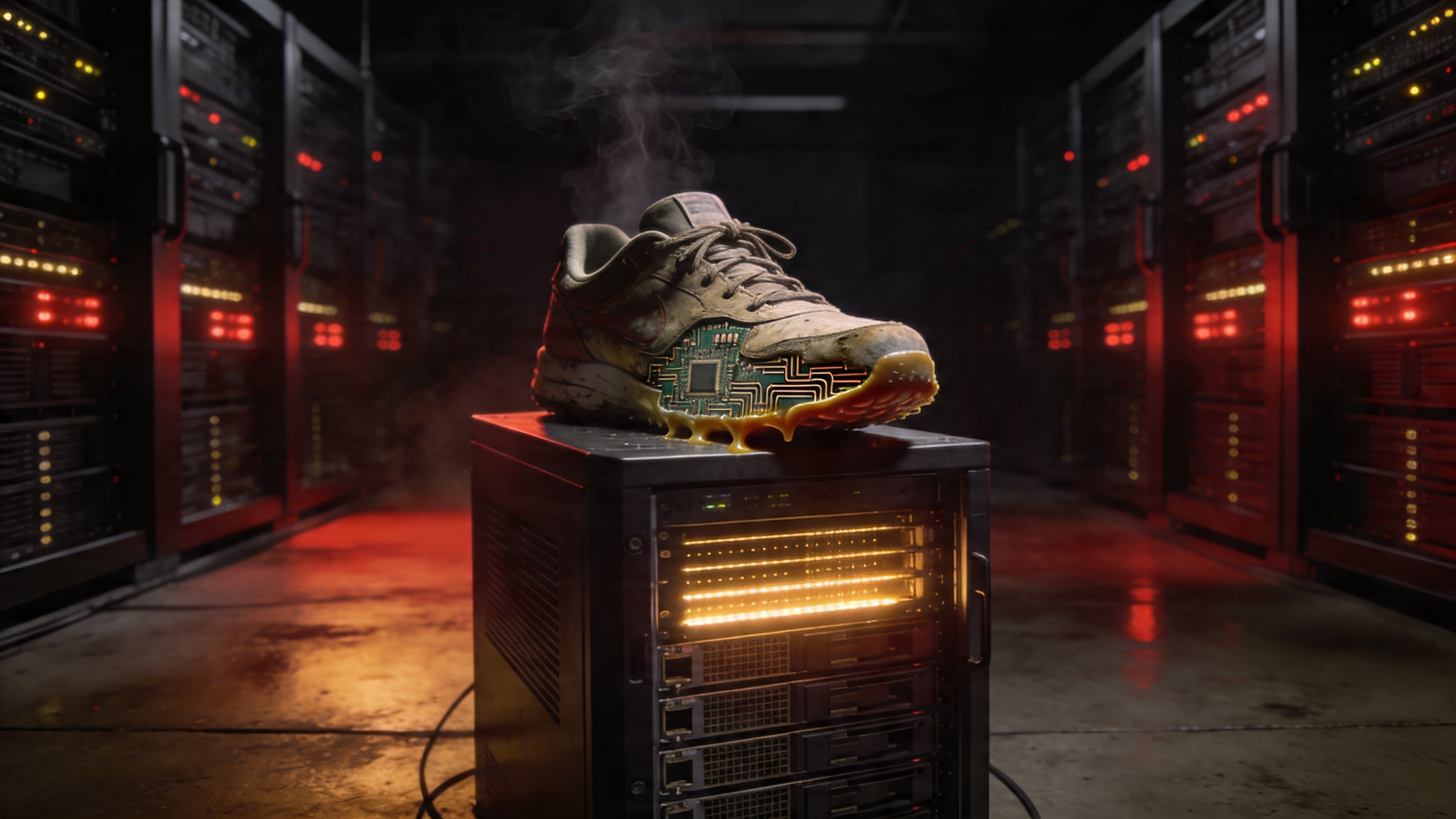
AI Gold Rush, Sneaker Servers,
and the Model Wars Heating Up
A sneaker brand goes full GPU landlord, Anthropic battles the Pentagon in court, Claude Opus 4.7 reshapes the model landscape, and Tufts researchers find a way to cut AI energy use by 100×. Your weekly AI briefing — no hype, all signal.
Segment 1 — The Big Weird
This week’s weird drawer was overflowing. A brand that built its identity on sustainable sneakers became an AI compute landlord overnight, and one of the most-watched AI companies in the world is now fighting a legal battle over its right to sell to the federal government.
Imagine explaining to your 2020 self that by 2026, the company behind your cozy wool sneakers would have sold off its shoe business entirely and rebranded as a GPU-as-a-Service provider called NewBird AI.
That’s what just happened. Allbirds announced a radical pivot: the shoe business is gone, and the new strategy centers entirely on renting out high-end GPU compute capacity to AI labs and developers who desperately need it. The rebrand is complete — the company is now operating as NewBird AI.
Investors treated this as the most 2026 thing imaginable. Headlines pointed to a massive stock surge as the market rewarded the AI story. This is peak gold rush logic: if you can’t build the models, rent them the shovels.
“If you can’t beat the model labs, you rent them the shovels. Welcome to the AI gold rush — population: everyone.”
JR DeLaney, The Friday DownloadIn March, U.S. defense officials designated Anthropic a “supply-chain risk,” effectively cutting the company off from Pentagon contracts. Anthropic fired back with a lawsuit, arguing the move was unfair — and that the impact could slice multiple billions from 2026 revenue.
Courts have since issued competing decisions: one judge temporarily blocked the blacklist, while others allowed portions of it to move forward. The fight has now moved to the appeals level, putting AI safety, national security framing, and government procurement on a collision course.
This one is deeply cyberpunk. And not the fun neon kind.
Segment 2 — Wait… That’s Actually Cool
Buried beneath the chaos: two stories that deserve your attention — one about a model that changes what coding assistance looks like, and one about research that could quietly change the entire trajectory of AI at scale.
Anthropic released Claude Opus 4.7 this week, and early benchmarks put it at or near the frontier on tough coding evaluations like SWE-bench. The improvements focus on agentic coding performance — better tool use, fewer failures on multi-step programming tasks, and stronger reasoning across complex workflows.
This is the beginning of a genuine Model Wars era: less “pick the default,” more “choose the right AI for the job.” For developers, educators, and builders, that means real reasons to test multiple models against your own workflows — and sustained pressure on every lab to keep shipping, not coast on brand recognition.
More serious options: Coding assistance now has real competition at the frontier level — no more defaulting to one tool out of habit.
Test everything: Early benchmarks show real differences across workflows. Run your own tests on actual tasks, not just demos.
The pressure is good: Competition means labs keep improving. Stagnation isn’t an option when three or four serious players are shipping every week.
Researchers at Tufts University announced a neuro-symbolic AI approach that can reportedly reduce energy consumption by up to 100× while boosting accuracy on certain tasks. Instead of throwing dense neural networks at every problem, the system pairs neural components with symbolic logic structures — allowing it to reason more efficiently at every step.
This isn’t a flashy chatbot launch. It’s the quiet, deeply technical work that actually changes AI’s long-term trajectory. If AI is going to run on phones, in classrooms, and across global data centers, it cannot demand a small country’s worth of electricity every time it runs. A 100× efficiency gain — even scoped to specific workloads — is a landmark result.
Segment 3 — The Tiny Tech Snack
Three plain-English concepts you can steal for your next conversation — no jargon, no caveats, just the thing and why it matters.
Subscribe, leave a review, and share with the friend who keeps asking what’s actually happening in AI. You’re officially more informed than the “I saw one headline” internet crowd.
References
- After sale of its shoe business, Allbirds pivots to AI. (2026, April 14). TechCrunch. techcrunch.com
- Allbirds shares soar on a very 2026 pivot to AI. (2026, April 15). CNN Business. cnn.com
- Anthropic says U.S. blacklist could cut 2026 revenue by multiple billions. (2026, March 10). Yahoo Finance.
- Analysis: Anthropic has strong case against Pentagon blacklisting. (2026, March 11). Reuters / Yahoo Finance.
- U.S. judge blocks Pentagon’s Anthropic blacklisting for now. (2026, March 26). Reuters / Yahoo Finance.
- AI breakthrough cuts energy use by 100x while boosting accuracy. (2026, April 16). ScienceDaily / Tufts University. sciencedaily.com
- New AI models could slash energy use while dramatically improving performance. (2026, March 16). Tufts Now. now.tufts.edu
- New AI approach cuts energy use 100x while boosting accuracy. (2026, April 5). Impactful Ninja. impactful.ninja
- Claude Opus 4.7 vs 4.6: Agentic coding comparison. (2026, April 16). Verdent AI Guides. verdent.ai
- Anthropic releases Claude Opus 4.7, narrowly retaking lead for most powerful generally available model. (2026, April 16). VentureBeat.
- Anthropic reveals new Opus 4.7 model with focus on advanced software engineering. (2026, April 15). 9to5Mac. 9to5mac.com
Additional Reading
- Allbirds / NewBird AI pivot: TechCrunch and CNN Business give well-sourced breakdowns of how the shoe-business sale led to the GPU pivot — good starting points before watching for similar moves from other consumer brands.
- Anthropic blacklisting & policy: Yahoo Finance and Reuters coverage walk through Anthropic’s revenue-risk estimates, the supply-chain-risk arguments, and the key court orders to date.
- AI energy & Tufts research: ScienceDaily and Tufts Now flesh out how the neuro-symbolic system works and why the 100× claim matters for AI’s overall electricity footprint.
- Claude Opus 4.7 benchmarks: Verdent AI’s guide and 9to5Mac’s article translate SWE-bench and coding gains into practical implications for developers — worth skimming before you test it on a real task.

Leave a Reply