


The New Rules of Hiring: Why Your First Interview Might Be With an Algorithm
AI is not simply taking entry-level jobs. It is reshaping the path into them – and students need a clearer map before graduation day turns into application-palooza with confetti.
The Current Narrative: The Algorithm Ate My First Job
Every graduating class gets its own anxiety soundtrack. Some years it is a recession. Some years it is student debt. Some years it is a hiring freeze wearing sunglasses and pretending to be temporary. For the Class of 2026, the theme music sounds suspiciously like a chatbot clearing its throat. Students are hearing that artificial intelligence is taking jobs, rewriting resumes, screening applicants, and quietly deciding who gets invited to the career-starting party. The vibe is less “pomp and circumstance” and more “please upload your resume into this portal and never hear from us again.”
That fear is not imaginary. AI is clearly entering hiring and workforce planning. But the public narrative often flattens the story into one big doom sandwich: AI replaces entry-level workers, employers stop training people, and graduates wander the LinkedIn wilderness with a diploma in one hand and existential dread in the other. Educators, counselors, homeschool families, and parents are hearing the same anxious question: if the first rung of the career ladder is being automated, what exactly are we preparing students to climb?
The evidence points to a more complicated and more useful story. New graduate hiring is not collapsing across the board. NACE’s Spring 2026 update reported that employers expected to hire 5.6% more new college graduates than the previous class, a rebound from earlier flat projections (NACE, 2026a). At the same time, the market remains uneven, and recent graduates still face a tougher landing than experienced workers. The Federal Reserve Bank of New York reported recent college graduate unemployment at about 5.7% in the first quarter of 2026 and underemployment at 41.5% (Federal Reserve Bank of New York, 2026). Translation: there are opportunities, but the gate has more locks, more codes, and possibly a robot bouncer named Greg.
This first episode in the June series, From Classroom to Career, focuses on the new rules of hiring. May’s series helped students reflect, showcase, celebrate, and plan. June asks the next question: what kind of workforce are students stepping into? The answer matters for elementary teachers introducing career curiosity, high school counselors building pathways, college career centers supporting graduates, and leaders designing AI-ready education systems.
May asked: What did students accomplish, and where are they going next?
June asks: What kind of workforce are students entering?
Episode 1 focuses on: AI-assisted hiring, skills-based screening, and the new path from classroom to first job.
What Is Actually Happening: Hiring Is Becoming More Automated, More Skills-Based, and More Demanding
The biggest mistake is treating AI hiring as one thing. It is not. In practice, AI can appear in several parts of the hiring process: resume parsing, applicant tracking, candidate matching, automated outreach, interview scheduling, skills assessments, video interview analysis, and recruiter decision support. Some tools are simple filters. Others use machine learning or generative AI to compare applicants to job descriptions, summarize resumes, draft interview questions, or rank candidates. The applicant may never see the system, but the system may still shape whether the applicant reaches a human being.
An applicant tracking system, or ATS, is software that helps employers collect, organize, search, and manage applications. Not every ATS is artificial intelligence, and not every AI recruiting tool makes decisions by itself. But together, these systems have changed the practical experience of applying for jobs. A student may spend hours crafting a thoughtful application only to be evaluated first by keywords, structured fields, and automated screening rules. The resume is no longer merely a document. It is also data.
At the same time, employers are moving toward skills-based hiring. NACE reported that 70% of employers in its Job Outlook 2026 survey use skills-based hiring, up from 65% the previous year. Among those employers, 87% use it during interviewing and 65% use it during screening. NACE also found that GPA screening has fallen sharply: 73% of employers screened by GPA in 2019, compared with 42% in the 2026 report (Gray, 2026). That does not mean grades are irrelevant. It means grades are increasingly one signal among many, and employers want evidence that students can apply what they know.
AI skills are also moving from bonus points to baseline expectations. NACE’s Spring 2026 update found that more than one-third of entry-level jobs now require AI skills, nearly triple the share reported in fall 2025. The same update found that 28% of employers are seeking early-career talent who can use AI in their work, and nearly 60% are assigning interns projects that use AI tools and skills (Gatta, 2026). That is a remarkable shift in only a few months. The message is not “major in computer science or abandon hope.” The message is that AI literacy is becoming part of workplace literacy.
This is where educators should resist both panic and denial. Microsoft framed the 2025 workplace shift as a moment when “intelligence on tap” will rewrite business rules (Spataro, 2025). The World Economic Forum projected that global labor markets will be reshaped by technology, demographics, green transition pressures, and economic uncertainty, with 170 million jobs created and 92 million displaced by 2030 (World Economic Forum, 2025a). That is not a neat little before-and-after picture. It is a churn machine. Some roles shrink. Some grow. Many are redesigned.
The important word is redesigned. NACE’s analysis emphasized that the current evidence points to AI reshaping, not simply replacing, early-career talent (Gatta, 2026). Employers are discussing productivity, task redesign, ethics, and job design. More than two-thirds of employers in the NACE Spring Update are considering how AI may be used in relation to tasks within jobs, while only 11% are discussing how AI might replace some positions (Gatta, 2026). That is still disruptive, but it is a different disruption than the headline version. The jobs may remain, while the tasks inside the jobs mutate like a career-readiness Pokémon.
“The question is no longer whether students will work with AI. The question is whether schools are preparing them to do it well.”
JR DeLaney, The AI Learning GuideVisual: Five Signals Defining the 2026 Graduate Hiring Market
The chart below pulls together the core workforce signals shaping this episode: new graduate hiring is projected upward, entry-level AI skill requirements are rising quickly, skills-based hiring is mainstreaming, and recent graduates still face elevated unemployment and underemployment. The story is not “no jobs.” It is “different rules.”
Where AI Is Already Showing Up in Education and Career Preparation
For elementary and middle school students, the classroom implication is not resume optimization. Please, nobody assign a fifth grader to create an ATS-friendly resume unless you also enjoy chaos, glitter glue, and existential confusion. At this stage, the opportunity is career awareness. Students can compare how jobs changed after earlier technologies – tractors, assembly lines, personal computers, the internet – and then imagine how AI might change work by the time they are adults. The goal is not prediction accuracy. The goal is adaptability literacy.
A teacher could run a simple “future job museum” activity. Students choose a current job, research what people do in that role, and then identify which tasks might be helped by AI and which tasks still need human judgment, relationships, or creativity. A nurse may use AI-assisted documentation, but the patient still needs a human advocate. A mechanic may use diagnostic software, but still needs practical troubleshooting. A teacher may use AI for lesson drafts, but still needs classroom presence, professional judgment, and the sixth sense that spots a student trying to hide a full bag of chips inside a hoodie.
For high school students, the stakes get more concrete. Counselors and teachers can help students understand how job descriptions work, how skills show up in hiring language, and why experiences matter. That does not mean turning school into a corporate onboarding seminar. It means helping students connect coursework, clubs, service projects, internships, career and technical education, dual enrollment, and part-time work to transferable skills. Communication, reliability, problem solving, leadership, data literacy, and AI literacy should not be mysterious adult words students meet for the first time during a rejected internship application.
High school career readiness can also include responsible AI practice. Students can compare a generic AI-written resume summary with a human-edited version grounded in real experience. They can analyze job descriptions and identify required skills versus preferred skills. They can practice verifying AI-generated career advice against credible sources such as BLS Occupational Outlook Handbook data, college career centers, industry associations, and employer websites. In other words, AI becomes a research assistant, not a fortune teller in a hoodie.
For college students and recent graduates, the connection is immediate. AI can help with resume tailoring, interview practice, job-search tracking, networking messages, salary preparation, and translating academic projects into employer language. But AI should not replace authenticity. A resume that reads like it was assembled by a caffeinated thesaurus will not save a candidate who cannot explain the work behind it. The best use of AI is to clarify, organize, practice, and refine – not to cosplay as a completely different person with twelve leadership styles and a suspicious amount of synergy.
This is also where colleges, universities, and workforce programs need to teach students how hiring systems work. Graduates should know that applications may be parsed by software. They should know why clear formatting matters. They should know that keywords should reflect real skills, not keyword stuffing. They should know that a portfolio, project, internship, certification, or work sample can help make skills visible. And they should know that networking is not cheating the system; it is often how humans re-enter a process that has become increasingly automated.
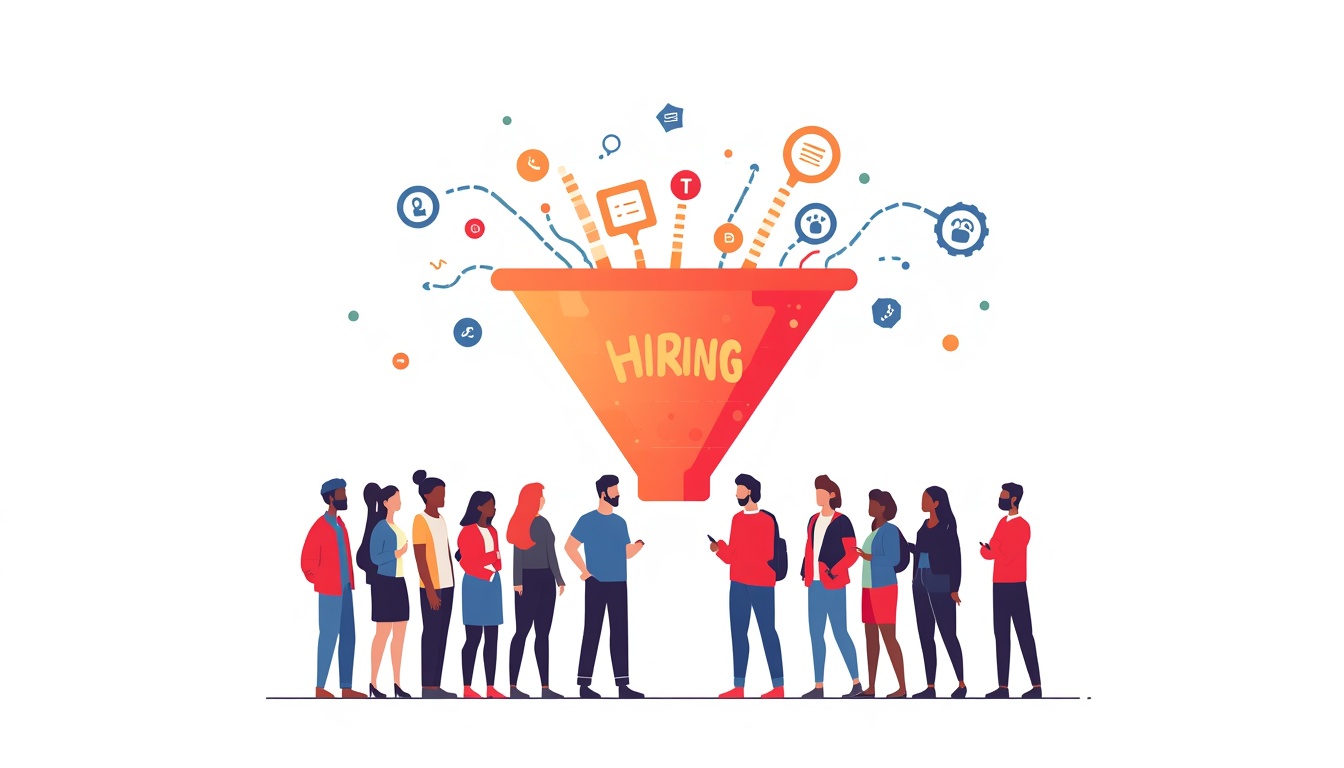
Visual: The AI-Era Hiring Funnel
A traditional hiring funnel was already stressful. The AI-era version adds more layers before many applicants ever reach a person. That is why students need to understand both the human and technical sides of job search strategy.
Risks and Tradeoffs: Efficiency Is Not the Same Thing as Fairness
There are good reasons employers use AI-assisted hiring tools. Recruiters may receive hundreds or thousands of applications for a single role. Screening tools can help organize large applicant pools, reduce administrative burden, and identify candidates whose experience matches job requirements. In high-volume hiring, efficiency matters. Humans are not magical fairness machines either; traditional hiring has always included bias, inconsistent review, pedigree preferences, and the mysterious power of whoever happens to read the resume after lunch.
But automation can scale unfairness faster than any tired recruiter ever could. The EEOC and Department of Justice have warned that employers’ use of AI and software tools can violate disability discrimination law if the tools screen out qualified applicants or fail to provide reasonable accommodations (EEOC & DOJ, 2022). The EEOC has also issued technical assistance on adverse impact under Title VII when employers use software, algorithms, and AI in employment selection (EEOC, 2023). The U.S. Department of Labor’s AI best practices call for meaningful human oversight, transparency, worker engagement, protection of labor rights, AI training, and secure worker data (U.S. Department of Labor, 2024).
The philosophical question hiding under all of this is simple and uncomfortable: should an algorithm determine who gets the chance to speak with a human? The answer may depend on how the tool is designed, audited, disclosed, and used. A system that helps organize applications is different from a black-box ranking system that quietly filters people out without explanation or appeal. For students, the concern is not merely whether AI is accurate. It is whether the process is visible enough, fair enough, and humane enough.
Researchers have repeatedly warned that algorithmic hiring requires careful governance. A multidisciplinary survey on algorithmic hiring fairness noted that the field is caught between two narratives: optimism that algorithms can reduce biased human decisions, and pessimism that algorithms automate discrimination. The authors conclude that whether algorithmic hiring can be less biased and more beneficial remains an open question requiring contextual governance, legal awareness, and shared benefits for stakeholders (Fabris et al., 2023). That is academic language for: the machine may help, but please do not hand it the keys and go get nachos.
There is also an equity issue for students. Learners with access to strong counseling, internships, AI tools, broadband, professional networks, and portfolio-building experiences may adapt more quickly to the new hiring environment. Students without those supports may be left to guess how the system works. That is why this is not just a college career center issue. It is a K-12 readiness issue, a district leadership issue, and a workforce development issue.
Visual: What Employers Are Prioritizing
The shift is not from degrees to no degrees. It is from credentials alone to credentials plus evidence. Employers still value education, but they increasingly want to see whether students can communicate, solve problems, use tools responsibly, and demonstrate competence in real contexts.
What Teachers Can Do Now
First, teach career literacy earlier. Career literacy does not mean asking every eighth grader to choose a lifelong profession before lunch. It means helping students understand that jobs are collections of tasks, skills, tools, relationships, and responsibilities. Once students see work that way, AI becomes less mysterious. They can ask better questions: Which tasks are repetitive? Which require judgment? Which involve people? Which require creativity? Which could be improved by technology?
Second, make skills visible. Students often complete projects without learning how to name the skills inside them. A group presentation may demonstrate collaboration, communication, research, time management, and conflict resolution. A science fair project may show data literacy, problem solving, and persistence. A student who helps organize a school event may be practicing logistics, stakeholder communication, and leadership. Educators can build short reflection moments where students identify the skills they used and explain how those skills might matter beyond school.
Third, introduce AI literacy as a responsibility, not a shortcut. Students should learn how to prompt AI tools, check outputs, cite sources, protect private information, and understand limitations. They should also learn when not to use AI. A useful classroom norm is: AI can help you think, but it cannot be responsible for your thinking. That one sentence can prevent approximately seventeen thousand future academic integrity debates, give or take a dramatic teenager.
Fourth, simulate the modern hiring process in low-stakes ways. High school students can examine sample job descriptions, identify skills, and build evidence statements from real experiences. College students can practice turning coursework into professional language. Even younger students can compare how a job looked twenty years ago with how it might look twenty years from now. The point is not to make school feel like HR paperwork. The point is to help students understand how learning connects to opportunity.
Fifth, involve families and homeschool communities. Parents and homeschool educators are also trying to make sense of AI, workforce disruption, and career readiness. Schools can share simple guides explaining AI literacy, hiring trends, and student skill development. Family-facing communication should avoid both hype and panic. The message should be: yes, the workforce is changing; no, your child is not doomed; yes, preparation needs to evolve.
What Leaders Should Be Considering
School and district leaders should treat AI workforce readiness as more than a technology initiative. It belongs in curriculum planning, counseling, career and technical education, professional learning, data privacy, assessment, and community partnerships. The question is not “Should we buy an AI tool?” The better question is “What do our graduates need to understand about learning, work, and responsible technology use?” The tool decision comes later. The vision comes first.
Leaders can begin by reviewing graduate profiles. Many schools already claim they want students to be communicators, collaborators, critical thinkers, creators, and responsible citizens. AI raises the stakes for those goals. If students can generate polished text in seconds, assessment must look more closely at process, judgment, originality, and evidence. If employers value demonstrated skills, schools should help students collect and explain evidence of learning. If AI literacy is becoming workplace literacy, then it should not be optional enrichment for the already-advantaged.
Partnerships also matter. Employers, community colleges, universities, chambers of commerce, workforce boards, and local industry groups can help schools understand how expectations are changing. Career readiness should not be built entirely from headlines. It should be informed by local labor market realities and credible national trends. A rural district, a suburban district, an urban district, and a homeschool co-op may all need different pathways, but they share the same challenge: preparing learners for work that is being redesigned in real time.
Finally, leaders need governance. If schools use AI tools for counseling, career exploration, writing support, assessment, or student data analysis, they need clear policies for privacy, transparency, accessibility, bias, and human oversight. The same concerns employers face in AI hiring apply to education. Students should not be sorted, labeled, or limited by opaque systems. AI can expand opportunity only if adults design guardrails that keep opportunity at the center.
A Forward-Looking Close: The First Rung Is Changing, Not Vanishing
The new rules of hiring are not a reason to panic. They are a reason to update the map. Students still need strong academic foundations. They still need mentors. They still need curiosity, persistence, and the ability to work with other humans without turning every group project into a tiny civilization collapse. But they also need to understand that the path from classroom to career now includes AI-assisted systems, skills-based evaluation, and workplaces where AI tools are increasingly normal.
For recent graduates, the practical lesson is clear: do not rely on a degree alone to tell your story. Learn to describe your skills. Show evidence. Practice with AI, but verify everything. Build relationships with humans, because humans still make meaning, trust, judgment, and opportunity. For high school students, the lesson is to start connecting experiences to skills before senior year becomes a deadline tornado. For younger students, the lesson is even simpler: the future will change, so learning how to learn may be the most durable career skill of all.
The future of work is not a single headline. It is a transition. Some jobs will shrink. Some will grow. Many will be rebuilt from the inside out. The students who thrive will not necessarily be the ones who memorize the most tools in 2026. They will be the ones who can adapt, ask better questions, work ethically with technology, and keep developing the human skills that make them more than a resume parsed by a machine.
Next week, we move from the hiring process to the human advantage: the skills AI cannot easily replace. Because if Episode 1 is about getting through the new gate, Episode 2 is about what makes students worth hiring once they walk through it.
References
- Equal Employment Opportunity Commission. (2023). Assessing adverse impact in software, algorithms, and artificial intelligence used in employment selection procedures under Title VII of the Civil Rights Act of 1964. https://www.eeoc.gov/
- Equal Employment Opportunity Commission & U.S. Department of Justice. (2022). Employers’ use of artificial intelligence tools can violate the Americans with Disabilities Act. https://www.eeoc.gov/
- Fabris, A., Baranowska, N., Dennis, M. J., Graus, D., Hacker, P., Saldivar, J., Zuiderveen Borgesius, F., & Biega, A. J. (2023). Fairness and bias in algorithmic hiring: A multidisciplinary survey. arXiv. https://arxiv.org/abs/2309.13933
- Federal Reserve Bank of New York. (2026). The labor market for recent college graduates. https://www.newyorkfed.org/research/college-labor-market
- Gatta, M. (2026, April 20). Demand for AI skills in entry-level jobs nearly triples since fall 2025. National Association of Colleges and Employers. https://naceweb.org/job-market/trends-and-predictions/demand-for-ai-skills-in-entry-level-jobs-nearly-triples-since-fall-2025
- Gray, K. (2026, January 12). Employer use of skills-based hiring practices grows. National Association of Colleges and Employers. https://naceweb.org/job-market/trends-and-predictions/employer-use-of-skills-based-hiring-practices-grows
- Gray, K. (2026, April 15). Employers expect to hire 5.6% more new college graduates this year. National Association of Colleges and Employers. https://www.naceweb.org/talent-acquisition/trends-and-predictions/employers-expect-to-hire-5-point-6-percent-more-new-college-graduates-this-year
- National Association of Colleges and Employers. (2026). Job Outlook 2026: Spring update. https://www.naceweb.org/research/reports/2026/job-outlook/spring-update/
- Spataro, J. (2025, April 23). The 2025 annual Work Trend Index: The Frontier Firm is born. Microsoft. https://blogs.microsoft.com/blog/2025/04/23/the-2025-annual-work-trend-index-the-frontier-firm-is-born/
- U.S. Department of Labor. (2024, October 16). Department of Labor releases AI best practices roadmap for developers, employers. https://www.dol.gov/newsroom/releases/osec/osec20241016
- World Economic Forum. (2025a, January 7). Future of Jobs Report 2025: 78 million new job opportunities by 2030 but urgent upskilling needed. https://www.weforum.org/press/2025/01/future-of-jobs-report-2025-78-million-new-job-opportunities-by-2030-but-urgent-upskilling-needed-to-prepare-workforces/
- World Economic Forum. (2025b). The Future of Jobs Report 2025. https://www.weforum.org/publications/the-future-of-jobs-report-2025/
Additional Reading
- NACE Job Outlook 2026 and Spring Update reports for Class of 2026 hiring projections.
- World Economic Forum Future of Jobs Report 2025 for global workforce and skills projections.
- Federal Reserve Bank of New York labor market dashboard for recent college graduates.
- U.S. Department of Labor AI Best Practices for worker-centered AI use.
- EEOC technical assistance on AI, algorithms, and employment selection procedures.
Additional Resources
- BLS Occupational Outlook Handbook – https://www.bls.gov/ooh/
- NACE Career Readiness Competencies – https://www.naceweb.org/career-readiness/competencies/career-readiness-defined/
- Partnership on Employment & Accessible Technology – https://www.peatworks.org/
- U.S. Department of Labor AI Principles and Best Practices – https://www.dol.gov/
- Federal Reserve Bank of New York College Labor Market Data – https://www.newyorkfed.org/research/college-labor-market

Leave a Reply