



The Skills AI Can’t Replace: Why Human Skills Are Becoming Career Superpowers
AI can generate answers, summarize reports, and make a spreadsheet look like it has its life together. But it still struggles with judgment, empathy, leadership, and the wonderfully chaotic art of being human.
The Current Narrative
If you spend even a few minutes scrolling through education headlines, workforce reports, or LinkedIn posts written by someone standing dramatically near a window, you will find two competing stories about artificial intelligence and work.
The first story says AI is coming for everyone’s job. The second story says every student should immediately learn to code, preferably yesterday, while also building a startup, mastering robotics, and somehow still remembering to bring a pencil to class.
For teachers, administrators, homeschool families, parents, high school students, college students, and recent graduates, that message can feel exhausting. AI now writes drafts, generates images, builds presentations, summarizes research, analyzes data, and answers questions with the confidence of a student who absolutely did not read the chapter but is hoping vibes will carry the day.
So it is understandable that many people assume technical skills are the only skills that matter. Learn coding. Learn prompting. Learn data. Learn automation. Learn the tool before the tool changes next Tuesday.
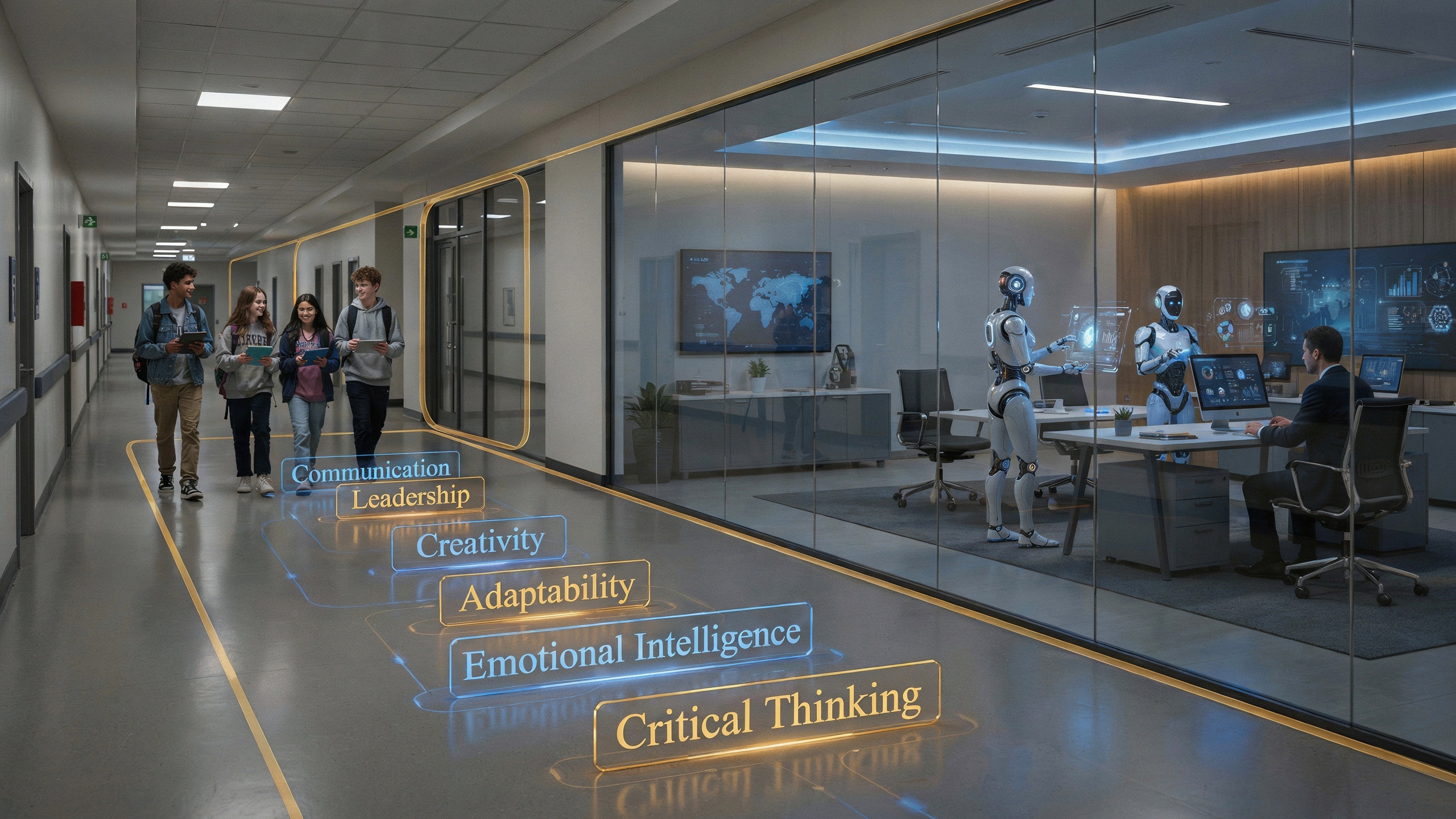
But underneath that noisy storyline, something more interesting is happening. As AI becomes more capable, employers are not only asking for technical literacy. They are also emphasizing communication, critical thinking, adaptability, emotional intelligence, creativity, leadership, curiosity, and resilience.
That may sound backwards at first. If machines can do more, why would human skills become more valuable?
The answer is simple, but not small: AI can generate outputs. Human beings still provide judgment.
Episode 1: We looked at how AI is changing hiring and why students need workforce literacy earlier.
Episode 2: We are focusing on the skills AI cannot easily replace: communication, judgment, empathy, adaptability, and leadership.
The big idea: The future is not only about using AI. It is about becoming the kind of person who can use AI wisely.
What’s Actually Happening
The future of work is not shaping up as a clean robot takeover. Sorry to the sci-fi villains. Very inconsiderate of reality.
Research from MIT Sloan argues that AI is more likely to complement many human workers than replace them entirely. The research highlights areas where human capability remains essential, including empathy, presence, opinion and judgment, creativity, and hope (MIT Sloan School of Management, 2025).
The World Economic Forum’s Future of Jobs Report 2025 similarly points toward a workforce where technology and human capability develop together. The report draws on more than 1,000 global employers representing over 14 million workers, and it identifies analytical thinking as the top core skill, with resilience, flexibility, agility, leadership, and social influence also ranking near the top (World Economic Forum, 2025).
That matters for schools because it changes the preparation target. Students do not simply need to know how to use AI tools. They need to know how to think with them, question them, collaborate around them, and decide when not to use them.
Emotional Intelligence
Emotional intelligence is the ability to recognize, understand, and manage emotions in yourself and others. AI can detect patterns in language. It can identify sentiment. It can produce something that sounds caring. But it does not genuinely understand what it means for a student to feel embarrassed, a parent to feel unheard, or a teacher to feel stretched to the limit.
That distinction matters. Workplaces, classrooms, counseling offices, leadership teams, and community relationships are not only information systems. They are human systems. People do not just need correct answers. They need trust, context, timing, tone, and care.
Critical Thinking
Critical thinking means evaluating information, identifying assumptions, recognizing bias, and making reasoned decisions. AI tools can generate polished responses that look impressive. Sometimes those responses are accurate. Sometimes they are confidently wrong, which is basically the academic version of walking into the wrong classroom and committing to the bit.
Students need to learn how to ask: Is this true? What evidence supports it? What might be missing? Who benefits from this answer? What would change if the context changed?
Adaptability
Adaptability is the ability to adjust, learn, and keep moving when the environment changes. This may become one of the most important workforce skills of the decade because the tools will not stand still.
The student who memorizes one platform may be outpaced by the student who understands how to learn new platforms. The graduate who knows one workflow may struggle if that workflow changes. But the person who can learn, unlearn, and relearn becomes harder to replace.
Communication
Communication is more than sending information. It is persuasion, storytelling, listening, explaining, negotiating, and building relationships. AI can draft an email. It cannot decide whether that email will land well with a frustrated parent, a nervous student, or a team that has already survived three meetings that could have been emails.
“AI can provide answers. Human beings still provide judgment.”
AI Innovations Unleashed · From Classroom to CareerWhere AI Is Already Showing Up
In schools, AI already appears in lesson planning, tutoring tools, accessibility supports, language translation, content generation, research assistance, and administrative workflows. In workplaces, AI helps with drafting, analysis, customer support, project planning, coding assistance, and knowledge retrieval.
That means students across age groups need age-appropriate preparation. This is not a high school problem only. It is a human development problem with school bells.
Elementary and Middle School: Building the Foundation
For younger students, the most important workforce preparation may not look like workforce preparation at all. It looks like collaboration, conversation, persistence, play, creativity, and reflection.
When students work in groups, explain their thinking, solve problems together, and recover from mistakes, they are practicing the exact skills that future employers will continue to value. A fourth-grade group project may not look like workforce development, but inside that glorious construction-paper storm are communication, negotiation, leadership, and resilience.
High School: Practicing Judgment
High school students need opportunities to use AI while also being responsible for the thinking behind the work. That means assignments should increasingly ask students to document process, compare sources, critique AI outputs, defend decisions, and reflect on what they changed after using a tool.
AI literacy should not only mean knowing which button to press. It should mean knowing when the answer is weak, when the source is questionable, when the shortcut becomes dependency, and when human judgment needs to take the wheel.
Recent Graduates: Combining AI Literacy with Human Value
Recent graduates are entering a workforce where many entry-level tasks are already being reshaped by AI. Drafting, summarizing, researching, scheduling, and analyzing can often be accelerated. That does not eliminate the need for human workers. It changes what entry-level workers must prove.
A graduate who can use AI to move faster is useful. A graduate who can use AI, evaluate the output, communicate clearly, collaborate with others, and make sound decisions is far more valuable.
The Human Skills Matrix
When people say “soft skills,” they often make these abilities sound optional, decorative, or nice to have. That framing is outdated. In an AI-shaped workforce, these are not soft skills. They are durable skills.
Communication helps people explain decisions, build trust, and move ideas from concept to reality. Critical thinking helps people evaluate whether AI-generated output is useful or misleading. Adaptability helps workers survive shifting tools and expectations. Emotional intelligence helps people manage conflict, support others, and read the room before the room catches fire.
Leadership helps teams move through ambiguity. Ethical judgment helps people decide what should happen, not merely what technology allows.
The point is not that AI has no value. AI has enormous value. But its value increases when paired with people who know how to ask better questions, interpret outputs responsibly, and understand the humans affected by the decision.
The Philosophical Question Schools Cannot Avoid
For decades, schools were often organized around information delivery. Students learned facts, practiced procedures, completed assignments, and demonstrated mastery. That still matters. Knowledge is not suddenly irrelevant because a chatbot can summarize the water cycle.
But AI forces a deeper question: if information is easier to access than ever, what should education prioritize?
The answer is not to abandon knowledge. Students cannot think critically about nothing. They need content, history, math, science, literature, civics, and context. But they also need to learn how to use knowledge wisely.
That means schools must place greater emphasis on judgment, discernment, ethical reasoning, collaboration, and communication. In other words, the AI era does not make education less human. It makes the human parts harder to ignore.
Risks and Tradeoffs
This is where the conversation needs balance. AI is not magic glitter sprinkled on learning. It brings real advantages and real risks.
Skill Atrophy
If students allow AI to do too much of the thinking, they may practice fewer cognitive skills themselves. A student who asks AI to draft every response may finish assignments faster while slowly weakening the very muscles school is supposed to build.
AI Dependency
There is a difference between using AI as a thinking partner and using AI as a thinking replacement. The first can support learning. The second can quietly hollow it out.
Loss of Independent Thinking
When AI-generated responses sound polished, students may accept them too quickly. This creates a risk that students confuse fluency with accuracy. A smooth paragraph is not the same as a sound argument. A confident answer is not the same as truth.
Equity Concerns
Some students will have access to better tools, better guidance, and better adult support than others. Schools should not assume that AI access automatically creates opportunity. Without thoughtful implementation, it can widen existing gaps.
What Teachers Can Do Now
Teachers do not need to wait for a 97-page district AI framework written by a committee that somehow named itself the Future-Ready Innovation Task Force of Excellence. Small classroom moves can start immediately.
1. Assess the Thinking, Not Just the Answer
Ask students to explain how they reached a conclusion. Require them to show process, identify sources, describe tradeoffs, and reflect on revisions. If AI was used, ask students what the tool did well, what it missed, and what they changed.
2. Build Communication Into the Work
Have students present, debate, explain, teach peers, write reflections, and defend decisions. Communication is not an “extra.” It is one of the clearest ways students show understanding.
3. Use AI Critique Assignments
Give students an AI-generated response and ask them to evaluate it. What is accurate? What is vague? What is missing? What source would verify it? How could the answer be improved?
4. Teach Adaptability Through Iteration
Design assignments where students revise based on feedback, test multiple approaches, or reflect on what they learned from a failed attempt. Adaptability grows when students experience productive struggle.
5. Name Human Skills Explicitly
Students need to understand that collaboration, empathy, leadership, and ethical judgment are not merely classroom behavior goals. They are career skills.
What Leaders Should Be Considering
School and district leaders should avoid framing AI strategy only around tools. Tools matter, but they are not the strategy. The strategy is preparing students and educators for a world where intelligent systems are part of everyday work.
That means professional development should include both AI literacy and human skill development. Teachers need support in designing assignments that preserve student thinking. Counselors need resources for explaining workforce shifts. Administrators need policies that address responsible use, privacy, academic integrity, and equity.
Leaders should also think carefully about assessment. If traditional assignments can be completed too easily by AI, the solution is not only detection. The better solution is redesigning learning experiences around process, performance, reflection, collaboration, and authentic application.
A Forward-Looking Close
The future workforce will not reward people simply for knowing facts. It will reward people who can use knowledge well.
AI will continue to improve. It will become faster, more personalized, more integrated, and more capable. Some tasks will disappear. Others will change. New roles will emerge. The ground will keep moving because apparently the future did not check with anyone’s calendar first.
But the human advantage remains real. Communication, empathy, ethical judgment, leadership, creativity, and adaptability are not leftovers from a pre-AI world. They are the foundation of thriving in an AI-powered one.
Students do not need to become machines to succeed in the future. They need to become thoughtful, capable, adaptable humans who know how to work with machines without surrendering their judgment to them.
That may be the real career superpower.
Episode 3: AI Careers You’ve Never Heard Of
We will explore the new roles emerging from the AI economy and why the fastest-growing AI careers may not all belong to programmers.
References
- MIT Sloan School of Management. (2025). New MIT Sloan research suggests AI is more likely to complement, not replace, human workers. https://mitsloan.mit.edu/press/new-mit-sloan-research-suggests-ai-more-likely-to-complement-not-replace-human-workers
- MIT Sloan School of Management. (2025). These human capabilities complement AI’s shortcomings. https://mitsloan.mit.edu/ideas-made-to-matter/these-human-capabilities-complement-ais-shortcomings
- World Economic Forum. (2025). The Future of Jobs Report 2025. https://www.weforum.org/publications/the-future-of-jobs-report-2025/
- World Economic Forum. (2025). Skills outlook: The Future of Jobs Report 2025. https://www.weforum.org/publications/the-future-of-jobs-report-2025/in-full/3-skills-outlook/
- Associated Press. (2026). Why some workers are embracing AI while others won’t use it, according to a new Gallup poll. https://apnews.com/article/e4c129e9773255203ccae208bfccb367
Additional Reading
- World Economic Forum — New Economy Skills: Unlocking the Human Advantage
- MIT Sloan — Human-Machine Complementarities at Work
- Gallup — AI adoption and worker attitudes
- OECD — AI and the future of skills
- National Association of Colleges and Employers — Career readiness competencies

Leave a Reply