


Kindergarten Bots, Blue Books, and the State-by-State AI Scramble
Kindergarteners in New York City are getting AI reading tutors. High schoolers are getting paper blue books to beat ChatGPT. Thirty-one states just started writing the rules — and the contradictions are absolutely delicious.
If education policy were a Star Wars character right now, it’d be a confused stormtrooper trying to aim at two opposite targets simultaneously. Schools are banning mobile phones while rolling out AI reading coaches to kindergarteners. They’re introducing algorithms to five-year-olds while handing paper exam booklets back to high schoolers. And the federal government has made AI in every classroom a national priority.
This week’s stories from the AI-in-education beat are chef’s kiss levels of contradictory, fascinating, and honestly — a little unhinged. Let’s get into it.
Let’s start with the absolute chaos that is policy whiplash in 2026. The New York Times surfaced something deliciously ironic this month: while school districts nationwide are banning mobile phones from classrooms, those same districts are simultaneously introducing AI to kindergarteners.
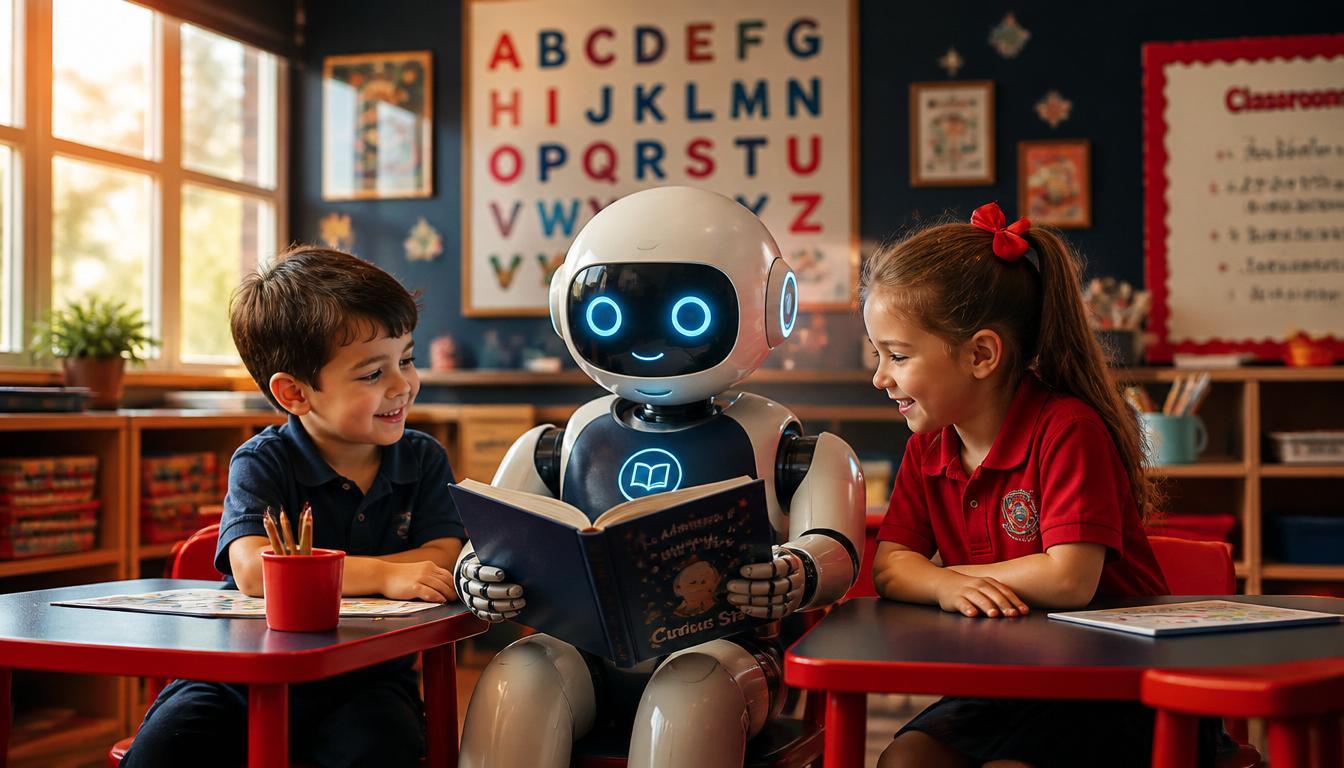
In New York City, roughly 150 schools are now using a reading tool called Amira — a gamified AI bot that listens to five- and six-year-olds read aloud, corrects them in real time, and collects detailed performance data. Thousands of kids are already using it. Think of it as a digital reading tutor that never gets tired, never needs coffee, and is definitely tracking everything your child says out loud. Adding high visibility to the trend: the First Lady has adopted AI integration into every classroom as her signature initiative.
Meanwhile, over in high school land? Schools are so overwhelmed by AI-generated essays that they’re literally dusting off blue books — those paper exam booklets your grandparents used — and bringing back handwritten exams. So to recap: bots for babies, paper for teenagers. Make it make sense.
“Schools are deploying AI tools to personalize learning, but those same tools are becoming vectors for academic dishonesty and student safety risks. It’s a genuine Catch-22.”
The Friday Download · May 29, 2026The Monitoring Reality Nobody’s Talking About
Here’s the stat that made me do a double-take. Real-time monitoring data from schools shows that roughly 1 in 5 student AI interactions involved cheating, self-harm content, bullying, or other red-flag behavior. Even more alarming: about 1 in 50 interactions were flagged for potential violence, cyberbullying, or self-harm. That’s not a rounding error — that’s a systemic issue hiding in plain sight on school-issued devices.
Schools are caught in a genuine Catch-22: they’re deploying AI tools to personalize learning, but those same tools are becoming vectors for academic dishonesty and student safety risks. It’s like handing out Swiss Army knives in shop class and being shocked when someone uses the corkscrew wrong. The tools aren’t inherently the problem — the deployment strategy is.
Okay, credit where it’s due: 2026 is the year states stopped debating and started legislating. According to data published May 26th, 134 bills related to AI in education have been introduced across 31 states this year alone. The patchwork is real — but so is the momentum. Frameworks are emerging, guardrails are being codified, and at least some legislatures are thinking ahead.
Idaho’s SB 1227 deserves its own moment: it requires a statewide AI framework, mandates educator training, and — in a move that finally says the quiet part out loud — explicitly prohibits AI from replacing human teachers. Someone made that law. That happened. California’s AB 1159 drew a meaningful legal line between “using AI to help students” and “using students to train AI.” Your child’s essay about their summer vacation cannot be fed into the next foundation model without consent.
Arizona’s HB 4040 requires schools to adopt policies for detecting and preventing unauthorized AI use in coursework — the “ChatGPT wrote my history paper” era now has legal pushback in at least one state. New York’s A 9190 restricts AI classroom use to 9th grade and above, with exceptions for diagnostics or special education. And both Georgia and Mississippi have made AI literacy a graduation requirement, taking effect in 2031 and 2029 respectively.
“If you’re in 7th grade right now, learning how to prompt an AI model is going to be as mandatory as passing algebra — at least in Georgia and Mississippi.”
The Friday Download · May 29, 2026Virginia Sets the Infrastructure Standard
Virginia announced that its data science standards of learning are now active in 132 high schools statewide. This isn’t a seminar. This is full curriculum integration — students learning Python, statistics, and AI ethics as part of their core coursework. Virginia went from “Should we teach AI?” to “Here’s how, and here’s the infrastructure to support it.” It’s a model worth watching.
The numbers are hard to argue with: 86% of education organizations now use generative AI — the highest adoption rate of any industry. Not finance. Not tech. Education. And students using AI-powered instruction systems showed a 62% increase in test scores, primarily because AI can identify knowledge gaps and adjust instruction in real time. When AI works the way it’s supposed to — personalized, adaptive, scaffolded — it genuinely helps kids learn. The trick is making sure it’s deployed that way, not as a shortcut factory.
Enjoying The Friday Download?
Join The Unleashed — our community of AI-curious educators, innovators, and forward-thinkers who help sponsor the show and get exclusive content, early episodes, and deeper dives into the stories we cover every week.

Leave a Reply