


LMS Glow‑Ups, Google’s AI Locker, and 5 Moves Before August
This week’s AI story in education isn’t about chatbots or hype — it’s about infrastructure. A 125‑year‑old university ditches its LMS, Google quietly supercharges the tools schools already use, and a former state CIO draws a line in the sand: next year is accountability year.
If last week was about rules, requirements, and big policy swings, this week is all about the plumbing. The systems underneath learning — the platforms, integrations, and data‑privacy habits — quietly got smarter. Whether schools are ready for that is a different conversation. Let’s get into it.
Rasmussen’s LMS Glow‑Up
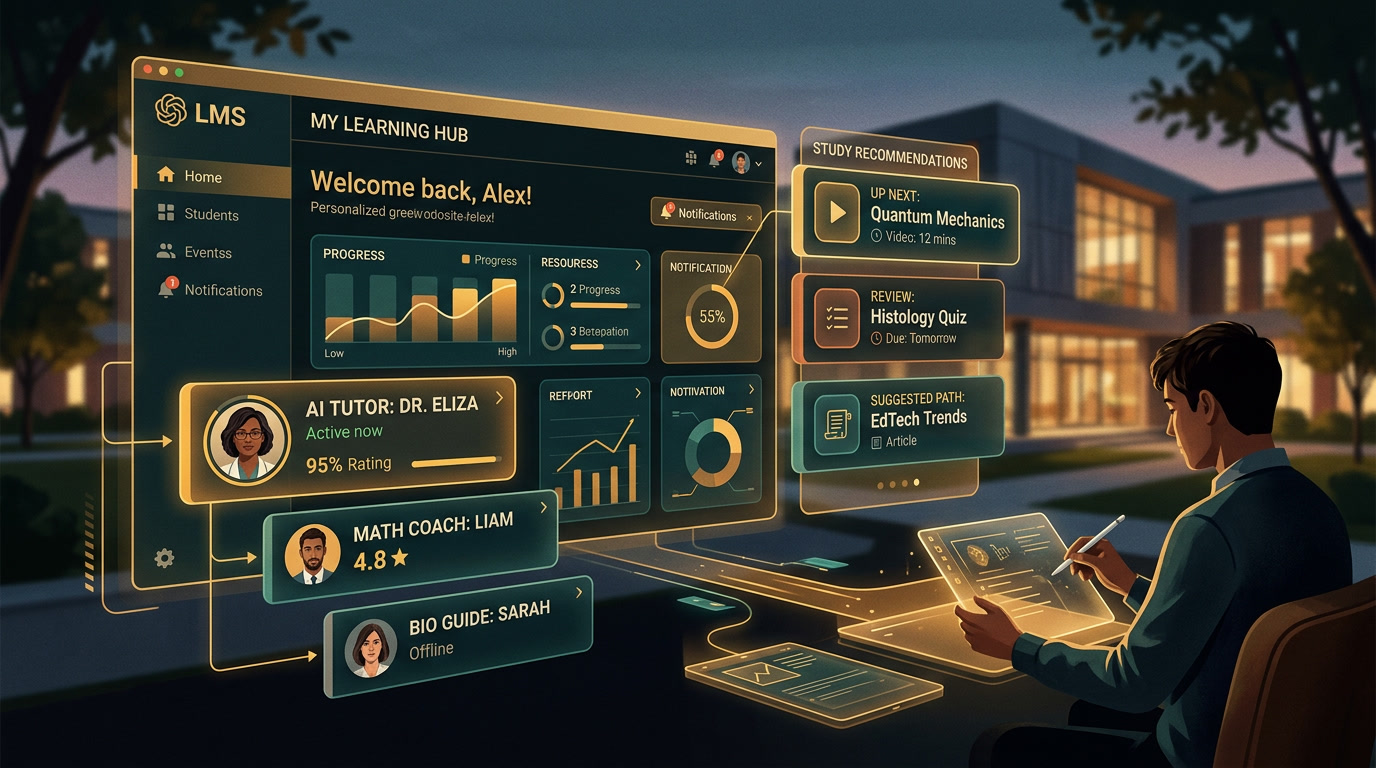
Rasmussen University — 125‑plus years old, campuses in six states — just announced it’s ditching Blackboard and moving to D2L Brightspace. But this isn’t just a “new platform, new login” situation. Rasmussen is going all‑in on D2L’s AI layer, Lumi, starting with its nursing programs.
They’re rolling out tools like Lumi Tutor, Lumi Feedback, and AI‑powered study recommendations directly inside the LMS. In other words: the place students already go for assignments and grades becomes the place that nudges them with personalized practice, hints, and “hey, you might want to review this before your exam.”
“When your LMS starts acting like a co‑teacher, who really owns the learning experience — the instructor, the institution, or the vendor’s AI?”
JR DeLaney · The Friday DownloadThat’s powerful, but also a little weird. And it opens up a real question about what happens when students start trusting the LMS more than the syllabus.
When AI Helps — and When It Quietly Hurts
Overlay that LMS news with what the research is saying. Recent reviews of AI in education highlight a consistent pattern: AI boosts learning when it scaffolds thinking, but it can hurt when it starts doing the thinking for students.
One study with 666 learners found a negative link between heavy AI use and critical‑thinking gains — largely thanks to cognitive offloading, which is letting the system reason so your brain doesn’t have to. The takeaway isn’t “AI bad.” It’s that we’re wiring AI deeply into LMSs, tutoring tools, and note‑taking apps at the exact moment research is warning us to be careful.
It’s not: “Should we use AI in the LMS?”
It’s: “Are we using AI to make thinking better — or just to make assignments faster?”
That distinction is going to define the quality gap between schools over the next three years.
Google’s Quiet AI Upgrade Pack
Google dropped a set of education‑ecosystem updates this week that don’t have splashy “revolutionize learning” marketing attached — but they solve real problems.
NotebookLM now supports roughly double the sources and notebooks for qualifying education accounts — which means it can realistically support full units, capstones, or project‑based work without hitting a wall mid‑semester.
Gemini is now an official AI provider inside Moodle, letting schools plug summarization and drafting directly into the LMS instead of pushing students off‑platform to random tools. Less copy‑pasting to unknown sites. More guardrails around privacy and expectations.
There’s also a small but very human addition: graduating students can now migrate photos from their school Google account to a personal account, so their memories don’t vanish the moment IT deactivates them. It doesn’t sound like a big deal — until it’s your kid’s four years of photos.
“This is AI‑adjacent infrastructure work. It doesn’t come with a keynote, but it’s the kind of thing that quietly raises the floor for everyone using these tools.”
JR DeLaney · The Friday DownloadThe AI for Education Accelerator Goes Nationwide
Google’s AI for Education Accelerator has now brought over 400 higher‑ed institutions across all 50 states into its program. Examples include the Texas A&M University System running an “AI Learnathon” for staff, and students at the University of Virginia using AI skills to support local small businesses.
This matters because it signals a shift from “What is AI?” to “What are we actually doing with it in practice?” For K‑12 folks, this is a preview of what your graduates are walking into: campuses that expect at least baseline AI literacy and are actively training staff to support it.
Five AI Moves Every District Leader Needs to Make Before August
GovTech published a piece this week that reads like a friendly but firm nudge from a former state CIO. The subtext: last year was the experiment year. Next year is accountability. Here’s the short version of what they’re asking for:
1. Set a clear district AI vision so schools aren’t left choosing between “block everything” and “anything goes.”
2. Build focused professional development so AI use aligns with instructional goals — not just the most enthusiastic early adopters.
3. Tighten procurement & data‑privacy practices so new AI tools don’t quietly undermine the safeguards you already have.
4. Define student AI literacy benchmarks at each grade band so progress is measurable, not aspirational.
5. Create accountability loops — because “we’ll figure it out as we go” is not a strategy anymore.
Quick explainers you can drop into emails, staff meetings, or parent nights without sounding like a robot. Four this week.
Before You Go
This week we saw an old‑school university give its LMS a very modern AI glow‑up, Google quietly build more AI into the tools schools already depend on, and K‑12 leaders get a clear, five‑step nudge to turn AI from improvisation into strategy.
If you’re still reading, you are officially more prepared for next year’s AI conversations than most curriculum committees. If this helped, subscribe, leave a quick review, and send this episode to the colleague who just got voluntold to write your district’s AI plan.
Sources & Further Reading
- D2L. (2026). Rasmussen University selects D2L Brightspace and Lumi AI for institutional LMS transition. D2L Newsroom.
- Cognitive offloading & AI in education: Recent meta-analyses examining AI tool use and critical-thinking outcomes across 666+ learners. Journal of Educational Technology Research.
- Google for Education. (2026). Spring 2026 education product updates: NotebookLM expansion, Gemini in Moodle, and the AI for Education Accelerator. Google Blog.
- GovTech. (2026). Five AI moves K‑12 district leaders must make before next school year. govtech.com

Leave a Reply