


Looking Back with AI: Designing End-of-Year Reflections for Every Stage
May is chaotic — but it’s also the most important moment for reflection. Here’s how AI can deepen that reflection for every learner, from 4th grade to first-job, without replacing the student doing the thinking.
Why AI-Supported Reflection Hits Different in May
There’s a particular kind of chaos that descends in May. Assessments are wrapping up, energy is fraying, and the end of the year looms like a finish line everyone is desperate to cross. It’s exactly the wrong time to ask students to reflect — and exactly the right time.
Reflection is how learning sticks. It’s how students connect what happened in September to who they are becoming in June. But here’s the problem most educators already know: standard reflection prompts produce standard reflection answers.
AI-assisted reflection is the practice of using an AI tool to scaffold the reflection process — offering sentence starters, asking follow-up questions, and surfacing patterns in a student’s work — while keeping the student as the sole author of what matters: their own voice, memory, and meaning.
It is not using AI to write the reflection for the student. That’s the trap this post is specifically designed to help you avoid.
Before we go further, let’s name the three problems we’re actually solving for:
How AI Scaffolding Works — and Where It Fits in the Process
Before diving into activities by grade level, it’s worth pausing on exactly how AI fits into the reflection process. Not as an endpoint. As a middle layer.
For Elementary & Middle School: Reflection That Still Feels Like Them
Young students reflect best when they’re anchored to specifics — a memory, a moment, a feeling they can name. Abstract prompts (“What did you learn this year?”) float away. Concrete ones land.
Activity 1: The “Year in Review” Visual Story
Students work with an AI tool to co-create a short “Year in Review” — five frames capturing a different moment, feeling, or achievement from the school year. The AI suggests possibilities; the student chooses, rejects, and adds.
“I’m thinking about my school year. Here are three things I remember: [student fills in]. Can you ask me questions to help me think about what I’m proud of, what was hard, and what surprised me?”
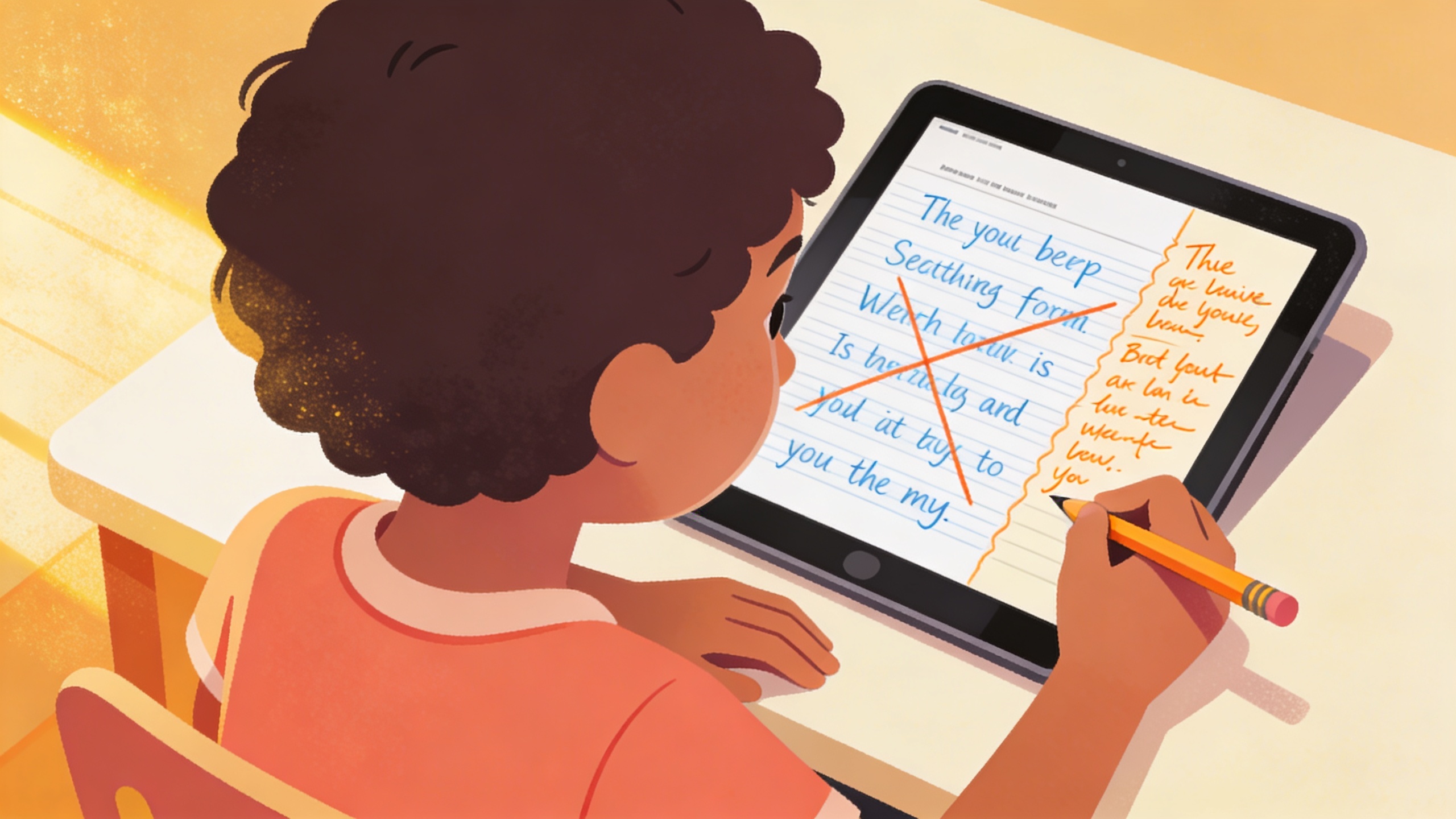
What makes this work: the AI’s questions are the scaffold. The student’s answers are the reflection. When a student crosses out what the AI got wrong, that act of rejection is where the thinking happens.
Activity 2: A Letter to Future Me
Students write a letter to themselves to open at the start of next year. AI offers sentence starters; students cross out what doesn’t fit and add what the AI missed.
“I’m writing a letter to myself for the future. Help me finish these sentences: ‘This year I learned that I am someone who ___.’ ‘The hardest thing was ___, and what I did was ___.’ ‘Something I want my future self to remember is ___.’ Give me a few options for each, and I’ll pick or change them.”
Permissions confirmed. Check your school/district policy on student AI tool use.
Tool selected. Choose an age-appropriate, school-approved tool. Review it yourself first.
Review output together. Read a few AI responses aloud as a class before students work independently.
Paper backup ready. Some students will prefer to write without the AI after seeing how it works. Let them.
Exit question prepared. End with one question only the student can answer.
Pick one class and run a 20-minute AI-assisted reflection. Collect three direct quotes from students afterward — things they said or wrote that surprised you. Those quotes will tell you more than any rubric.
For High School: Turning Reflection into College-, Career-, and Life-Ready Narratives
High schoolers have a complicated relationship with reflection. They have four years of material to draw from — but “reflection” often feels like a hoop to jump through. AI can interrupt that pattern by doing something genuinely useful: helping students find patterns in their own work they couldn’t see themselves.
From Reflection to Ready-to-Use Stories
The final step transforms reflection into fuel for college essays, job applications, and interviews. Students use their rewritten observations to complete this template:
A challenge: “The hardest thing I navigated this year was ___, and here’s what I did ___.”
A win: “I’m most proud of ___, because it showed me that I ___.”
A surprise: “I didn’t expect ___, and it changed how I think about ___.”
These three stories are reusable. They can be expanded into a college personal statement, compressed into a cover letter bullet, or pulled out verbatim in a “Tell me about yourself” moment.
“Here’s a challenge I wrote about: [student’s paragraph]. Can you help me identify the strongest sentence — the one that shows who I am — and suggest a version I could use as an opening for a college essay?”
Run one reflection session where students produce their three short stories. Tell them upfront: these are theirs to keep. They may need them sooner than they think.
For Recent Grads: Using AI to Tell the Story of Your Journey
Graduation is a hinge moment. One chapter closes; another opens. The challenge is that most grads are so focused on what’s next that they skip the closing entirely. That skip is a loss.
“AI can help find better words for real experiences. It cannot manufacture the experiences themselves. If you couldn’t back it up in conversation, it shouldn’t be in the document.”
The guiding principle for AI-assisted grad reflectionLooking back: “I’m finishing [high school / college / a program]. Help me think through the past year. What do I most want to remember? Ask me one question at a time.”
Translating to career language: “Here’s something I’m proud of: [paragraph]. Turn this into a resume bullet, a LinkedIn sentence, and a one-sentence interview answer.”
The goodbye-and-thank-you letter: “Help me write a short letter to someone who made a difference. Ask me: who the person is, one specific thing they did, and how it changed me.”
Ask your graduating seniors to create a one-page “Year in Review” narrative — a short document that captures their biggest learning moments in their own voice. Tell them explicitly: this is not a resume. It’s a story.
Protecting Authentic Voice in AI-Powered Reflection
The biggest risk isn’t that students will use AI. It’s that AI will replace the student entirely — producing output that is polished, grammatically sound, and completely hollow.
Add at least one “Only you can answer this” question to any AI-assisted reflection prompt you use this week. Simple example: “What’s one thing from this year that no one else in your class experienced the same way you did?” That question alone will tell you more about your students than the rest of the reflection combined.
Your 7-Day Action Plan
You don’t have to do everything. Pick your grade band and work through this sequence. One week, one activity, one sentence of learning. That’s how the best things scale.
A Forward-Looking Close
Here’s what we know is coming: AI will get better at generating fluent, emotionally resonant, structurally sophisticated writing. The gap between AI-assisted and AI-authored will narrow — and in some cases disappear visually. That means the work of protecting authentic voice won’t get easier. It will get more deliberate.
The activities in this post aren’t just good ideas for May 2026. They’re the beginning of a practice. Every teacher who designs one “only you can answer this” question this week is building the instinct to design ten more next year. Every student who crosses out an AI’s sentence and writes their own is learning something about authorship that will matter when the stakes are higher.
“We’re not just helping students reflect on this year. We’re teaching them what reflection is for.”
JR DeLaney — The AI Learning Guide, May 2026Next week in the series: Week 2 — Using AI to Help Students Set Intentions for Summer and Beyond.
Additional Resources
- National Council of Teachers of English. (2024). AI and writing: Supporting authentic student expression. NCTE Position Statement. ncte.org
- Boud, D., Keogh, R., & Walker, D. (Eds.). (1985). Reflection: Turning experience into learning. Kogan Page.
- Zuboff, S. (2023, March). AI literacy in education: What teachers need to know now. Harvard Graduate School of Education Usable Knowledge. gse.harvard.edu
- ISTE. (2024). AI in education: A framework for responsible use. International Society for Technology in Education. iste.org

Leave a Reply