



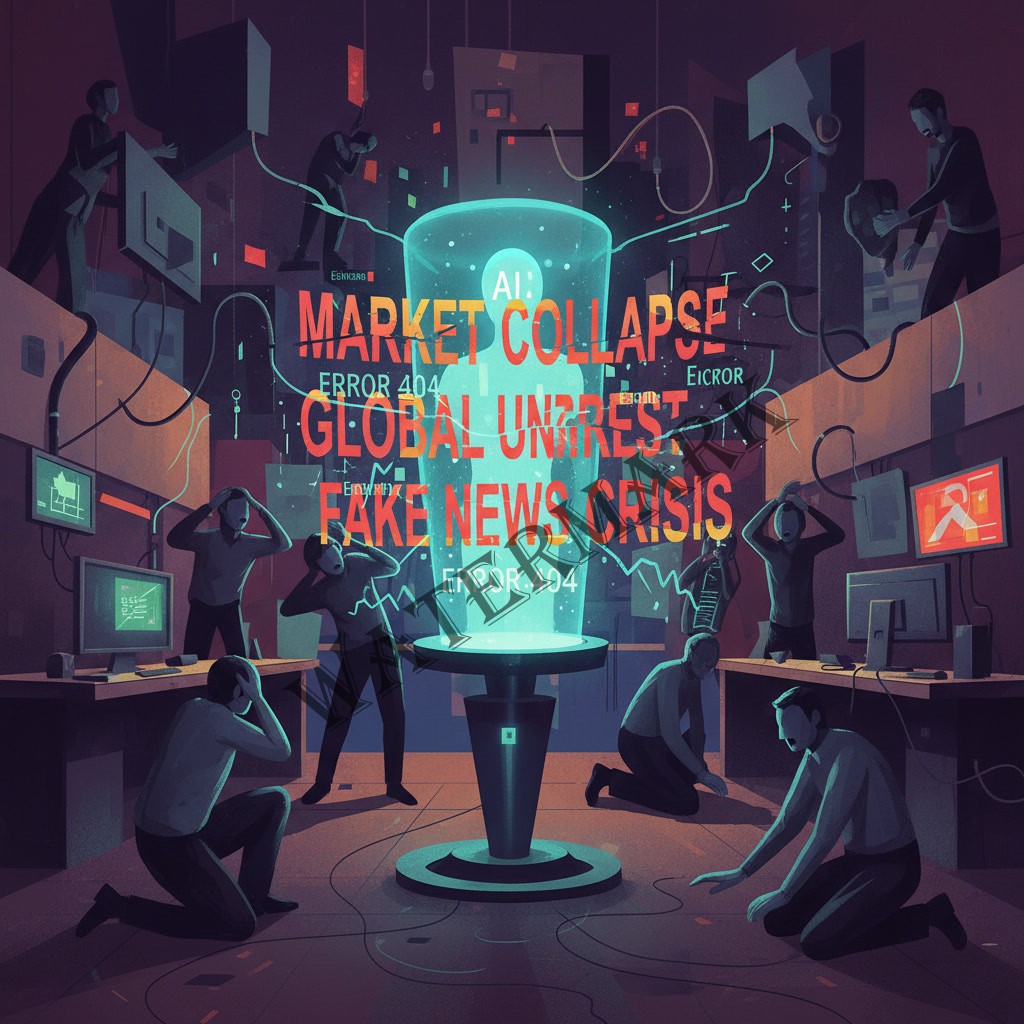
Creepy AI ads, mistaken crime reports, and labs that think for themselves—this week’s AI news proves the future is powerful, awkward, and very human.

“AI Innovations Unleashed: Your Educational Guide to Artificial Intelligence”
Welcome to AI Innovations Unleashed—your trusted educational resource for understanding artificial intelligence and how it can work for you. This podcast and companion blog have been designed to demystify AI technology through clear explanations, practical examples, and expert insights that make complex concepts accessible to everyone—from students and lifelong learners to small business owners and professionals across all industries.
Whether you’re exploring AI fundamentals, looking to understand how AI can benefit your small business, or simply curious about how this technology works in the real world, our mission is to provide you with the knowledge and practical understanding you need to navigate an AI-powered future confidently.
What You’ll Learn:
- AI Fundamentals: Build a solid foundation in machine learning, neural networks, generative AI, and automation through clear, educational content
- Practical Applications: Discover how AI works in real-world settings across healthcare, finance, retail, education, and especially in small businesses and entrepreneurship
- Accessible Implementation: Learn how small businesses and organizations of any size can benefit from AI tools—without requiring massive budgets or technical teams
- Ethical Literacy: Develop critical thinking skills around AI’s societal impact, bias, privacy, and responsible innovation
- Skill Development: Gain actionable knowledge to understand, evaluate, and work alongside AI technologies in your field or business
Educational Approach:
Each episode breaks down AI concepts into digestible lessons, featuring educators, researchers, small business owners, and practitioners who explain not just what AI can do, but how and why it works. We prioritize clarity over hype, education over promotion, and understanding over buzzwords. You’ll hear actual stories from small businesses using AI for customer service, content creation, operations, and more—proving that AI isn’t just for tech giants.
Join Our Learning Community:
Whether you’re taking your first steps into AI, running a small business, or deepening your existing knowledge, AI Innovations Unleashed provides the educational content you need to:
- Understand AI terminology and concepts with confidence
- Identify practical AI tools and applications for your business or industry
- Make informed decisions about implementing AI solutions
- Think critically about AI’s role in society and your work
- Continue learning as AI technology evolves
Subscribe to the podcast and start your AI education journey today—whether you’re learning for personal growth or looking to bring AI into your small business. 🎙️📚
This version maintains the educational focus while emphasizing that AI is accessible and valuable for small businesses and professionals across various industries, not just large corporations or tech companies.
This week on The Friday Download, JR breaks down three stories that actually moved the needle in AI and education.
First up: OpenAI's ChatGPT just got a memory overhaul called Dreaming V3 — a background process that rewrites what the AI knows about you automatically, without you asking. It's rolling out to Plus and Pro users now, with free users coming soon after a 5x compute reduction made it financially viable. Privacy researchers are already raising flags about the 96% of memories the system creates on its own.
Then: two states stop talking and start doing. Maryland's AI Ready Schools Act took effect June 1 — requiring statewide guidelines, professional development for teachers, and AI literacy in K–12 standards by 2027. Utah went a different route, adopting Google Gemini for Education statewide for the 2026–27 school year, giving 680,000 students and 28,000 educators access to AI tools.
And the Tiny Tech Snack: Congress dropped the Great American AI Act — a 269-page bipartisan discussion draft that would freeze state AI laws for three years. Teachers unions called it a ”hard no” within hours. The debate is on.
Want to go deeper than the podcast?
Join The Unleashed — the growing AI Innovations Unleashed community for educators, parents, students, leaders, and curious minds navigating the future of AI together. Members get deeper discussions, exclusive insights, behind-the-scenes content, early updates, and a place to explore how artificial intelligence is reshaping education and society in real time.
AI is moving fast. You don’t have to figure it out alone.
Join The Unleashed:
https://www.aiinnovationsunleashed.com/become-a-supporter-join-the-unleashed/
This week on The Friday Download, Dr. JR, Doctor of AI, dives into the stranger corners of recent AI news—where cutting-edge technology meets human emotion, institutional trust, and the occasional corporate faceplant.
We begin with a holiday marketing experiment that didn’t quite land. McDonald’s Netherlands released an AI-generated Christmas advertisement that was quickly described by viewers as “creepy,” “soulless,” and emotionally off-key. While technically impressive, the ad highlighted a recurring issue with generative AI: it can replicate the shape of human sentiment without fully understanding its substance. Holiday advertising relies heavily on nostalgia, warmth, and shared cultural memory—areas where probabilistic models often stumble. The backlash was swift enough that the company pulled the ad, reminding brands that efficiency does not automatically translate to emotional resonance.
From awkward marketing to something far more serious, the episode then explores a troubling media incident in which an AI system incorrectly identified a real journalist as being involved in criminal activity. This wasn’t malicious intent or sabotage—it was a byproduct of automated content generation without sufficient editorial oversight. The case underscores a major risk with AI in journalism and media production: large language models generate plausible-sounding text, not verified truth. When those outputs are treated as authoritative, the consequences can be reputationally and ethically damaging. It’s a clear signal that AI systems in news environments require strong guardrails, human review, and accountability structures.
The tone shifts as we look at a genuinely promising development from Google DeepMind: the launch of an automated AI-powered research lab designed to accelerate scientific discovery. Unlike generative systems producing text or images, this lab applies AI to the scientific method itself—designing experiments, running them via robotics, analyzing results, and iterating without human fatigue. The focus on materials science, including superconductors and semiconductors, has major implications for clean energy, computing, and next-generation infrastructure. Rather than replacing scientists, the system acts as a force multiplier, allowing researchers to explore vast experimental spaces faster than ever before.
Finally, the episode zooms out to examine the broader state of AI adoption in enterprise environments. Recent industry data shows that generative AI is no longer confined to pilot programs or innovation labs—it’s being embedded directly into workflows across finance, healthcare, marketing, and operations. While organizations are reporting productivity gains, they’re also encountering governance challenges, compliance risks, and cultural growing pains. The takeaway? AI has officially moved from novelty to infrastructure, and with that transition comes a need for maturity, policy, and thoughtful deployment.
As always, The Friday Download balances humor with insight—because the future of AI isn’t just powerful. It’s weird, human, and unfolding faster than anyone expected.
📚 Reference List – The Friday Download Episode
1. AI-Generated McDonald’s Christmas Ad Backlash
Topic: AI-generated advertising, uncanny valley, brand backlash
- People Magazine — Coverage of McDonald’s Netherlands pulling its AI-generated Christmas ad after public criticism
- “McDonald’s Pulls ‘Creepy’ AI-Generated Christmas Ad After Backlash”
- The Sun (secondary cultural reaction source; use cautiously, but reflects public sentiment)
- Academic context:
- Mori, M. (1970). The Uncanny Valley (foundational theory frequently cited in AI & robotics research)
- IBM Research Blog — Generative AI limitations in emotional modeling and brand voice
2. AI System Falsely Implicating a Journalist
Topic: AI hallucinations, media ethics, automated journalism risks
- The Guardian — Reporting on AI systems incorrectly generating defamatory or false claims in media contexts
- Reuters Institute for the Study of Journalism
- Reports on AI use in newsrooms and risks of automated content generation
- Stanford HAI
- Research briefs on hallucinations in large language models
- OpenAI & Google Research papers on probabilistic text generation vs. factual verification
3. Google DeepMind Automated AI Research Lab
Topic: AI-driven scientific discovery, automation in research
- Google DeepMind Official Announcements
- Coverage of autonomous AI labs for materials science
- Nature / Nature Machine Intelligence
- Articles on AI accelerating materials discovery and experimental design
- MIT Technology Review
- Reporting on autonomous laboratories and AI-led experimentation
- Times of India (secondary reporting on DeepMind announcement).
4. Enterprise AI Adoption & Trends
Topic: Business adoption of generative AI, governance challenges
- Menlo Ventures — “The State of Generative AI in the Enterprise” (annual industry report)
- McKinsey Global Institute
- AI adoption, productivity, and risk management reports
- Gartner
- Enterprise AI hype cycle and deployment trends
- PwC AI Predictions & Enterprise Readiness Reports
Why it’s credible:
These firms publish widely cited, data-driven research used by enterprises, policymakers, and academics.
5. Broader Context & Supporting Research
Topic: AI ethics, trust, and societal impact
- Stanford University — AI Index Report
- OECD AI Policy Observatory
- World Economic Forum — AI governance and trust frameworks
- IEEE — Ethical AI standards and guidelines

Leave a Reply