


Show What You’ve Done: AI-Enhanced Portfolios from Classroom to Career
From elementary classrooms to first-job interviews, AI-powered portfolios are transforming how students tell the story of who they are, what they’ve learned, and where they’re headed next.
Listen to Episode #2: Show What You’ve Done
This feature is the deeper companion read for Episode #2 of AI Innovations Unleashed. The episode link is staged for release, so it can point directly to the podcast companion page once the episode is live.
The Portfolio Just Escaped the Three-Ring Binder Era
There was a time when “student portfolio” meant a dusty folder hidden somewhere in a classroom cabinet beside a dying glue stick and a marker that definitely smelled suspicious. Today? Portfolios are becoming dynamic, searchable, multimedia learning identities powered by AI.
And honestly, the shift makes sense. Students already live in a world where digital identity matters. College admissions officers scan online projects. Recruiters search LinkedIn and GitHub. Scholarship reviewers increasingly want evidence of creativity, communication, and applied thinking — not just GPA numbers floating around lonely on a transcript like abandoned shopping carts in cyberspace.
Artificial intelligence is now stepping into that ecosystem as both an assistant and a translator. It can help students organize work, summarize growth, identify patterns, generate captions, improve accessibility, and tailor presentation styles for different audiences. The classroom portfolio is quietly evolving into something much larger: a living narrative of learning.
What People Think Is Happening
If you spend five minutes online reading conversations about AI in schools, you might think classrooms have transformed into a strange sci-fi crossover between a Silicon Valley startup and a cheating scandal documentary.
Teachers worry students will use AI to generate fake reflections. Parents worry student privacy could disappear into giant corporate training datasets. Students themselves often swing between excitement and anxiety — because apparently nothing says “teenage stress” quite like wondering if your scholarship essay sounds “too AI.”
Homeschool communities are wrestling with the same questions. Some families see AI portfolios as a way to document personalized learning paths and project-based work more effectively. Others worry the technology could flatten individuality into algorithmically optimized sameness.
“AI is perhaps the most transformative technology of our time.”— Satya Nadella, CEO of Microsoft
That quote gets repeated constantly — and for good reason. AI is changing communication itself. But schools are discovering something important: portfolios are not becoming less human because of AI. In many cases, they’re becoming more reflective, more multimedia-rich, and more personalized.
AI Is Becoming a Reflection Tool, Not Just a Writing Tool
Modern generative AI systems — particularly Large Language Models (LLMs) — are designed to predict and generate language patterns. That sounds wildly technical, but the classroom application often becomes surprisingly practical.
A student uploads several writing samples. The AI identifies recurring themes: leadership, resilience, collaboration, scientific curiosity. Suddenly, instead of staring blankly at a blinking cursor while trying to write a college reflection essay, the student has a starting point.
That matters because reflection is hard. Even adults struggle to explain their own growth without sounding like they’re improvising a motivational conference speech after three cups of coffee.
“Reflection is one of the most underused yet powerful tools for learning.”— John Hattie, educational researcher and author of Visible Learning
AI can support reflection by helping students:
- Organize artifacts by skills or themes instead of assignment dates.
- Generate interview-style reflection prompts.
- Summarize long projects into concise portfolio descriptions.
- Adapt language for college, scholarship, or career audiences.
- Create accessibility supports like captions, summaries, and translation assistance.
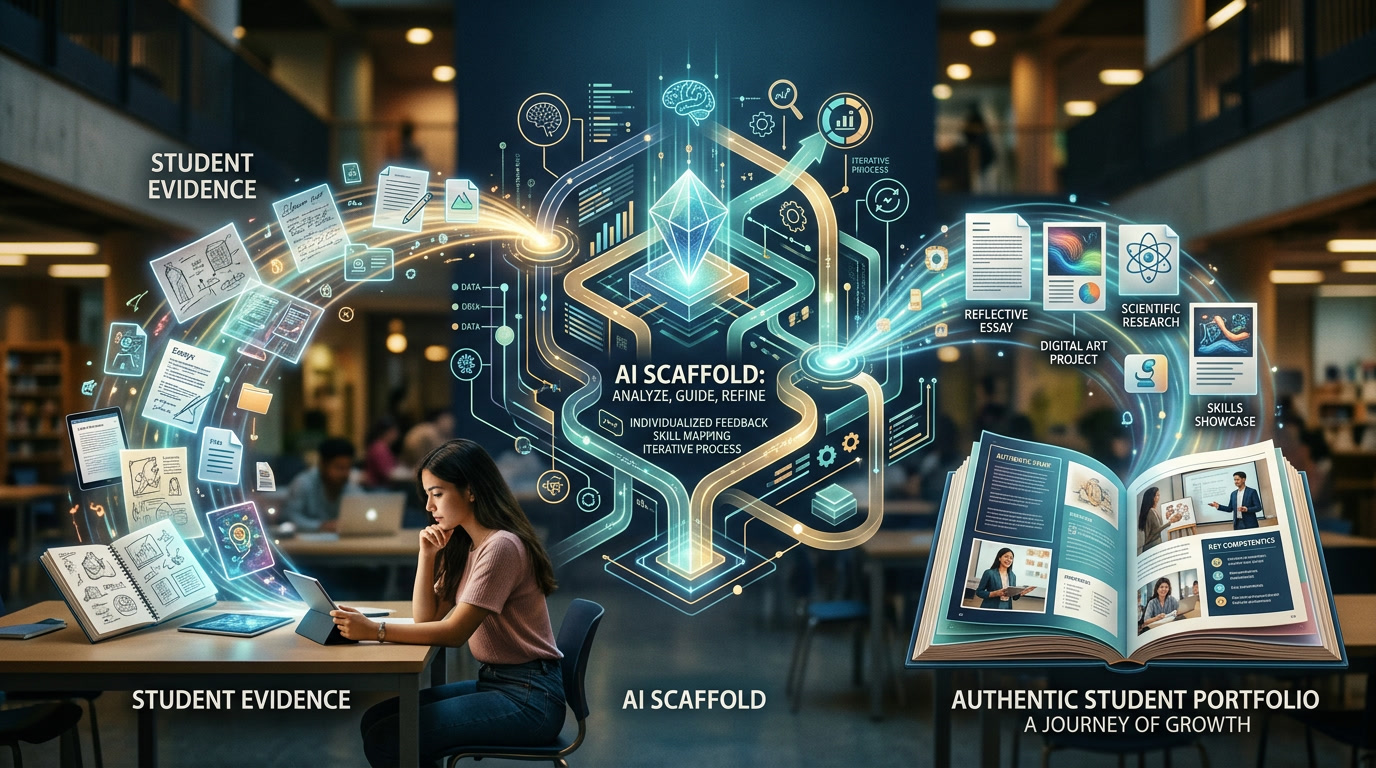
Students are not just using AI to generate text. They are increasingly using it as a reflection assistant, organization tool, accessibility layer, and communication coach that helps translate learning into visible evidence of growth.
The important distinction here is that the student still owns the ideas, decisions, and learning experiences. AI is supporting the storytelling process — not replacing the learner.
Collect
Students gather artifacts: writing, projects, videos, reflections, presentations, and performance tasks.
Reflect
AI helps generate prompts that push students to explain growth, struggle, revision, and learning choices.
Curate
Students choose the pieces that best represent their skills, voice, and readiness for the next stage.
Translate
AI helps students adapt their portfolio language for families, teachers, colleges, scholarships, or employers.
Where Confidence Starts
Younger students often struggle to explain what they learned in sophisticated language. AI-assisted portfolio systems can help bridge that gap without taking away student ownership.
Imagine a fourth grader uploading a science project photo. The AI suggests prompts like:
- “What surprised you most during this experiment?”
- “What mistake helped you learn something new?”
- “How would you explain this project to next year’s students?”
Suddenly the portfolio becomes less about perfection and more about growth. Teachers can use AI-generated scaffolding to help quieter students participate more confidently in reflection activities.
There’s also something surprisingly powerful about multimedia storytelling at younger ages. Students can create AI-assisted year-in-review comics, narrated slideshows, classroom radio shows, and digital “museum exhibits” documenting the school year.
And honestly? Families love it. A lot more than deciphering cryptic pencil handwriting on wrinkled construction paper. No offense to construction paper. You had a good run.
From Assignments to Identity
High school is where portfolios become strategically important. Students are increasingly expected to demonstrate competencies instead of simply listing courses completed.
AI-supported portfolio platforms can help students group projects around themes like:
- Leadership
- Collaboration
- Communication
- Research Skills
- Creative Problem Solving
- Community Engagement
This matters because college admissions and scholarship reviewers increasingly want evidence of applied learning. A transcript shows what class a student took. A portfolio can show what the student actually created.
AI can also help students tailor presentations for different goals. The same robotics project might be framed one way for an engineering scholarship and another way for a leadership-focused application.
The fascinating part? Students begin recognizing patterns in themselves. They start seeing connections between classes, projects, extracurriculars, and future goals. The portfolio becomes less like a storage system and more like a map of emerging identity.
Welcome to the Era of Skills-Based Hiring
For recent graduates, AI-enhanced portfolios may become even more important than resumes in certain industries.
Employers increasingly want evidence of actual skills. Can the applicant communicate clearly? Solve problems? Collaborate? Adapt? Build? Create? Reflect?
AI can help graduates translate classroom work into career-ready language. A capstone project becomes a case study. A research paper becomes a policy analysis sample. A design project becomes a portfolio showcase optimized for hiring systems.
Students entering creative fields, technology careers, marketing, education, and communications are already seeing this shift happen in real time.
The resume still matters, but the AI-enhanced portfolio gives students something stronger: evidence, context, reflection, and a living record of growth.
Traditional Resume
A useful summary — but usually a thin snapshot.
- Static snapshot in time
- Credential-focused
- Usually text-only
- Limited project evidence
- Compresses learning into short bullet points
- Often one-size-fits-all for every audience
- Shows what was completed, not always how it was learned
- Rarely captures collaboration, revision, or growth over time
- Harder for young learners to make meaningful or memorable
evidence + story
AI-Enhanced Portfolio
A dynamic showcase of skills, process, and identity.
- Interactive and adaptive
- Skills and competency-based
- Includes multimedia proof of learning
- Can be personalized for teachers, colleges, families, or employers
- Shows process, reflection, revision, and growth
- Connects projects to transferable skills and future goals
- Helps students translate classroom work into career-ready language
- Supports accessibility through captions, summaries, and multiple formats
- Evolves throughout a learner’s journey instead of freezing one moment
That doesn’t mean resumes disappear tomorrow. But it does mean portfolios are becoming a powerful companion piece in a workforce increasingly shaped by AI itself.
The Authenticity Question Nobody Can Ignore
Here’s the philosophical tension quietly sitting underneath this entire conversation:
If AI helps students communicate themselves more effectively, where exactly is the line between assistance and authenticity?
That question matters because portfolios are supposed to represent the learner. Schools must avoid creating environments where students feel pressured to optimize every sentence until it sounds polished but emotionally hollow.
There are also legitimate concerns involving:
- Student privacy and data security.
- Bias in AI-generated language.
- Overreliance on automated writing support.
- Socioeconomic access gaps between schools.
- The temptation to prioritize polish over learning.
The healthiest approach is transparency. Students should understand what AI helped with, what they created independently, and why that distinction matters.
What Teachers and Leaders Can Do Right Now
For Teachers
- Use AI for reflection prompts instead of final answers.
- Require students to explain their AI-assisted decisions.
- Build “process reflection” directly into grading rubrics.
- Experiment with multimedia portfolio formats.
- Teach students how to evaluate AI outputs critically.
For School Leaders
- Create district AI governance guidelines.
- Invest in professional development for AI literacy.
- Develop ethical portfolio policies centered on student ownership.
- Prioritize accessibility and privacy protections.
- Think beyond compliance and toward workforce readiness.
Schools that treat AI only as a cheating issue may completely miss the bigger transformation happening around digital identity, communication, and skills-based hiring.
The Portfolio of the Future Is a Living Story
The next generation of portfolios will likely look less like static assignment folders and more like evolving learning ecosystems. Students may build longitudinal narratives that connect elementary curiosity, high school specialization, college experiences, and career growth into a single adaptive showcase.
And despite all the technology involved, the most important ingredient remains stubbornly, beautifully human:
Voice.
AI can organize information. It can polish language. It can suggest structure.
But students still have to bring the curiosity, resilience, creativity, humor, perspective, and lived experience themselves.
That part cannot be automated. At least not until somebody invents an AI capable of surviving sophomore group projects without emotional damage.
Reference List
EDUCAUSE. (2024). 2024 EDUCAUSE Horizon Report: Teaching and Learning Edition. EDUCAUSE.
Hattie, J. (2023). Visible Learning: The Sequel. Routledge.
Microsoft Education. (2024). AI in Education Special Report. Microsoft.
National Association of Colleges and Employers (NACE). (2024). Career Readiness Competencies. NACE Center for Career Development and Talent Acquisition.
Organisation for Economic Co-operation and Development (OECD). (2023). Shaping Digital Education: Enabling Factors for Quality, Equity and Efficiency. OECD Publishing.
UNESCO. (2023). Guidance for Generative AI in Education and Research. UNESCO Publishing.
World Economic Forum. (2025). The Future of Jobs Report 2025. World Economic Forum.
Additional Reading
- Stanford HAI — Research on AI literacy and education systems
- Common Sense Media — AI guidance for educators and families
- ISTE — Artificial intelligence classroom implementation frameworks
- Brookings Institution — Future of work and AI readiness research
- MIT Sloan — Workforce transformation and AI adaptation studies
Additional Resources
- https://www.unesco.org/en/artificial-intelligence/education
- https://www.weforum.org
- https://www.edutopia.org
- https://www.iste.org
- https://www.educause.edu

Leave a Reply