


Embrace the Bots, Ban the Phones: This Week in AI Classrooms
Schools are being told to welcome AI-powered learning tools and crack down on smartphones — at the same time. This week’s whirlwind replay covers the contradiction at the heart of modern education, rising AI literacy mandates, and who’s actually doing something about it.
Schools are navigating a strange new reality: embrace AI, limit phones, and somehow teach students to use powerful tools responsibly. This week’s Friday Download looks at the tension between AI adoption and phone bans, the U.S. Department of Education’s new AI-related grant priorities, and the growing push for AI literacy in K–12 education.
Somewhere, a teenager just rage-quit homework — and they don’t even know why.
Segment 1 — The Big Weird
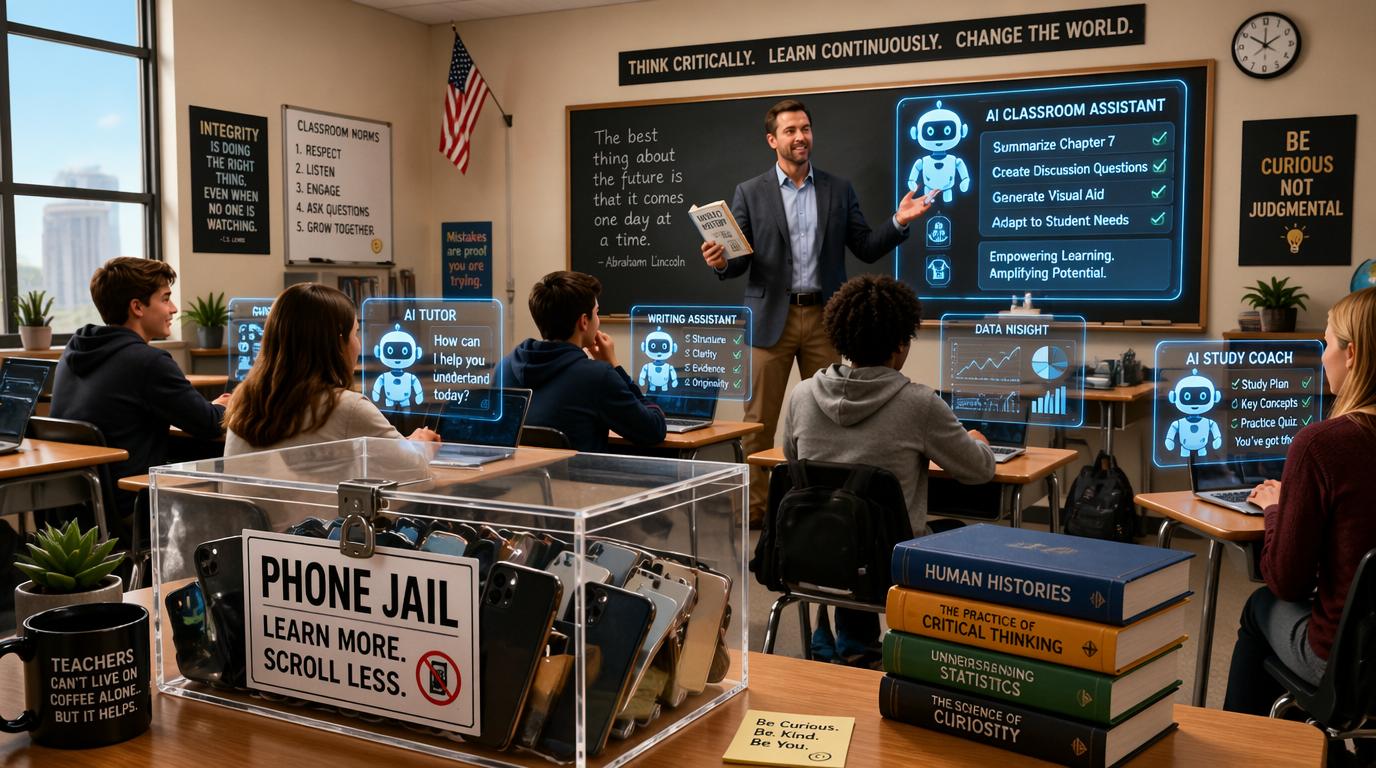
This week’s Big Weird is deceptively simple: schools are being urged to embrace AI while simultaneously expanding phone bans. That contradiction isn’t a footnote — it’s the whole story.
Recent coverage highlights the tension between promoting AI-powered learning tools and restricting the devices students most commonly use to access them. Colleges and K–12 schools are still struggling to define clear boundaries for AI use, even as student adoption continues to climb. That leaves teachers and students in a policy gray zone where AI is treated as both inevitable and suspicious — often at the same time, in the same building.
The question this episode keeps circling back to: Should schools teach students how to use AI responsibly, or keep pretending the tools aren’t already part of everyday learning?
“AI is treated as both inevitable and suspicious — often at the same time, in the same building.”
The Friday Download, April 2026Segment 2 — Wait… That’s Actually Cool
One of the most important developments this week: the U.S. Department of Education has formally made AI and AI literacy a priority in discretionary grantmaking. This isn’t a press release — it signals that AI literacy is becoming a strategic education issue, not just a classroom experiment or a teacher’s side project.
Boston Public Schools is also moving with unusual urgency, pushing toward AI fluency as a graduation-level expectation backed by a $1 million grant to train educators and launch the initiative. That district’s move suggests AI literacy may soon be treated more like a foundational skill than an optional tech topic — more like algebra, less like robotics club.
Teacher training is part of the story too. Growing educator interest in practical AI guidance and professional development is being met with structured training opportunities tied to responsible classroom use. How teachers understand AI will shape whether it becomes genuinely useful or just another layer of confusion layered on top of an already complicated job.
Federal signal: U.S. Department of Education elevates AI literacy in discretionary grant priorities — real money, not just talking points.
District action: Boston Public Schools moves toward AI fluency as a graduation-level skill with a $1M educator training grant.
Teacher pipeline: Structured AI professional development is growing, focused on practical, responsible classroom application.
Segment 3 — The Tiny Tech Snack
Three concepts making the rounds in every education conversation right now. If you’ve been nodding along in meetings without fully knowing what these mean, this one’s for you.
That’s Your Download
By the end of this week’s roundup, you should feel caught up on one of the strangest tensions in modern education: schools want AI innovation, but they’re still unsure how to govern the devices, habits, and expectations that come with it.
This week also shows that AI literacy is moving quickly from buzzword to policy priority — with federal, district, and professional development efforts all accelerating at once. If you work in education, these conversations are coming to your school whether you’re ready or not. Might as well know the vocabulary.
“This has been your tour guide, JR D — and this has been your whirlwind replay of the week where we embraced the bots, banned the phones, and tried to teach everybody how to survive the upgrade.”
JR DeLaney · The Friday DownloadSources & Further Reading
- Pursuit. Coverage on AI in education policies and innovations — school-level AI adoption and governance frameworks.
- Education Week. Commentary on schools embracing AI tools while expanding smartphone restrictions.
- NAPSA. Coverage of new U.S. Department of Education AI grant priorities and K–12 implications.
- K-12 Dive. Reporting on federal discretionary grantmaking and AI literacy as an education policy priority.
- AI Literacy Institute. Review of recent AI literacy developments, educator training opportunities, and responsible AI use frameworks.

Leave a Reply