


Exploring the Linguistic and Cognitive Shifts in the Age of Artificial Intelligence
Introduction: Welcome to the Age of Robo-Rhetoric
Once upon a time, the biggest shift in how we communicated was the invention of the printing press. Then came the telephone, the internet, emojis, and TikTok. But now? We’re talking to algorithms. More than that — they’re talking back. Whether it’s your Gmail auto-completing your sentences, ChatGPT helping you brainstorm a wedding speech, or a chatbot responding to your customer complaint with unsettling cheer, artificial intelligence is quietly — and sometimes not so quietly — changing the way we speak, write, and even think.
Pause for a moment. Ask yourself: Has the way you express yourself changed in the last year or two? Do you sometimes find yourself thinking in bullet points, writing emails that sound suspiciously like a LinkedIn post, or wondering whether your own words feel… less you? You’re not alone. We’re in the middle of a subtle but profound shift in human expression — one where AI is not just a tool, but an influence.
This isn’t just about autocorrects or clever copy suggestions. It’s about how our language is becoming more algorithm-friendly, our thoughts more machine-assisted, and our communication styles more… well, predictable. AI doesn’t just respond to human input — it shapes it. And that’s got everyone from linguists to philosophers, poets to professors, asking some very deep questions.
Are we outsourcing our originality? Are machines flattening the richness of human nuance into standardized templates? Or, on the flip side, are they helping us become clearer, more efficient, and even more creative?
In this post, we’ll dive into:
- How AI is influencing everyday language and communication styles,
- Whether it’s making us smarter or just more efficient typists,
- What the latest research, writers, and thinkers are saying about AI’s cognitive ripple effects,
- And whether your brain — yes, yours — might already be thinking a little more like a machine than you’d realized.
But don’t worry — we’ll keep it light. After all, if AI can joke, so can we.
From Shakespeare to Smart Replies: Language in Flux
Before we can answer how AI is affecting our deeper thinking, we have to start at the surface — with our words. After all, language is the bridge between thoughts and actions, the way we share ideas, shape identities, and make sense of the world. If that bridge starts to look a little different… maybe even a little robotic… that’s worth talking about.
Let’s begin with the most immediate impact AI is having: the way we speak and write.
The Linguistic Shift: AI’s Influence on Language
Language isn’t static; it evolves constantly — adapting to culture, technology, and the whims of generations. Shakespeare once delighted in coining new words. The Victorians gave us convoluted prose and excessively polite letters. The 20th century brought slang, tech jargon, and emojis. But today, the evolution has entered a new phase: welcome to the age of “AI-speak.”
A recent study by Yakura et al. (2024) found that human language — particularly in academic and public-facing communication — is subtly beginning to reflect the rhythm and tone of AI-generated content. After analyzing over 280,000 educational videos, researchers noted an increase in sentence structures and word choices that resemble those frequently produced by large language models.
So what exactly is AI-speak? According to Dr. Emily Bender, Professor of Linguistics at the University of Washington, it’s a blend of clear, concise, often emotionally neutral phrasing optimized for efficiency. “What we’re seeing is a shift toward machine-pleasing language — writing that’s stripped of ambiguity, optimized for algorithms, and increasingly devoid of metaphor,” she notes.
Predictive text, auto-suggest features, and AI writing assistants all nudge us toward this clarity-first communication. They favor short sentences, consistent structure, and sanitized language. Dr. Bender calls this the “linguistic flattening effect” — where expression becomes uniform, and idiosyncrasies are trimmed away for the sake of smooth processing.
Pop culture has already started showcasing these shifts. In 2024, a short film titled The Safe Zone was co-written with ChatGPT — and while it grabbed attention for its innovation, critics pointed out the oddly flat, overly agreeable dialogue. One reviewer described it as “Siri meets Shakespeare in a PowerPoint presentation.” The characters were coherent, but eerily devoid of human spark.
It’s not just film. Social media influencers are increasingly using AI tools to caption their posts and generate scripts for Reels and TikToks. The result? A wave of videos with a strangely uniform tone — upbeat, overly polished, and full of phrases like “optimize your mindset” or “level up your life.” It’s the language of productivity software — now in your daily scroll.
Even in music, we see artists experimenting with AI-generated lyrics. While catchy, critics note a certain “linguistic blandness.” As musician and producer Brian Eno once warned, “When you remove the flaws, you remove the soul.”
Dr. Neil Postman, a media theorist (though pre-AI era), once said, “Technological change is not additive; it is ecological.” When applied to language, AI isn’t just offering new words — it’s changing the environment in which language lives.
According to Hashmat, Ahmad, and Gulzar (2024), the shift goes deeper than convenience. In their study published in the Policy Research Journal, frequent users of AI-based communication platforms began to internalize simplified syntax and lexical choices. It’s not just that we’re writing more like AI — we’re thinking in its patterns.
But not everyone sees this as a loss. Dr. Ethan Mollick from the Wharton School argues that “AI can help democratize communication.” For people who struggle with traditional writing — non-native speakers, neurodivergent individuals, or professionals outside of literary fields — AI can be a liberating equalizer. “It’s not about losing voice,” he says, “but amplifying access.”
There’s another curious phenomenon emerging: people are adapting their language to communicate with AI more effectively. AI whisperers, prompt engineers, and savvy users are learning the “sweet spots” of phrasing that get better results from ChatGPT or image generators like DALL·E. In other words, we’re learning a dialect tailored to machines — one that’s creeping into our broader speech.
This fusion of human expression and machine optimization may be leading to a new hybrid language — one part plain English, one part algorithmic command. And that raises the question: who’s really setting the linguistic trends now — us, or the models we’ve built?
So yes — our language is shifting. It’s becoming cleaner, faster, and more AI-compatible. Whether that’s evolution or erosion depends on your perspective. But as our words adapt, so too do our thoughts. Because language doesn’t just express what we think — it also shapes what we’re capable of thinking.
And that brings us to the next level of the conversation: how AI may be rewriting not just our emails and texts, but the very wiring of our minds.
Writing in the AI Era: Efficiency vs. Authenticity
Now that we’ve explored how AI is changing our words and phrasing, it’s only natural to zoom out and ask: what’s happening to the art — and the act — of writing itself?
At the heart of this conversation are two competing forces: efficiency and authenticity.
Efficiency in the AI writing world means speed, structure, and slickness. It’s that feeling when you input a few bullet points and watch a full blog post pop out. You save time. You skip the blank page dread. You get something that sounds right, instantly. For busy professionals, students on deadlines, or marketers with five articles due yesterday — this is a dream. AI helps turn rough ideas into polished paragraphs, outlines into newsletters, and thoughts into taglines. It’s your brainstorming buddy and ghostwriter rolled into one.
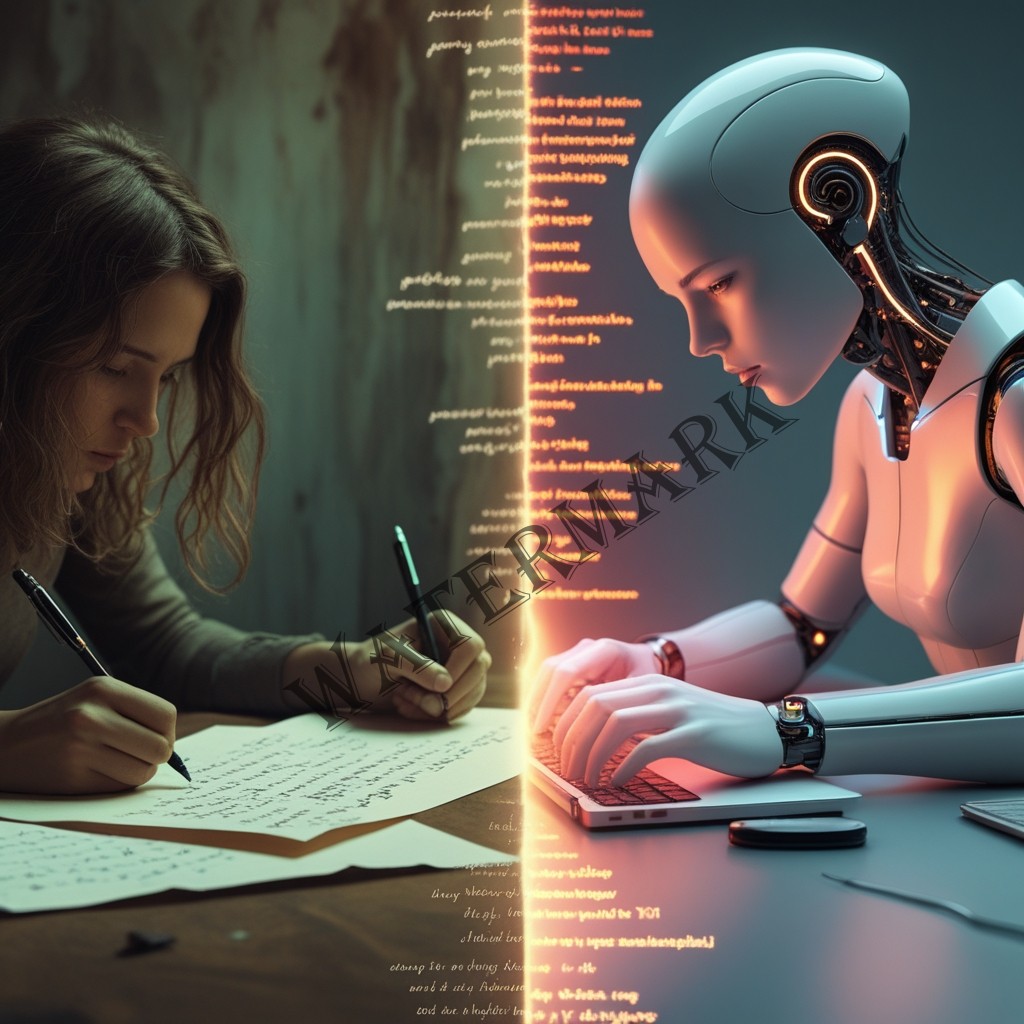
But what about authenticity? That’s the stuff good writing is made of — the voice, the imperfections, the weird metaphors you didn’t know you loved. Authentic writing is slower. It’s frustrating. Sometimes it meanders. But it often says something real. Think of a handwritten letter from a friend, a messy but heartfelt blog post, or a journal entry that makes zero grammatical sense but hits you right in the feelings.
Here’s where the tension lives: AI writing tools are fantastic at efficiency. But they don’t always know how to be you.
Take author Vauhini Vara, who famously co-wrote an essay with GPT-3 about the loss of her sister. The AI-generated version was smooth and technically well-written — but Vara felt something was missing. So she rewrote it, blending her emotional memory with the AI’s framing. The final result was a hybrid of speed and soul (Vara, 2024).
Educators are grappling with the same issue. AI can write a five-paragraph essay that checks every rubric box — but does it capture a student’s curiosity, confusion, or breakthrough moment? As one professor told The Guardian, “If your assignment can be completed by an algorithm, maybe the assignment needs to change.” Ouch, but also… fair.
On the flip side, some professionals embrace AI as a starting point, not a replacement. Priya Desai, a marketing lead at a startup, explains: “AI drafts the bones — I add the muscle. It saves me hours but I still own the voice.” For her, it’s not about writing less. It’s about writing smarter.
And that might be the sweet spot. Using AI to clear the clutter, beat the block, or get the job done — then stepping back in to inject your tone, values, and quirks. Efficiency and authenticity don’t have to be enemies. They just have to take turns.
So why does this era feel so important? Because we’re at a crossroads. For the first time in history, you can choose to never write from scratch again. That’s wild. And empowering. And a little scary.
But writing isn’t just about communication. It’s about thinking. And the more we let AI draft our thoughts, the more intentional we’ll need to be about staying in the driver’s seat.
Let’s keep going — because as our tools evolve, so too do our minds. The next question is: what’s happening inside our heads when we rely on AI to do the heavy lifting?
Thinking with Machines: The Cognitive Impact of AI
If you’ve ever found yourself asking, “What did I come in here for?” while staring at a screen of AI-generated suggestions — congratulations, you’ve brushed up against cognitive offloading. It’s a real thing, and we’re doing it more than ever.
Cognitive offloading refers to the act of outsourcing mental tasks to external tools — like setting calendar reminders, using GPS, or, in today’s case, asking ChatGPT to summarize a dense article so you don’t have to. Handy? Absolutely. But as researchers have pointed out, every time we delegate a task to a machine, we potentially weaken our ability to perform that task ourselves.
In a 2024 report from Neuroscience News, scientists explored how AI systems are beginning to shape the way we reason and problem-solve. By offering quick solutions, AI tools often encourage users to accept rather than engage. In short: we stop wrestling with complexity because a smoother answer is just one click away.
Dr. Abigail Thompson, a cognitive scientist at Stanford, describes it this way: “AI doesn’t make us dumb — but it does make thinking feel optional.” That’s a zinger, but it comes with a warning: convenience shouldn’t come at the cost of curiosity.
Let’s put this into context. Imagine planning a vacation. A few years ago, you’d browse travel blogs, check maps, maybe even call a travel agent. Now? You type “best Paris itinerary 3 days” into ChatGPT and voilà — done. You’ve saved hours, yes. But you’ve also missed the opportunity to explore, to be surprised, to think your way through a problem.
AI also affects memory. A phenomenon called the Google Effect (or digital amnesia) shows that people are less likely to remember information they know they can access again easily. The same goes for AI-generated knowledge. Why memorize a process or understand the nuance if you can just ask your chatbot again tomorrow?
However, it’s not all bad news. AI can also stimulate thinking — especially when used as a creative collaborator. When used with intention, AI can expand the range of ideas we consider, challenge assumptions, or provide perspectives we hadn’t thought of.
Consider students working with AI to brainstorm thesis ideas. Or therapists exploring chatbot-assisted journaling to help clients unpack emotions. Used correctly, these tools can spark deeper reflection — not suppress it.
As Dr. Kate Darling from MIT’s Media Lab puts it, “We’re not outsourcing thinking — we’re scaffolding it. But we need to stay conscious of the architecture.”
So, is AI changing the way we think? Yes. But whether it’s a crutch or a catalyst depends on how we use it.
And that leads us to the big questions: What is wisdom in the age of AI? And how do we keep our humanity while embracing the machines?
Philosophy, Personhood, and the Pursuit of Wisdom
By now, we’ve seen how AI is reshaping language, writing, and even the way we think. But underneath all of this lies a deeper, more timeless question: what does it mean to be wise in an age when machines can mimic intelligence?
Let’s get a little philosophical — in a coffeehouse, not a textbook, kind of way.
Wisdom has always been more than just knowledge. It’s the ability to discern, to reflect, to sit with uncertainty. But AI, for all its processing power, thrives on certainty. It calculates. It completes. It doesn’t pause to wonder, second-guess, or change its mind. And that’s where the gap between artificial and human intelligence still holds.
Marvin Minsky, one of the pioneers of AI, once wrote that human intelligence isn’t one thing — it’s a symphony of mental processes: reason, emotion, intuition, memory. He called emotions “ways of thinking,” not distractions from it. AI might replicate logic, but can it ever understand irony, grief, awe? Probably not — at least not without experiencing them.
There’s also the issue of trust. When we interact with AI, we often attribute far more understanding to it than it really has — a phenomenon known as the ELIZA effect. The danger isn’t that AI will become too human, but that we might forget it isn’t.
As philosopher Shannon Vallor writes, “Wisdom is the ethical intelligence to live well with others in a fragile, complex world.” That includes other people — and increasingly, our technologies.
So where does that leave us?
Perhaps wisdom in the age of AI means knowing when to use the tool — and when to walk away from it. It means keeping our messiness, our contradictions, our poetic tangents. It means asking better questions, not just getting faster answers.
In a world full of machine-speak, maybe the most radical thing we can do is sound like ourselves.
Your Turn: Pause, Reflect, and Speak Human
So here’s your gentle challenge: next time you reach for an AI tool to write an email, draft a caption, or think through a tricky idea — pause. Ask yourself: is this the moment for efficiency, or authenticity? Is this a time to delegate, or a time to dig deep?
Let the tools be tools, not your voice. Let the machines help, but don’t let them flatten. And once in a while, write something entirely your own — even if it’s clumsy, weird, or wonderfully human.
Because maybe the future of thought isn’t just artificial or intelligent. Maybe it’s aware. And maybe the best wisdom starts with simply asking, “Is this really me?”
Conclusion: The Mirror and the Machine
AI is not just a reflection of us — it’s becoming part of the way we reflect. It’s changing how we speak, how we write, and how we think. The question isn’t whether that change is good or bad, but how conscious we’re willing to be about it.
We’ve moved from Shakespeare’s quill to Siri’s suggestions, from personal essays to prompt engineering. And somewhere in between, we’ve learned that while technology may evolve, our need for voice, nuance, and authenticity never really fades.
This era isn’t the end of human creativity. It’s a call to shape it more deliberately — to bring ourselves into each line, each click, each prompt. Because the more we automate expression, the more important it becomes to remember why we express anything at all.
So, dear reader, keep your humanity close. Keep your curiosity sharp. And above all, keep talking like you.
References
- Bender, E. (2024). Personal commentary on machine-pleasing language. University of Washington, Department of Linguistics.
- Hashmat, S., Ahmad, E., & Gulzar, S. (2024). Impact of AI on Language Evolution. Policy Research Journal, 1(1), 142–155.
- Minsky, M. (2006). The Emotion Machine: Commonsense Thinking, Artificial Intelligence, and the Future of the Human Mind. Simon & Schuster.
- Neuroscience News. (2024). How AI is Reshaping Human Thought and Decision-Making. https://neurosciencenews.com/ai-human-decision-thought-28911/
- Postman, N. (1985). Amusing Ourselves to Death: Public Discourse in the Age of Show Business. Penguin.
- Schechner, S. (2025). How I Realized AI Was Making Me Stupid—and What I Do Now. The Wall Street Journal. https://www.wsj.com/tech/ai/how-i-realized-ai-was-making-me-stupidand-what-i-do-now-5862ac4d
- The Guardian. (2025). Students’ Use of AI Spells Death Knell for Critical Thinking. https://www.theguardian.com/technology/2025/mar/02/students-use-of-ai-spells-death-knell-for-critical-thinking
- Vallor, S. (2016). Technology and the Virtues: A Philosophical Guide to a Future Worth Wanting. Oxford University Press.
- Vara, V. (2024). Can A.I. Writing Be More Than a Gimmick? The New Yorker. https://www.newyorker.com/books/under-review/can-ai-writing-be-more-than-a-gimmick
- Yakura, H., Lopez-Lopez, E., Brinkmann, L., Serna, I., Gupta, P., & Rahwan, I. (2024). Empirical Evidence of Large Language Model’s Influence on Human Spoken Communication. arXiv. https://arxiv.org/abs/2409.01754
Additional Readings
- Carr, N. (2010). The Shallows: What the Internet Is Doing to Our Brains. W. W. Norton & Company.
- Mitchell, M. (2019). Artificial Intelligence: A Guide for Thinking Humans. Farrar, Straus and Giroux.
- Turkle, S. (2011). Alone Together: Why We Expect More from Technology and Less from Each Other. Basic Books.
- Crawford, K. (2021). Atlas of AI: Power, Politics, and the Planetary Costs of Artificial Intelligence. Yale University Press.
- Rushkoff, D. (2019). Team Human. W. W. Norton & Company.
Additional Resources
- OpenAI – Research and tools shaping the future of language models.
- Center for Humane Technology – Advocating for responsible tech development with a human-centered approach.
- AI Ethics Guidelines Global Inventory – Track global standards and policies on AI use.
- The Gradient – Accessible AI and machine learning commentary from researchers and thinkers.
- MIT Media Lab – Pioneering work in human-computer interaction and ethical AI.