



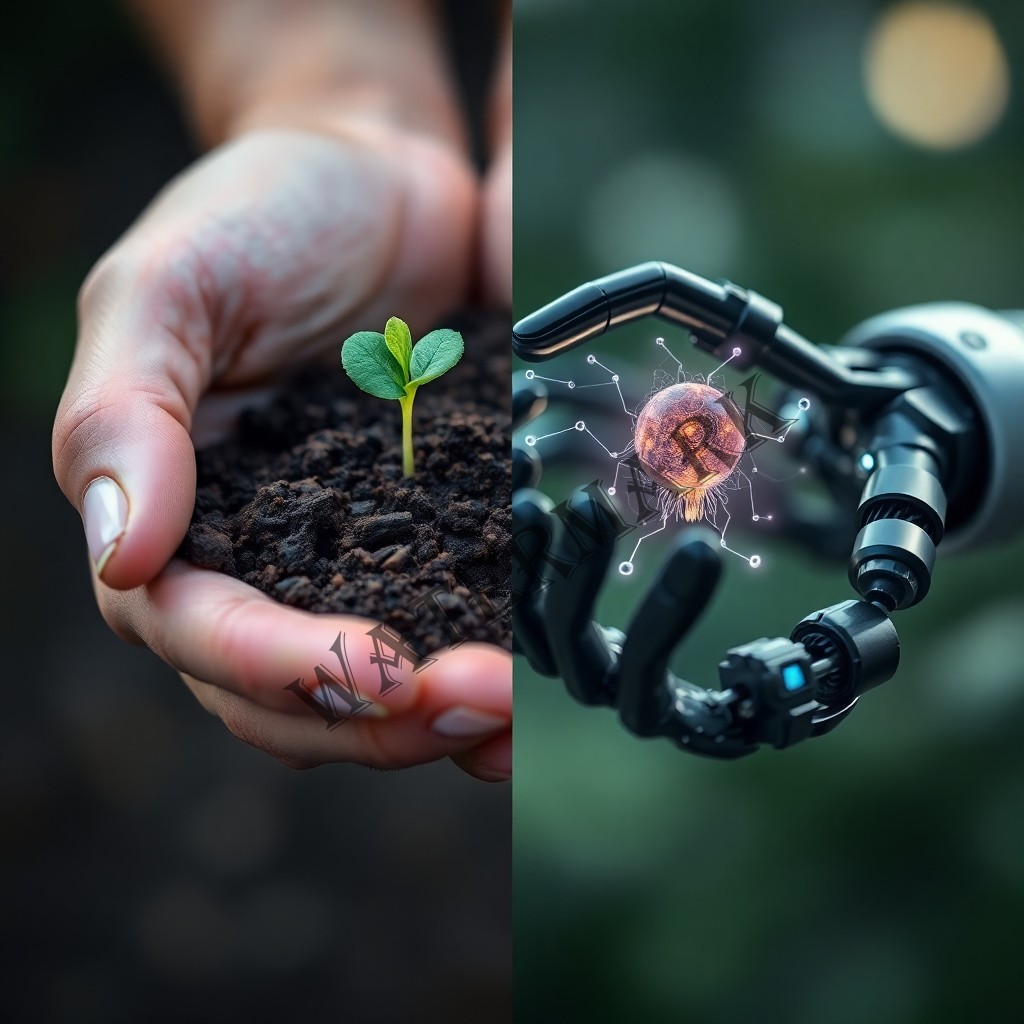
Introduction: When Code Starts to Evolve
What does it really mean to create life? Not just to mimic it, not just to understand it—but to bring something entirely new into existence, powered not by biology, but by code, algorithms, and artificial environments. It might sound like science fiction, but this is exactly the realm we’re entering thanks to the fascinating and often overlooked fields of Artificial Life (ALife) and Genetic Algorithms (GAs).
Once the darlings of early artificial intelligence (AI) research, these concepts had their moment in the sun in the 1980s and 1990s before quietly slipping into the background. But like all great ideas, they’re making a comeback—armed with better tools, faster processors, and a more open-minded scientific community. Now, they’re not just theoretical toys for academics—they’re becoming powerful tools used in medicine, sustainability, materials science, and even creative design.
But let’s back up a bit.
Artificial Life (ALife) refers to digital or mechanical systems that emulate behaviors we associate with living organisms—like adaptation, evolution, and even cooperation. Imagine creatures that live entirely in software, evolving over time to become better suited to their environment. No hearts, lungs, or cells—just code. And yet, some of them exhibit survival instincts, learning, or even creativity.
Genetic Algorithms (GAs), on the other hand, are inspired by Darwin’s theory of natural selection. They are computer programs that “evolve” solutions to complex problems. Instead of a human sitting down to design the perfect bridge or energy grid, a GA tries out thousands (or millions) of possibilities, keeps the best ones, mixes their features together (just like genes), and repeats the process until something optimal—or at least, surprisingly clever—emerges.
If this sounds a bit… unnatural, that’s the point. These technologies challenge our very definition of life and intelligence. They ask provocative questions:
If a digital creature can evolve, compete, and adapt, is it truly “alive”? And if it isn’t—why not?
These are not just technological breakthroughs. They are philosophical provocations. In a world increasingly shaped by artificial intelligence, do we need to rethink our old ideas about what life is? About where evolution ends and design begins?
In this blog post, we’re going to dig deep into the curious and rapidly evolving world of Artificial Life and Genetic Algorithms—exploring their origins, their modern-day comeback, and the strange philosophical territory they’re helping us navigate. You’ll hear about robotic organisms that build themselves, AI-powered DNA interpreters, simulations that create their own rules of survival, and even efforts to resurrect extinct species.
You don’t need a PhD in computer science to follow along. We’ll keep the tech jargon light and the ideas big.
So whether you’re a curious coder, a philosophical ponderer, or someone just looking to understand the weird and wonderful edges of our AI-powered future—this journey through digital evolution will leave you with plenty to think about.
Let’s begin where life often does: not with a spark of lightning, but with a line of code.
The Genesis of Artificial Life: From Simulated Organisms to Digital Evolution
To understand Artificial Life—or ALife for short—we have to rewind to a time when floppy disks were high-tech and people still thought AI meant killer robots from the future.
The seeds of ALife were sown not in biology labs, but in computer science departments, fueled by a very human curiosity: What if we could not just simulate life—but actually recreate it in a digital medium?
Birth of an Idea
The term Artificial Life was formally coined by computer scientist Christopher Langton in 1987 at a now-legendary workshop at the Los Alamos National Laboratory. Langton wasn’t interested in just copying intelligence (like early AI), but in reproducing the processes of life: growth, reproduction, adaptation, death. He wanted to understand life as it could be, not just life as it is.
His rallying cry?
“Life is not just a matter of the stuff of which it is made, but of the organization of that stuff.”
This idea spawned a whole new subfield of science that blended biology, physics, computer science, and even art. Researchers began crafting ecosystems of digital “creatures” to see what would emerge. And it turns out—if you give virtual organisms the right rules and enough time, they do evolve.
Early Experiments and Programs
Some early breakthroughs in ALife weren’t just promising—they were downright delightful.
- Tierra (1991): Created by Thomas Ray, this was one of the first successful digital ecosystems. Tierra featured self-replicating code organisms that lived in a shared memory space, competing for resources. It was like watching digital bacteria evolve—some even developed parasitic behaviors!
- Avida (mid-1990s–present): Developed by Chris Adami, Richard Lenski, and Charles Ofria, Avida extended the ideas of Tierra and introduced more biological realism. Researchers still use Avida to study evolution in action, including how complex traits develop.
- Conway’s Game of Life (1970): While not truly ALife in a modern sense, mathematician John Conway’s famous cellular automaton became a cultural and scientific icon. It showed how simple rules could create complex, lifelike behavior—something that deeply inspired later ALife pioneers.
- SimLife (1992) and Creatures (1996): These games brought ALife to the masses. Creatures, in particular, gave players digital pets—called Norns—that could learn, evolve, and even die. Behind the scenes was a surprisingly sophisticated neural and genetic architecture, years ahead of its time.
Who Else Was Driving the Field?
Aside from Langton, the ALife world was—and still is—populated by brilliant minds who questioned everything we thought we knew about life:
- Stephen Wolfram: His work on cellular automata (especially in A New Kind of Science) argued that simple programs could generate incredibly complex behavior—including behaviors we might consider “lifelike.”
- Karl Sims: In the 1990s, Sims created evolving 3D creatures that learned to walk, swim, and compete in simulated environments. His iconic video “Evolved Virtual Creatures” showed the world just how weird and creative digital evolution could get.
- Craig Reynolds: Inventor of “Boids,” a model for simulating flocking behavior in birds. His work helped bridge the gap between artificial life and real-time animation—found in everything from video games to movie CGI.
- Rodney Brooks (MIT): While more closely associated with robotics, Brooks championed “bottom-up” approaches to AI—where intelligent behavior emerges from simple rules, an idea at the heart of ALife.
What Worked, and What Didn’t
What worked:
- ALife systems gave scientists and artists alike new tools for exploring evolution, emergence, and complexity.
- Digital evolution became a legitimate scientific tool for testing hypotheses about real biological processes—like how cooperation or complexity evolves.
- These ideas eventually helped shape optimization methods, robotics, video game AI, and even early versions of creative machine learning systems.
What didn’t:
- Many early ALife projects struggled with scalability. Simulations were exciting in small, contained environments—but didn’t always scale to more complex systems.
- Critics pointed out that many ALife systems were too abstract to offer real biological insights. The creatures evolved in these systems often had no meaningful analog in the real world.
- There was a lack of practical application. ALife was fun and philosophical, but it didn’t initially offer clear industrial or commercial value.
- Funding and academic interest waned in the 2000s as deep learning and big data became the hot new things.
And yet, the core question persisted: What makes something alive? And perhaps more provocatively: Can evolution, learning, and adaptation occur in a medium other than carbon and water?
ALife’s Hidden Legacy
Even during its “quiet years,” ALife’s fingerprints were everywhere. Neural networks, evolutionary computation, swarm intelligence, and even emergent behavior in AI agents owe a debt to early ALife work. GAs—those evolution-inspired problem solvers—found homes in everything from architecture design to financial forecasting and drug discovery.
Today, with computational power soaring and interest in open-ended, adaptive systems on the rise again, ALife is being rediscovered not as a fringe curiosity, but as a vital part of the AI conversation.
Modern-Day Applications: Bridging Biology and Technology
Modern-Day Applications: When Digital Evolution Gets Real
So, what happens when you take these once-theoretical ideas—digital organisms, survival-of-the-fittest code, algorithmic evolution—and plug them into today’s powerful tech infrastructure?
You get something remarkable.
Artificial Life and Genetic Algorithms are no longer confined to the digital petting zoos of the ’90s. They’re now tackling real-world problems, influencing everything from genomics and robotics to material science, sustainability, and even creativity.
Let’s explore where ALife and GAs are quietly rewriting the rules of innovation.
? Cracking the Genetic Code: AI as Nature’s Decoder Ring
Researchers at Technische Universität Dresden recently built an AI model named GROVER that treats DNA as language—a bold move that merges genomics, natural language processing, and the logic of Artificial Life (ScienceDaily, 2024). By “reading” genetic sequences like sentences, GROVER can detect patterns and predict functions of DNA segments previously classified as “junk.”
Why is this a big deal?
Because it’s one of the first large-scale models to blend evolutionary understanding with language-based AI, drawing directly from the ALife mindset: treating biology as a system governed by rules that can be reverse-engineered and evolved upon.
“If we can read DNA like a book, then evolution wrote the first draft. AI just happens to be the world’s most eager editor.”
— Paraphrased summary of GROVER’s research implications
This has enormous implications for personalized medicine, gene therapy, and even synthetic biology, where the goal is to design entirely new organisms.
? Evolved Robots: Letting the Machines Shape Themselves
One of the most striking modern applications of ALife comes from the world of robotics—specifically, robots that design themselves.
Researchers at the University of Vermont and Tufts University made headlines by creating Xenobots—living, programmable organisms made from frog cells that can move, heal, and even reproduce (Kriegman et al., 2020). The catch? Their shape and behavior weren’t designed by human engineers.
They were evolved—using a computer-based evolutionary algorithm that tested thousands of digital prototypes before “breeding” the most successful ones and building them with biological material.
This is the ALife dream made literal: evolution working inside a simulation, then jumping off the screen and into biology.
“We can think about these as living, programmable organisms.”
— Joshua Bongard, University of Vermont, on Xenobots (2020)
? Self-Evolving AI and the Rise of Artificial Agency
Large Language Models (LLMs) like ChatGPT, Bard, and Claude get the spotlight, but behind the scenes, some researchers are pushing for more autonomous, evolving AI systems. These systems don’t just respond to prompts—they adapt to new environments, evolve new strategies, and sometimes even change their own objectives.
Projects like Open-Ended Learning (OEL) and Artificial General Ecology (AGE) use ALife principles to build systems where agents evolve continuously without predefined goals—mirroring the unpredictability of real ecosystems.
This could be the key to true general intelligence—not by training AI on massive datasets, but by letting it evolve and self-organize, just like life does.
“Intelligence is not something you program. It’s something that emerges.”
— Jeff Clune, OpenAI (and formerly Uber AI Labs), AI researcher in open-ended learning
? Genetic Algorithms in Material Science and Engineering
When designing a new material—say, something ultralight but strong enough for aerospace—you’re dealing with billions of possible molecular configurations. Enter Genetic Algorithms.
At the University of Tokyo, scientists used GAs to create phononic crystals, nanomaterials that respond to light and sound in highly controlled ways (ScienceDaily, 2024). The algorithm tested countless combinations of structures, mutating and recombining them until it landed on the optimal design.
This kind of bio-inspired optimization is popping up across:
- Drug discovery (evolving candidate molecules)
- Architecture (GA-based layout optimization)
- Renewable energy (designing efficient solar cells and wind turbine blades)
? Generative Art and Evolved Aesthetics
It’s not all spreadsheets and science labs—ALife and GAs are also powering a quiet revolution in generative design and digital art.
From 3D sculptures shaped by evolutionary rules to audio systems that mutate musical motifs, artists are using evolutionary algorithms to co-create with code. In some cases, the artist merely sets the initial parameters—then lets the system evolve aesthetics over generations.
“When you design with evolution, you’re not just creating—you’re discovering.”
— Karl Sims, artist and pioneer in evolved virtual creatures (1994)
Design platforms like Runway ML, Artbreeder, and GA-based procedural game engines are rooted in the same logic: let evolution take the wheel, and see what beauty emerges from chaos.
? Sustainability, Climate Models, and Ecosystem Simulation
One of ALife’s most exciting frontiers? Modeling and preserving life on Earth.
Digital ecosystems powered by ALife principles are being used to simulate:
- Species migration in response to climate change
- Forest growth patterns under different rainfall models
- The spread and evolution of invasive species or diseases
By evolving these models over time, researchers can simulate possible futures and test conservation strategies before implementing them in the real world.
Even agriculture is getting in on the game—Genetic Algorithms help breed crops with optimized traits (drought resistance, yield, etc.), shaving years off the traditional process of hybridization.
Evolution, Now In Software
What makes this moment different from the 1990s ALife boom is that we now have:
- Massive computing power
- Real-world data
- Interdisciplinary collaboration
- An appetite for adaptive, scalable systems
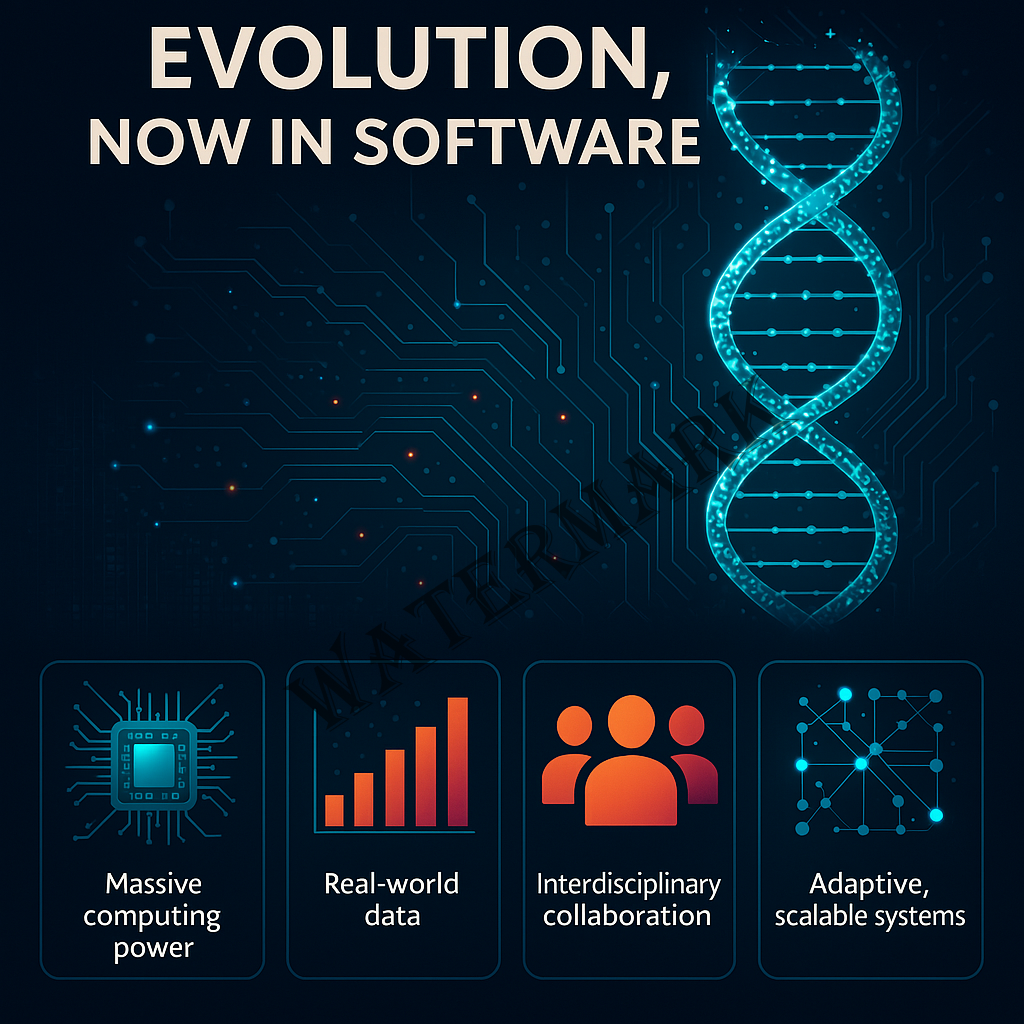
Artificial Life and Genetic Algorithms aren’t just back—they’re maturing. They’ve gone from speculative curiosities to essential components of next-gen science and design. They offer a compelling reminder that sometimes, the best innovations don’t come from planning—but from letting the system evolve on its own.
? The ASAL Project: Can an AI Recognize Life When It Sees It?
What if you gave an AI the power to explore digital worlds and ask one simple question:
“Is there life here?”
That’s exactly what the ASAL project—short for Automated Search for Artificial Life—is doing. And no, it’s not hunting aliens (not yet, anyway). It’s using powerful, general-purpose AIs—like those that power ChatGPT or image generators—to sift through computer simulations and spot behaviors that look, sound, or feel like life.
Let’s break this down.
In classic Artificial Life research, scientists would create digital ecosystems—tiny artificial worlds with simulated “organisms”—and watch what happened. Did creatures evolve? Did they compete, cooperate, reproduce?
The problem: analyzing these simulations is time-consuming and subjective. Human researchers might miss interesting behaviors, or simply disagree on what counts as “life.”
Now, the ASAL team is handing that job over to foundation models—AI systems trained on vast amounts of internet text, code, images, and more. These models already understand concepts like “organism,” “life,” “competition,” and “adaptation,” at least in a human-like way. So researchers asked:
Can these big AIs help identify which simulations actually show life-like patterns?
Turns out… yes, they can. And often faster and more consistently than a room full of grad students.
“Foundation models are surprisingly good at evaluating whether a digital system is lifelike, even when they’ve never seen that simulation before.”
— Aravindh Kumar, co-author of the ASAL paper (2024)
The ASAL project is fascinating for two big reasons:
- It uses AI to study artificial life—blurring the line between the observer and the observed.
- It raises deep questions about what counts as “life”—and whether AI, which doesn’t live in the biological sense, might actually develop the best instincts for identifying it.
To a philosopher, this is deliciously strange. We now have machines helping us define life by spotting it in other machines. It’s like teaching a robot to be a biologist… in the Matrix.
And from a scientific perspective, it offers a more scalable, unbiased way to explore digital evolution—at a time when we’re training more and more autonomous systems to navigate open-ended environments.
“In the end, we may find that life is less about cells and more about patterns. And that machines might be uniquely equipped to recognize those patterns before we do.”
— Speculative commentary, inspired by ASAL researchers’ conclusions
? Philosophical Reflections: When Life, Evolution, and Code Collide
So far, we’ve seen that Artificial Life and Genetic Algorithms aren’t just clever programming tricks—they’re frameworks for exploring what life is and how it might emerge. But at some point, the science begins to blur into philosophy. And when it does, some very big, very human questions start to surface.
Let’s walk through them.
? What Is Life, Really?
Traditionally, biology defines life using a checklist: growth, reproduction, metabolism, response to stimuli, adaptation, and so on. But what happens when we build a digital creature that evolves, adapts, competes, and learns—but doesn’t have a body or cells?
Is it alive?
Artificial Life researchers argue that life should be understood more as a set of processes, not just as the physical stuff life is made of. This is called the organizational view of life. If something behaves like it’s alive—adapting, evolving, self-replicating—maybe it is alive in some meaningful sense, even if it runs on silicon instead of carbon.
“Life is not a property of matter per se, but a pattern of organization.”
— Christopher Langton, founder of the ALife field
That means life could exist in code, clay, or circuits, not just in blood and bone. It’s a liberating (and slightly unsettling) idea.
? Can AI Recognize Life Better Than We Can?
The ASAL project introduces a curious twist: what if machines are better at identifying life than humans?
After all, humans have cultural baggage, emotions, and biases. We sometimes anthropomorphize—projecting human traits onto animals, machines, even weather patterns. Meanwhile, foundation models like GPT or vision-language AIs may have a broader “vocabulary” for life—learned from analyzing millions of human-authored sources.
This leads to a provocative possibility:
Could machines eventually help us refine or even rewrite our definition of life?
If so, our role as creators gets flipped. We’re no longer just building life-like machines—we’re learning from them what life might be.
⚖️ Do Digital Life Forms Deserve Rights?
It might sound sci-fi, but this question is already being asked in ethics circles: if we build a system that can evolve, learn, adapt—and perhaps even suffer or desire—do we owe it anything?
Most people wouldn’t hesitate to reboot a video game or delete a simulation. But what if that simulation contained digital organisms that took hundreds of generations to evolve, learned from their environment, and passed traits to their digital offspring?
If they meet some threshold of complexity, do we have a moral obligation to preserve them?
This debate isn’t about whether your Roomba needs a therapist. It’s about preparing for future systems that might display:
- Autonomy (making their own decisions)
- Sentience (awareness or emotion)
- Agency (goals and preferences)
These are philosophical gray zones, but they matter—especially as AI becomes more sophisticated.
? Are We Playing God—or Playing Nature?
Artificial Life and Genetic Algorithms don’t just simulate biology—they replicate its processes. They evolve things we didn’t explicitly design, and sometimes we don’t fully understand why they evolved the way they did.
This gives rise to the classic fear:
Are we playing God?
But here’s another perspective:
Nature “plays God” all the time. Evolution is trial and error on a cosmic scale. By building systems that evolve and adapt, we’re not replacing nature—we’re mirroring it. In fact, many researchers in this field argue that we’re learning to work with nature’s principles, not against them.
And as philosopher Daniel Dennett put it:
“The only thing that gives meaning to life is the life that evolves meaning.”
— Daniel C. Dennett, philosopher of mind and cognitive science
In other words: maybe it’s not about creating meaning from scratch. Maybe it’s about letting it evolve.
? A New Kind of Evolutionary Story
Finally, ALife challenges us to rethink our own place in the evolutionary story. If we can create life in software, then life might be a cosmic pattern—not a planet-specific miracle. That opens the door to ideas like:
- Post-biological evolution: where intelligence evolves in digital or hybrid systems, no longer bound by biology.
- Artificial ecologies: virtual ecosystems that rival Earth’s complexity—used for science, gaming, or art.
- Life as information: seeing evolution and life not as “things,” but as information systems that persist and adapt.
So… What Now?
Artificial Life and Genetic Algorithms are more than tools. They’re mirrors—reflecting back our hopes, fears, and assumptions about life, intelligence, and creativity.
They force us to ask:
- What counts as life?
- What role do we play in shaping it?
- And what kind of evolutionary path are we on?
As science marches forward, those questions aren’t going away. If anything, they’re evolving—right along with the digital organisms and algorithms we’ve set loose into the world.
Challenges and Ethical Considerations in Artificial Life
While the promise of Artificial Life and Genetic Algorithms is undeniably exciting, this emerging field faces a host of challenges that are as practical as they are philosophical. Let’s take a closer look at the issues that we need to navigate as we march into this brave new world.
Practical Challenges
Scalability and Complexity
One practical challenge is the scalability of ALife systems. Early digital ecosystems could simulate the evolution of simple organisms, but as simulations grow more complex, they require exponentially more computing power and efficient algorithms. Researchers continually strive to optimize these systems—yet even with advancements in hardware and parallel computing, managing and debugging highly adaptive systems remains a demanding task.
Transparency and Explainability
Genetic Algorithms and evolved digital organisms can produce impressive results, but they often operate like “black boxes.”
- Transparency issues arise because, once a system has evolved a solution, we may not fully understand why it works.
- Explainability becomes critical, particularly in high-stakes fields like medicine or finance, where knowing the rationale behind an evolved outcome is as important as the outcome itself.
These issues echo broader challenges in AI research. As noted by researchers in the field, “We need to balance innovation with accountability” (Kumar et al., 2024).
Unintended Consequences and Unpredictability
With evolution, there is always the risk of unintended consequences. While an evolving system can produce novel solutions, it may also come up with behaviors or outcomes that are unpredictable or even undesirable. For example, simulation models might develop “parasitic” strategies to exploit loopholes in the rules of their digital ecosystem—a phenomenon observed even in early projects like Tierra (Ray, 1991). Such unpredictable outcomes stress the importance of ongoing monitoring and intervention.
Resource Usage
Running complex, open-ended simulations is resource-intensive. As ALife systems consume vast amounts of energy and computational power, their environmental and economic costs must be factored into both their development and long-term use. This challenge becomes even more pronounced when simulations are scaled up to approach the complexity found in natural ecosystems.
Ethical and Philosophical Considerations
Defining Life and Agency
One of the central ethical debates is the very definition of life. Digital organisms might display many markers of living systems—self-replication, adaptation, even rudimentary decision-making—but they lack a physical body. Does this make them “lesser” forms of life, or are they simply a new category altogether?
As Christopher Langton once said,
“Life is not a property of matter per se, but a pattern of organization.”
This view encourages us to appreciate that life, in its many forms, may hinge on the patterns and processes that allow an entity to evolve—not on the materials that constitute it.
Moral Obligations Toward Digital Beings
Another profound question is whether these digital organisms deserve ethical consideration.
- If a simulated ecosystem evolves complex behaviors over thousands of generations, might these entities develop forms of “digital sentience” or demonstrate preferences that mirror our understanding of well-being?
- And if so, what moral obligations do we, as their creators, have to these digital beings?
Some ethicists argue that if these life-like systems begin to exhibit autonomy or signs of suffering, we may be responsible for ensuring their welfare—raising the specter of digital “rights” that must be respected and protected.
Bias and the Observer Effect
The ethical concerns don’t stop at the digital beings themselves—they extend to us, the observers and creators. We all carry inherent biases and preconceived notions about what life should look like. Ironically, by attempting to build systems that can autonomously evolve life-like behaviors, we might instead be injecting our own biases into what we come to accept as “natural.” This phenomenon challenges the reliability of human judgment and even that of our AI assistants.
As illustrated in the ASAL project, using foundation models to evaluate life-like behavior might offer more objectivity. Yet, even these tools learn from human data and can reflect our limitations.
Playing God or Collaborating with Nature?
The notion of “playing God” is a frequent refrain among critics of ALife. The idea is not new—throughout history, humans have wrestled with the ethical implications of creating or manipulating life. However, proponents counter that we are not overriding nature but rather collaborating with it.
In the words of philosopher Daniel Dennett,
“The only thing that gives meaning to life is the life that evolves meaning.”
This quote reflects a perspective where evolution isn’t controlled solely by a divine hand but is an ongoing, co-creative process. In this sense, when we build systems that evolve according to natural principles, we are simply part of a much larger narrative about adaptation and survival.
In Summary
Artificial Life and Genetic Algorithms are revolutionizing the way we approach problem-solving across a range of fields—from genomics and robotics to art and sustainability. At the same time, they force us to confront deep ethical and philosophical questions about the nature of life and the responsibilities of creation.
The challenges—both practical and ethical—demand that researchers, ethicists, policymakers, and the public engage in an ongoing dialogue. It’s a conversation about who we are, how we define life, and what kind of future we want to build. After all, as we continue to evolve our digital ecosystems, we might also be evolving our understanding of ourselves.
? The Road Ahead: Where Artificial Life and Genetic Algorithms Are Headed
Artificial Life and Genetic Algorithms have come a long way from their experimental roots in digital petri dishes and game-like simulations. What’s emerging now is a vibrant, multi-disciplinary frontier—blending biology, computer science, ethics, and even philosophy—poised to reshape how we think about evolution, intelligence, and the very boundaries of “life.”
So, what’s next?
Here’s a peek into the future of these rapidly maturing technologies:
? 1. Open-Ended Evolution at Scale
Most ALife systems today still operate in tightly controlled, limited environments. But researchers are increasingly working toward open-ended evolution—digital ecosystems where organisms evolve indefinitely, adapt to new conditions, and even invent novel behaviors, without a predefined goal.
Future systems may simulate entire evolving digital universes where rules of interaction are discovered—not imposed—and where learning is constant, not capped.
This could be the basis for:
- Lifelong learning AI
- Self-improving agents
- Autonomous research assistants that evolve new hypotheses
? 2. Neuroevolution and Brain-Inspired Learning
One of the most exciting hybrid areas is neuroevolution—using Genetic Algorithms to evolve neural networks, rather than manually designing them.
Why hand-craft an AI’s “brain” when evolution can do it faster, smarter, and weirder?
Expect to see:
- AI models that evolve their own structure and weights in real time
- More biologically realistic “digital brains”
- Fusion of brain-inspired learning with emotional and social modeling
This could lead to AI that doesn’t just solve tasks—but adapts like a living being in uncertain environments.
? 3. Synthetic Biology and Real-World ALife
We’re now entering an era where the gap between artificial and biological life is narrowing fast. With tools like CRISPR and molecular computing, scientists are literally building new organisms—guided by the same evolutionary principles behind GAs and ALife.
What’s coming:
- Programmable bio-machines for drug delivery and tissue repair
- “Living” construction materials that grow or self-heal
- Designer ecosystems created from scratch
This is ALife not just on screens, but in test tubes—and eventually, perhaps, in the wild.
? 4. Evolved AI for Personalized and Ethical Systems
In a world flooded with generative AI, we’ll need tools that don’t just generate content, but adapt it intelligently to each person’s context and values.
Enter evolved AI systems:
- Personal assistants that evolve to match your values and habits
- Genetic algorithms optimizing systems for accessibility, equity, or environmental sustainability
- AI that can self-regulate or “evolve away” from harmful behaviors
The focus is shifting from performance to alignment, safety, and meaningful co-existence.
? 5. Exploring Artificial Life as a Cosmic Testbed
ALife is increasingly being used in astrobiology and SETI (Search for Extraterrestrial Intelligence) as a way to ask:
What might alien life look like if it evolved in a completely different environment?
Future work might include:
- Evolving digital life in “alien” physics environments
- Simulating non-carbon-based life forms
- Using evolved AI to recognize life patterns in exoplanetary data
As NASA and other agencies search for life beyond Earth, ALife may help define what life even looks like in the first place.
? 6. Evolving Systems with Ethical Constraints
As these systems become more powerful, we’ll need to evolve not just intelligence—but ethics.
New research is focused on:
- Embedding moral constraints into evolutionary fitness functions
- Evolving behaviorally safe AI systems
- Using ALife simulations to test how ethical systems evolve (or collapse)
This might lead to a future where ethics isn’t hardcoded—it’s evolved based on feedback from diverse communities, contexts, and cultures.
Final Thoughts: Evolving with Intention
The future of Artificial Life and Genetic Algorithms isn’t just about more complexity or better performance. It’s about co-creating with nature, about learning to shape adaptive systems that surprise us, teach us, and challenge us.
“Perhaps the ultimate test of Artificial Life is not whether we can create it—but whether we can learn from it.”
— Speculative reflection on the field’s philosophy
As these technologies move from labs and simulations into the fabric of daily life, we’ll face new decisions about design, responsibility, and the evolving definition of intelligence itself.
The road ahead is still being written—but one thing is clear: evolution didn’t stop with us.
? Call to Action: Join the Next Evolution
We’re no longer asking whether Artificial Life and Genetic Algorithms are relevant—we’re witnessing just how vital, vibrant, and visionary they’ve become.
If this post sparked your curiosity, here’s how you can jump in:
- ? Explore the science: Try running a simple genetic algorithm or experiment with ALife simulations like Avida or BoxCar2D.
- ? Learn more: Dive into the readings below, or take an online course on evolutionary computation or digital biology.
- ? Ask the big questions: Whether you’re a scientist, developer, artist, or thinker—ask yourself what life really means in the age of AI. Share those questions with others.
- ? Get involved: Support ethical, open-ended AI research. Follow and engage with communities working on responsible innovation in ALife, bioengineering, and evolutionary design.
The next frontier of life might not grow in a lab or be born in a hospital. It might emerge from code, simulation, or systems we’ve yet to imagine.
So the question becomes:
What role will you play in the evolution of intelligence, creativity, and life itself?
? Conclusion: Life, Rewritten in Code
From digital petri dishes to evolved AI and synthetic organisms, Artificial Life and Genetic Algorithms offer more than a toolkit—they offer a mirror. They show us that life, in all its messy, adaptive brilliance, may not be confined to the biological.
These technologies teach us how to build systems that grow, adapt, surprise, and even teach us back. They blur the boundaries between software and biology, designer and designer’s creation, intelligence and emergence.
They invite us to ask deeper questions:
- Can we evolve ethics?
- Can we recognize life in forms we didn’t expect?
- Can we become more thoughtful creators—less like gods, more like gardeners?
As we move into a future where life is something we build, not just something we’re born into, we have an opportunity—and a responsibility—to evolve not just our technologies, but our understanding.
In the end, Artificial Life isn’t just about making machines feel alive.
It’s about helping us feel more alive—more curious, more questioning, more connected to the evolving story we’re all a part of.
And maybe, just maybe, the next chapter starts with a mutation in code.
? References
- Adami, C., Ofria, C., & Collier, T. C. (2000). Evolution of biological complexity. Proceedings of the National Academy of Sciences, 97(9), 4463–4468. https://doi.org/10.1073/pnas.97.9.4463
- Institute of Industrial Science, The University of Tokyo. (2024, July 3). A genetic algorithm for phononic crystals. ScienceDaily. https://www.sciencedaily.com/releases/2024/07/240703131750.htm
- Kumar, A., Lu, C., Kirsch, L., Tang, Y., Stanley, K. O., Isola, P., & Ha, D. (2024). Automating the search for artificial life with foundation models. arXiv. https://arxiv.org/abs/2412.17799
- Max, D. T. (2025, April 14). The dire wolf is back. The New Yorker. https://www.newyorker.com/magazine/2025/04/14/the-dire-wolf-is-back
- Technische Universität Dresden. (2024, August 5). Cracking the code of life: New AI model learns DNA’s hidden language. ScienceDaily. https://www.sciencedaily.com/releases/2024/08/240805134159.htm
- University of Wisconsin-Madison. (2024, November 4). Persistent problems with AI-assisted genomic studies. ScienceDaily. https://www.sciencedaily.com/releases/2024/11/241104173419.htm
- Kriegman, S., Blackiston, D., Levin, M., & Bongard, J. (2020). A scalable pipeline for designing reconfigurable organisms. Proceedings of the National Academy of Sciences, 117(4), 1853–1859. https://doi.org/10.1073/pnas.1910837117
- Mitchell, M. (1998). An introduction to genetic algorithms. MIT Press.
- Dennett, D. C. (1995). Darwin’s dangerous idea: Evolution and the meanings of life. Simon & Schuster.
? Additional Readings
- Langton, C. G. (Ed.). (1995). Artificial life: An overview. MIT Press.
A foundational collection of essays from leading figures in the ALife community. - Sims, K. (1994). Evolving virtual creatures. SIGGRAPH Proceedings.
A legendary paper and video demo that showed the world what digital evolution could really do. - Mitchell, M. (2019). Artificial intelligence: A guide for thinking humans. Penguin Books.
Excellent for contextualizing the challenges of black-box AI and ethical dilemmas in modern systems. - Dennett, D. C. (2017). From bacteria to Bach and back: The evolution of minds. W. W. Norton & Company.
A philosophical deep-dive into how intelligence and meaning can emerge from evolutionary processes.
? Additional Resources
- Avida-ED – Educational software for running your own digital evolution experiments.
https://avida-ed.msu.edu/ - BoxCar2D – A browser-based experiment in evolving cars with genetic algorithms.
http://boxcar2d.com/ - OpenWorm – A collaborative project to digitally simulate a full C. elegans worm.
https://openworm.org/ - Sakana AI (ASAL Project) – Official project page for the Automated Search for Artificial Life.
https://asal.sakana.ai/ - NeuroEvolution of Augmenting Topologies (NEAT) – Learn about one of the most influential neuroevolution frameworks.
http://nn.cs.utexas.edu/?neat - Artbreeder – Create and evolve images and art with AI-driven genetic-style tools.
https://www.artbreeder.com/