


For 600 years, the Voynich Manuscript has stumped experts. Now AI is taking its shot—and learning humility. What happens when algorithms meet medieval mystery?
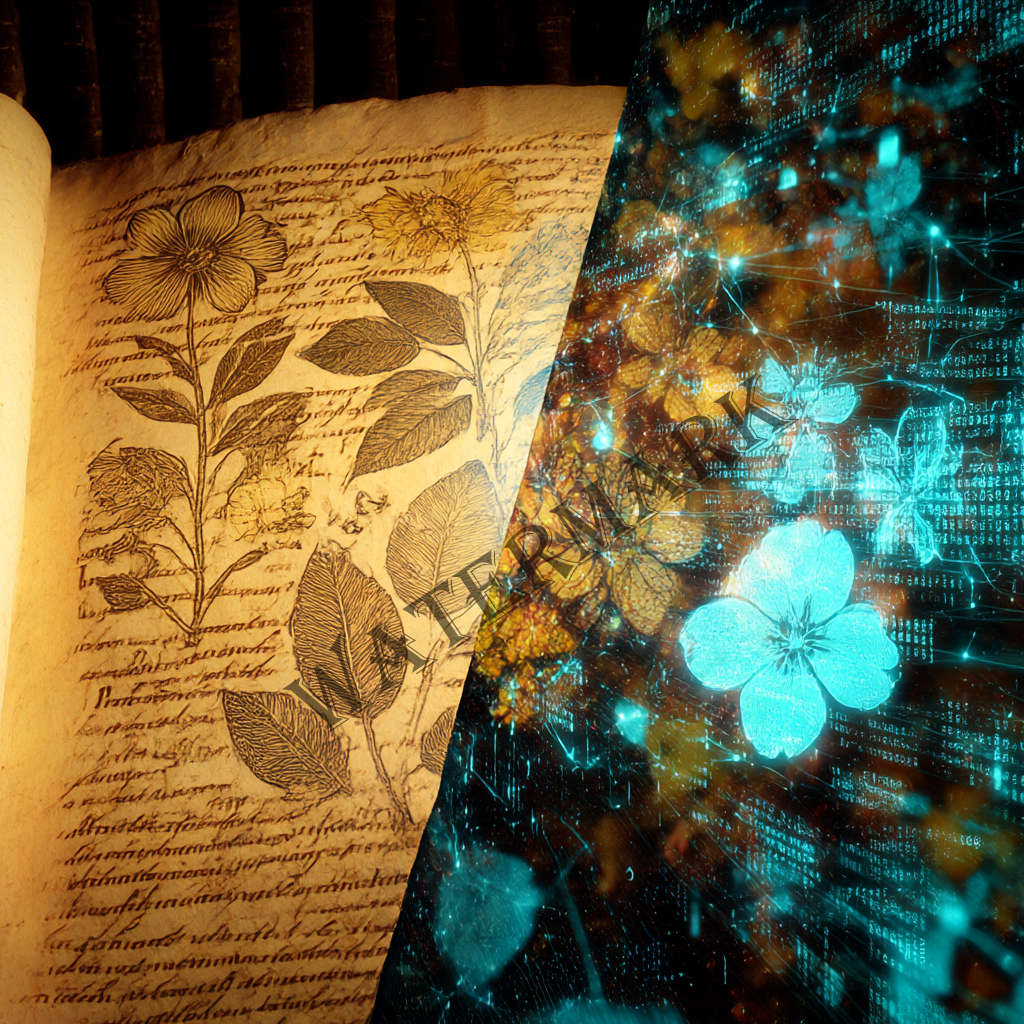
Picture this: It’s 1912, and a Polish book dealer named Wilfrid Voynich is rummaging through a dusty Jesuit college near Rome when he stumbles upon something extraordinary. Hidden among forgotten volumes lies a manuscript covered in elegant, flowing script—except the script belongs to no known alphabet. Its pages bloom with botanical illustrations of plants that don’t exist, astronomical charts depicting impossible star systems, and diagrams of nude figures swimming through bizarre networks of tubes. The text runs smoothly, confidently, as if the author knew exactly what they were saying. But for the past 600 years, no one else has had a clue.
Welcome to the Voynich Manuscript: history’s most exquisite middle finger to human comprehension.
Fast-forward to today, and we live in an era where artificial intelligence can translate between 100+ languages in seconds, generate photorealistic images from text descriptions, and beat grandmasters at chess while simultaneously composing poetry. Surely, in this golden age of computational wizardry, we can crack one medieval book, right?
Well, spoiler alert: we can’t. Not yet, anyway. And the journey of watching cutting-edge AI repeatedly face-plant against this 600-year-old puzzle reveals something profound about the limits of even our most sophisticated technology—and what it actually takes to unlock the past.
Chapter One: The Manuscript That Time Forgot
The Voynich Manuscript consists of 240 pages of vellum (calfskin parchment) that radiocarbon dating has confirmed came from animals that died between 1404 and 1438—placing its creation squarely in the early 15th century, during the twilight of the medieval period. The manuscript now resides at Yale University’s Beinecke Rare Book and Manuscript Library, where it has been housed since 1969, and has been fully digitized for researchers worldwide.
But what makes this particular medieval codex so maddeningly fascinating isn’t just its age—it’s what’s inside.
The manuscript is divided into distinct sections, each more bewildering than the last. The botanical section, taking up nearly half the book with 113 detailed illustrations, depicts plants that experts cannot identify—leaving scholars to wonder if they represent lost species, fictional creations, or purely symbolic representations. The astronomical pages feature zodiac symbols surrounded by rings of naked women. There are biological diagrams showing interconnected vessels and organ-like structures. And through it all runs that elegant, mysterious script: Voynichese.
The text itself appears remarkably consistent. There are no obvious corrections or cross-outs. Words are separated by spaces. The flow suggests natural language. Statistical analyses have revealed sophisticated linguistic patterns, including non-random word co-occurrences and syntactic structures that would be extraordinarily difficult to fabricate manually without computational aids available only after the 1940s.
Lisa Fagin Davis, executive director of the Medieval Academy of America and one of the world’s leading Voynich scholars, has examined the manuscript in person more than half a dozen times. By applying principles of Latin paleography to the Voynichese writing system, Davis has identified five separate hands at work in the manuscript, revealing it to be a much more collaborative production than previously assumed.
“It’s an actual object, it exists in space and time, it has a history, it has physical characteristics, and because of that, it has a true story,” Davis told Yale Library. “We just don’t know what that true story is yet.”
This is where AI enters our story—stage left, confidently striding toward what looks like a solvable puzzle, algorithms humming with possibility.
Chapter Two: When Silicon Met Parchment
In 2018, a team of computing scientists at the University of Alberta—professor Greg Kondrak and graduate student Bradley Hauer—made international headlines by claiming their AI had cracked the code. Using natural language processing algorithms, they ran the manuscript’s text through a comparison with the “Universal Declaration of Human Rights” in 380 different languages.
Kondrak, a professor of Computing Science at the University of Alberta and a Fellow at the Alberta Machine Intelligence Institute, specializes in computational linguistics and cryptography—exactly the skill set you’d want for tackling an ancient cipher. In his computational cryptography classes, he teaches students about everything from Caesar ciphers to modern encryption, always emphasizing the intersection of language and computer science.
Their AI indicated Hebrew was the most likely source language. The researchers hypothesized the cipher was based on alphagrams—rearranging letters in alphabetical order while dropping vowels. When they attempted to unscramble the first 10 pages, they found that over 80 percent of the words appeared in a Hebrew dictionary.
The translated first sentence? “She made recommendations to the priest, man of the house and me and people.”
Weird, yes. But also… possibly meaningful?
However, Kondrak himself acknowledged the limitations: “It turned out that over 80 per cent of the words were in a Hebrew dictionary, but we didn’t know if they made sense together.” Unable to find Hebrew scholars to validate their findings, the team resorted to using Google Translate—a move that immediately raised eyebrows in the academic community.
And therein lies the first crucial lesson about AI and ancient mysteries: pattern recognition isn’t understanding.
The Voynich community’s response was swift and skeptical. Medievalist Damian Fleming of Indiana University–Purdue University Fort Wayne was among those who expressed frustration on social media, specifically critiquing the decision to use Google Translate rather than consult actual Hebrew scholars. Kondrak himself admitted that early responses from Voynich specialists hadn’t been positive: “I don’t think they are friendly to this kind of research”.
The problem wasn’t that the AI was wrong, necessarily—it was that it couldn’t explain why it arrived at its conclusions, nor could it verify whether those conclusions made any semantic sense. The algorithm could match patterns to Hebrew, but it couldn’t tell you if the resulting sentences were gibberish or revelation.
This is the dirty secret of modern machine learning: AI is extraordinarily good at finding correlations, but it’s often terrible at understanding causation or meaning.
Chapter Three: The Transformer Revolution (Still Stumped)
But wait, you might be thinking—that was 2018, ancient history in AI years. Surely the transformer models that power ChatGPT and its ilk have changed the game?
Well, yes and no.
In their comprehensive 2023 survey “Machine Learning for Ancient Languages,” published in Computational Linguistics, researchers including Thea Sommerschield and Yannis Assael note that “advances in artificial intelligence and machine learning have enabled analyses on a scale and in a detail that are reshaping the field of humanities, similarly to how microscopes and telescopes have contributed to the realm of science”.
Modern approaches leveraging transformer models—the same architecture behind ChatGPT—have shown promise with ancient texts. These systems excel at understanding language patterns across different contexts through their attention mechanisms, which allow them to focus on the most relevant parts of data and understand context in ways traditional models cannot.
The key insight? AI works spectacularly well when you have two things: lots of training data and established linguistic patterns to learn from.
Consider DeepMind’s Ithaca system for restoring damaged ancient Greek inscriptions. When expert historians worked alone to restore ancient texts, they achieved 25% accuracy. But when using Ithaca, their performance leaped to 72%. The system has become so useful that over 300 researchers query it weekly, and educational institutions have integrated it into their curricula.
But here’s the catch: Ithaca works because we understand ancient Greek. We have thousands of examples. We know the grammar, the vocabulary, the cultural context. The AI isn’t translating unknown text—it’s filling in gaps in a known language using pattern matching at superhuman scale.
The Voynich Manuscript offers none of these advantages. Despite intensive research and multiple AI approaches using natural language processing, the manuscript remains resistant to decipherment. Recent studies in 2024 have explored whether sections of the manuscript might relate to gynecological topics or reproduction, based on its illustrations, but the text itself continues to elude comprehension.
Chapter Four: The Ethical Maze of Digital Archaeology
Here’s where things get philosophically thorny.
When we point AI at ancient texts, we’re not just extracting information—we’re making interpretive choices that shape how we understand entire cultures and historical periods. And those choices come freighted with ethical implications we’re only beginning to grapple with.
As researchers noted in a 2024 article in Internet Archaeology, AI algorithms analyzing archaeological data could inadvertently lead to biased interpretations of historical events or reinforce existing power structures if the models aren’t designed with ethical considerations in mind. There’s the potential harm of fostering a linguistic monoculture and unintentionally strengthening existing power structures.
Think about it: if an AI trained predominantly on Western European languages tries to decode an ancient text, might it impose Western linguistic structures where none existed? Important ethical considerations include issues of data ownership, the cultural sensitivity of ancient texts, and the potential for misinterpretation or misuse of decoded information.
The Voynich Manuscript exists in this ethical gray zone precisely because we don’t know its origins. Is it a serious scientific treatise? A medieval joke? Someone’s elaborate fantasy world-building? Without context, any “translation” risks imposing our modern assumptions onto something that might have meant something entirely different to its creators.
The reliance on AI raises questions about data quality and representation. The scarcity of labeled data necessary for training AI models can hinder progress. The integration of technology into historical research necessitates a careful balancing act between machine efficiency and the nuanced understanding that human scholars bring to the table.
Walter Scheirer, professor in the Department of Computer Science and Engineering at the University of Notre Dame, put it eloquently in describing his team’s work on medieval manuscripts: “We’re dealing with historical documents written in styles that have long fallen out of fashion, going back many centuries, and in languages like Latin, which are rarely ever used anymore. You can get beautiful photos of these materials, but what we’ve set out to do is automate transcription in a way that mimics the perception of the page through the eyes of the expert reader”.
That phrase—”mimics the perception of the expert reader”—is crucial. AI can process. It can correlate. It can match patterns. But can it understand in the way a human scholar who has spent years immersed in a historical period can understand? Can an algorithm grasp the cultural nuances, the political contexts, the private jokes of a 15th-century scribe?
The answer, at least for now, seems to be: not really.
Chapter Five: What the Voynich Teaches Us About AI’s Limits
The Voynich Manuscript has become more than just an unsolved mystery—it’s become a litmus test for the actual capabilities versus the marketing promises of artificial intelligence.
And that test is revealing.
In 2024, new research using multispectral imaging revealed previously hidden columns of letters on the manuscript’s first page—attempts by an earlier owner, Johannes Marcus Marci in the 1660s, to decrypt the text. Even 350 years ago, brilliant minds were attempting the same pattern-matching we’re trying today, just with different tools.
Lisa Fagin Davis, who studied the newly revealed writing, noted: “Linguists and cryptologists continue to apply sophisticated analytics to the text in order to discern underlying patterns, but to no avail so far. The more data we have, as revealed by these scans, the more the work can move forward”.
There’s that word again: patterns. It’s what AI does brilliantly. But the Voynich has patterns that lead nowhere, or everywhere, or in circles. The text exhibits statistical properties of natural language while simultaneously defying every attempt to map it onto actual language families.
The most promising approach to decoding ancient scripts merges machine learning technology with traditional linguistic expertise. Machine learning can process and analyze data at speeds and scales unimaginable to human scholars, but human linguists play an irreplaceable role in interpreting these findings, applying cultural, historical, and contextual knowledge that AI lacks.
Consider what AI can’t do with the Voynich:
It can’t provide historical context. An algorithm doesn’t know that 15th-century northern Italy was a hotbed of alchemical experimentation, Renaissance humanism, and cryptographic innovation. It doesn’t understand why someone might encode knowledge during this period, or what knowledge would have been considered dangerous enough to hide.
It can’t evaluate plausibility. When the Alberta team’s AI suggested a sentence about recommendations to priests, a human scholar would immediately ask: Does this fit the manuscript’s illustrations? Does it match the social structures of the period? Is this linguistically coherent with what we know about medieval Hebrew?
It can’t handle unique or unprecedented cases well. AI learns from examples. The Voynich, by its very nature, might be a linguistic one-off—a constructed language, an elaborate cipher with rules we’ve never seen before, or something else entirely. There’s no training data for “weird things someone invented once in 1420.”
As the comprehensive survey in Computational Linguistics emphasizes, the goal should be promoting and supporting “the continued collaborative impetus between the humanities and machine learning,” highlighting how “active collaboration between specialists from both fields is key to producing impactful and compelling scholarship”.
Chapter Six: The Future of the Undecipherable
So where does this leave us? With a 600-year-old book that has defeated everyone from 17th-century alchemists to 21st-century neural networks?
Not quite.
The Voynich Manuscript’s resistance to AI decryption isn’t a failure of technology—it’s a reminder that some mysteries require more than computational power. They require imagination, intuition, cultural understanding, and the willingness to sit with uncertainty.
In 2024 alone, more than 150,000 online users searched for the Voynich Manuscript on Yale Library’s digital collections—making it the third-most popular search. The manuscript continues to captivate precisely because it remains unsolved. In an age where AI can answer almost any question, there’s something profoundly human about our fascination with the questions it can’t.
Recent developments offer glimmers of hope—or at least new directions for research. Davis’s finding that the manuscript pages are probably not in their original order could be crucial. Linguists like Yale Professor Claire Bowern are now building on these findings to analyze whether different scribes were writing in different languages or dialects—or even whether some scribes were writing a real language while others were not.
This is detective work that requires human judgment calls at every step. An AI can help analyze the paleographic evidence, but it takes a human scholar to recognize that the binding doesn’t match the content, to notice that certain sections use different writing styles, to hypothesize that pages have been shuffled.
The real breakthrough might come not from better AI, but from better collaboration between AI and humans. As David Stork, an adjunct professor at Stanford who has pioneered machine learning applications in art history, wrote in Nature in 2023, applying AI methods at scale will do for art and historical scholars what the microscope has done for biologists and the telescope for astronomers—but only if we remember that tools, no matter how sophisticated, still need skilled hands to wield them.
Epilogue: What We Learn from What We Can’t Read
Standing here in 2024, staring at Voynich’s enigmatic pages through our high-resolution screens and cutting-edge algorithms, perhaps the manuscript’s greatest gift isn’t the mystery of what it says but what it reveals about us.
It reminds us that human ingenuity extends in both directions—backward into history, where anonymous scribes created something so clever it still defeats our best efforts, and forward into the future, where we keep building new tools to satisfy our relentless curiosity.
It teaches us that pattern recognition, no matter how sophisticated, isn’t the same as understanding. That correlation isn’t causation. That matching 80% of words to a dictionary doesn’t mean you’ve captured 80% of the meaning.
Most importantly, it demonstrates that some of the most valuable work happens in the spaces between disciplines: where medieval scholars meet machine learning engineers, where paleographers collaborate with computational linguists, where the humanities and technology stop viewing each other as adversaries and start working as partners.
The Voynich Manuscript will likely be decoded someday. Maybe it’ll be an AI that makes the crucial breakthrough. Maybe it’ll be a human scholar who recognizes a pattern everyone else missed. Most likely, it’ll be a combination—human intuition guiding algorithmic analysis, computational power revealing details that lead to human insights.
Until then, the manuscript sits in its climate-controlled vault at Yale, its pages available to anyone with an internet connection, its secrets still locked behind those elegant, flowing characters. A reminder that for all our technological prowess, for all our neural networks and transformer models and natural language processors, some doors to the past remain stubbornly closed.
And maybe that’s okay. Maybe we need a few mysteries that remind us we haven’t figured everything out yet. That the past still has surprises. That intelligence—artificial or otherwise—still has its limits.
The book nobody can read keeps teaching us lessons, even if we don’t know what it says.
References
- Assael, Y., Sommerschield, T., Shillingford, B., Bordbar, M., Pavlopoulos, J., Chatzipanagiotou, M., Androutsopoulos, I., Prag, J., & de Freitas, N. (2022). Restoring and attributing ancient texts using deep neural networks. Nature, 603(7900), 280-283. https://doi.org/10.1038/s41586-022-04448-z
- Kondrak, G., & Hauer, B. (2016). Decoding anagrammed texts written in an unknown language and script. Transactions of the Association for Computational Linguistics, 4, 75-86.
- Sabar, A. (2024, September). The woman who’s still trying to solve the Voynich Manuscript. The Atlantic. https://www.theatlantic.com/
- Sommerschield, T., Assael, Y., Pavlopoulos, J., Stefanak, V., Senior, A., Dyer, C., Bodel, J., Prag, J., Androutsopoulos, I., & de Freitas, N. (2023). Machine learning for ancient languages: A survey. Computational Linguistics, 49(3), 703-747. https://doi.org/10.1162/coli_a_00481
- Tenzer, M., Pistilli, G., Brandsen, A., & Shenfield, A. (2024). Debating AI in archaeology: applications, implications, and ethical considerations. Internet Archaeology, 67. https://doi.org/10.11141/ia.67.8
- University of Arizona. (2011, February 10). Experts determine age of book ‘nobody can read’. Phys.org. https://phys.org/news/2011-02-experts-age.html
- Yale University Library. (2024). Alumna joins the long search to unlock an enigmatic 15th-century manuscript. https://library.yale.edu/news/
Additional Reading
- Clemens, R., & Harkness, D. (Eds.). (2016). The Voynich Manuscript. Yale University Press.
- Davis, L. F. (2020). How many glyphs and how many scribes? Digital paleography and the Voynich Manuscript. Manuscript Studies: A Journal of the Schoenberg Institute for Manuscript Studies, 5(1), 164-181.
- Kennedy, G., & Churchill, R. (2024). For 600 years the Voynich manuscript has remained a mystery—now, researchers think it’s partly about sex. The Conversation. https://phys.org/news/2024-04-years-voynich-manuscript-mystery-sex.html
- Pelling, N. (2006). The Curse of the Voynich: The Secret History of the World’s Most Mysterious Manuscript. Compelling Press.
- Zandbergen, R. (2024). Voynich MS – Various topics. Voynich.nu. https://www.voynich.nu/
Additional Resources
- Beinecke Rare Book & Manuscript Library – Voynich Manuscript Digital Collection
High-resolution scans of the complete manuscript, freely accessible to researchers worldwide
https://collections.library.yale.edu/catalog/2002046 - Medieval Academy of America
Professional organization advancing medieval studies, led by Dr. Lisa Fagin Davis
https://themedievalacademy.org/ - Alberta Machine Intelligence Institute (Amii)
Research institute where Dr. Greg Kondrak serves as a Fellow, advancing NLP and machine learning
https://www.amii.ca/ - Machine Learning for Ancient Languages Workshop (ML4AL)
Academic workshop fostering collaboration between computer scientists and humanities scholars
https://www.ml4al.com/ - Manuscript Road Trip Blog
- Dr. Lisa Fagin Davis’s blog promoting medieval manuscript collections in North America
- https://manuscriptroadtrip.wordpress.com/

Leave a Reply