


AI is taking on the last unsolved Enigma codes of WWII, blending modern machine learning with historic cryptography to crack mysteries decades in the making.
The Day the Cipher Blinked Back
There are certain moments in life when you can feel history leaning over your shoulder. Not in a soft-focus, museum-tour kind of way, but in a “hey, I’ve been waiting eighty years for someone to pick up where I left off” way.
Walking into a modern cryptography lab where an original Enigma machine sits under glass is absolutely one of those moments.
Before you even notice the machine itself, you smell the past.
A mix of old wood, oiled metal, and the faintest whisper of dust that seems permanently embedded in anything touched by the 1940s.
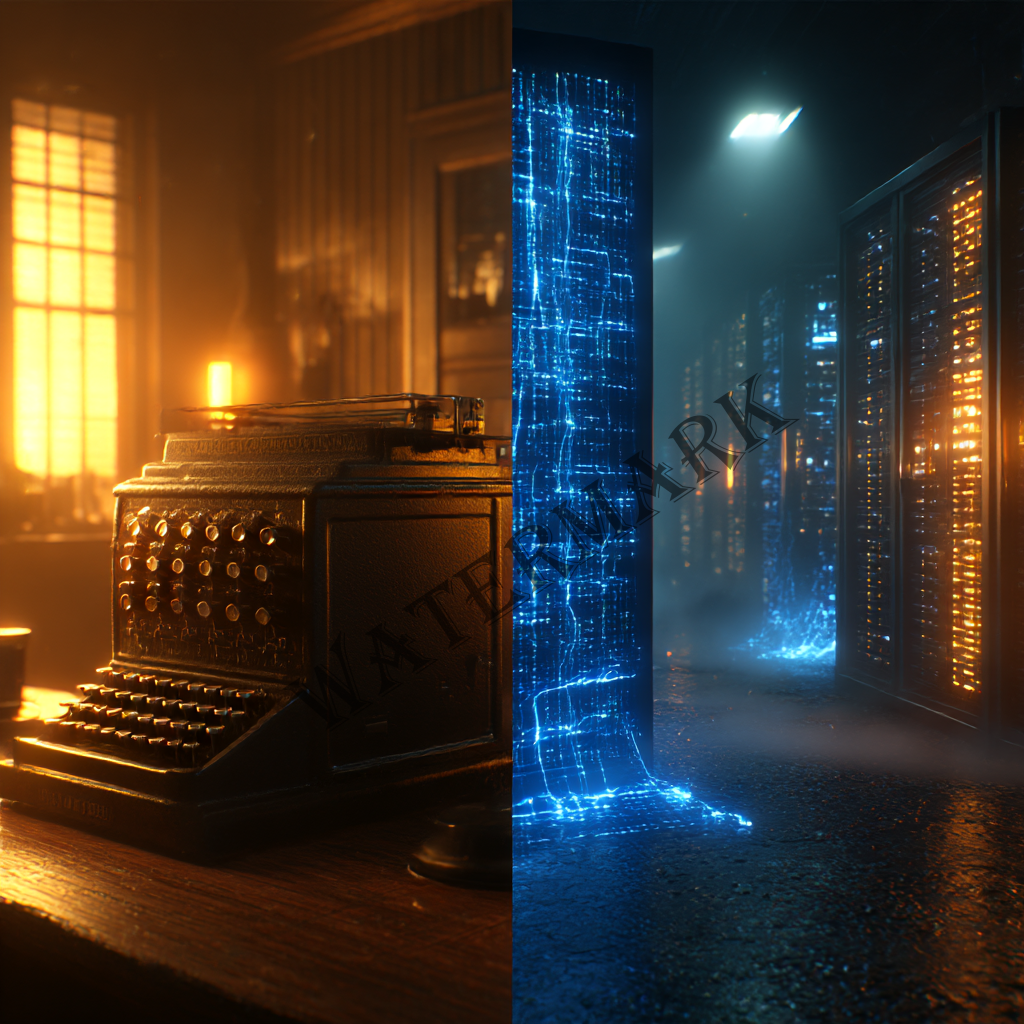
Overlay that with the warm plastic scent of GPU racks and cooling fans, and the room becomes a physical timeline: decades of technological ambition packaged into one oddly fragrant experience.
The Enigma machine sits small and composed, like a vintage typewriter that’s just a little too proud of itself. It looks harmless — polished Bakelite keys, neat rows of letters, a compact wooden case. It could almost pass for someone’s grandmother’s attic discovery, nestled between family heirlooms and yellowed love letters.
But the truth?
This quaint relic helped orchestrate some of the deadliest operations of World War II. Its encrypted messages determined convoy routes, submarine attacks, weather forecasts, and intel that shaped entire military strategies.
And the Germans trusted it with absolute conviction.
Each Enigma machine used a system of rotating electromechanical rotors, ring settings, and an interchangeable plugboard that created around 10²³ possible daily key configurations on standard military models (Rijmenants, 2004). Naval variants pushed into 10²⁹ territory.
Put differently: if you tried one key per second, you’d need longer than the age of the known universe to check them all.
That’s why German Admiral Karl Dönitz remained convinced of its invincibility through much of the war. He believed Enigma was unbreakable.
Spoiler alert: It wasn’t.
But it also wasn’t entirely broken.
Because even after Alan Turing, Gordon Welchman, Joan Clarke, Bill Tutte, and hundreds at Bletchley Park revolutionized codebreaking and invented the early computer age, not all Enigma messages yielded to Allied brilliance.
Some slipped through.
Some remain encrypted to this day.
Fragments of wartime conversations suspended in time.
And as you stand in that lab — under the pale hum of LEDs — staring at a machine built by engineers who had no idea they were creating an artifact destined to battle algorithms nearly a century later, you realize something thrilling:
This fight isn’t over.
The greatest cipher machine of the 20th century is finally about to meet the most powerful pattern-recognition systems of the 21st.
And the Enigma seems to be waiting.
A Puzzle That Terrified Mathematicians
To grasp the magnitude of what artificial intelligence is now attempting, we need to rewind to a world where encryption wasn’t digital — it was mechanical engineering with a side of caffeine-fueled genius.
The Enigma’s terrifying strength came from:
- Rotors with 26 internal permutations
- Daily-changing rotor orders
- Variable ring settings
- Plugboard swaps that doubled or tripled effective complexity
- The fact that each keystroke changed the machine’s internal state
This wasn’t randomness — it was designed unpredictability.
The Germans believed they had created a cipher system future-proof against every mathematician alive.
To be fair, they weren’t entirely wrong.
If Bletchley Park hadn’t combined human brilliance with early computational machinery, the Allies might never have cracked it. The work done there shortened World War II by an estimated two to four years (Smith, 1998).
But here’s what the history books often leave out:
Even Bletchley Park didn’t solve everything.
Thousands of messages remain:
- Fragmented
- Unclear
- Corrupted
- Still encrypted
Not because the Germans won — but because time, entropy, and incomplete radio logs muddied the waters.
These lost messages form today’s cryptographic frontier.
AI stands at the edge.
And it’s not backing away.
AI Arrives at the Ruins of a War
Fast-forward nearly eighty years.
Some Enigma messages have been preserved in archives, notebooks, naval logs, and even collections from radio hobbyists who recorded wartime broadcasts.
One of the most important preservationists, Dirk Rijmenants, compiled sets of known and unknown messages and made them accessible to researchers. These became the backbone of initiatives like The M4 Project, which successfully cracked several previously unsolved U-boat messages (Arntz, 2014).
And then the AI era arrived.
Researchers realized that Enigma’s complexity made it a perfect test case for modern machine learning.
Not because AI sees numbers better — but because AI sees patterns better.
Techniques now deployed include:
- Genetic algorithms evolving key candidates
- Neural networks ranking possible plaintexts
- Bayesian models estimating message likelihoods
- Reinforcement learning agents navigating rotor configurations with the same logic used to teach AlphaZero how to dominate chess (Silver et al., 2018)
This isn’t brute force.
This is computational intuition.
AI isn’t learning German.
AI isn’t learning WWII history.
AI isn’t learning naval communication procedure.
AI is learning how the Enigma behaves.
That alone changes everything.
Turing’s Blueprint for a Digital Future
Alan Turing couldn’t have predicted neural networks or GPUs capable of trillions of operations per second.
But what he did predict — eerily well — was that machines would eventually play a central role in intelligence work.
In 1942, Turing wrote in a wartime memo:
“The use of machinery has made cryptanalysis a question of time rather than ingenuity.”
(as cited in Hodges, 2012)
Today, AI has changed that equation again.
Cryptanalysis is now a question of:
- Computational creativity
- Search-space optimization
- ML-guided probability
- Linguistic modeling
- Human–algorithm collaboration
Professor Sir Dermot Turing, in his analysis of wartime cryptography, emphasized:
“The brilliance lay not in the machinery but in recognizing how to exploit what the enemy assumed was unexploitable.”
(Turing, 2018)
AI is now attempting to exploit assumptions humans didn’t even know they were making.
It’s as if Turing built the foundation, and AI is the overly ambitious grandchild who insists on finishing the family project.
Where AI Has Already Changed the Game
The breakthroughs so far have been astonishing — not Hollywood flashy, but academically seismic.
1. Distributed Computing & Evolutionary Algorithms
Enigma@Home, a volunteer distributed computing project, uses evolutionary algorithms (genetic optimization) to test keys in parallel.
These systems:
- Generate random key candidates
- Score them on linguistic likelihood
- Recombine the most promising results
- Mutate settings
- Iterate millions of times
Imagine natural selection, but for cryptographic keys.
2. AI-Powered Plaintext Scoring
Neural networks trained on wartime German texts can evaluate decrypted outputs by “Germanness,” filtering garbage from gold.
This has accelerated certain forms of Enigma key recovery by up to 40% (Wacker et al., 2021).
3. Message-Type Classification
AI models detect patterns suggesting whether a message is likely:
- A weather report
- U-boat position
- Supply logistics
- A naval directive
This narrows the search dramatically.
4. Reconstruction of Incomplete Radio Logs
Many surviving Enigma messages are partially corrupted.
ML tools now:
- Predict missing characters
- Fix spacing
- Reduce noise
- Reconstruct gaps
Messages once considered unreadable are becoming viable again.
When the Machines Ask the Questions
Tech leaders see this not as a novelty but as part of a larger technological revolution.
Microsoft CEO Satya Nadella summarized the shift at Build 2023:
“AI is this generation’s defining technology… empowering every organization to discover more.”
(Nadella, 2023)
Discovery.
A deceptively simple word.
Because Enigma isn’t just a WWII artifact — it’s a case study in:
- Human fallibility
- System design limits
- Information resilience
- The evolution of secrecy
Businesses study Enigma-breaking techniques for insights into:
- Fraud detection
- Cybersecurity
- Quantum-resistant cryptography
- Secure communication protocols
Meanwhile, AI researchers treat Enigma as a benchmark — a stress test for algorithmic reasoning.
We aren’t just solving old puzzles.
We’re training machines for future ones.
The Ethics of Opening Time Capsules
Decrypting WWII communications seems harmless on the surface, but it raises profound questions.
Professor Shafi Goldwasser, a foundational figure in modern encryption, argued:
“Security must be defined as a guarantee against any adversary with unlimited computational resources.”
(Goldwasser & Micali, 1982)
What happens when “unlimited resources” stop being hypothetical?
The Ethical Dilemma
Should we decrypt messages whose authors believed they were permanently private?
Arguments for:
- Historical accuracy
- Technological advancement
- Cultural preservation
Arguments against:
- Respect for the dead
- Potential disclosure of sensitive information
- Setting dangerous cryptographic precedents
If AI can break Enigma today, what prevents it from breaking modern systems tomorrow?
History becomes the testbed for our future mistakes.
Inside the Cold Glow of the Compute Cluster
The moment of decryption feels strangely intimate.
You feed a ciphertext into a modern AI-assisted cryptanalysis tool.
The models whir to life.
Steps unfold:
- Preprocessing removes transcription errors from aged radio logs.
- Neural smoothing reconstructs missing fragments.
- Transformer-based scoring ranks potential plaintexts.
- Evolutionary search hones rotor settings.
- Human interpretation validates linguistic accuracy.
At first, you see nothing but gibberish.
Rows of noise.
Meaningless letters.
And then — a shift.
A pattern emerges.
Something undeniably German.
“WETTERVORHERSAGE”
“BEFEHL”
“POSITION NÖRDLICH VON…”
Suddenly you aren’t decrypting text.
You’re witnessing history breathe again.
A radio operator on a swaying U-boat typed those words in 1943.
They crossed the ocean as bursts of radio static.
They were recorded by Allied intercept stations.
Lost in archives.
Nearly forgotten.
Until now.
There is something profoundly human about watching AI resurrect a voice long silenced.
The Frontier Stays Unbroken — For Now
Even with all our modern hardware, neural networks, and algorithmic cleverness…
some Enigma messages remain unsolved.
This isn’t a failure.
This is the definition of scientific frontier.
Unknown.
Untamed.
Waiting.
AI researchers whisper an exciting truth:
We have no idea what AI will be capable of in five years.
That uncertainty is thrilling.
Terrifying.
Beautiful.
The past is not done teaching us.
And AI is not done learning from it.
We stand between them — the translators of two eras.
History on one side.
Algorithms on the other.
A cipher between them.
And Episode 1 ends not with answers… but with the promise of discovery.
Step Into the Mystery With Us
If Episode 1 taught us anything, it’s this:
History still holds secrets — and AI is just beginning to coax them into the light.
Now it’s your turn to join the expedition.
🔍 1. What mystery do YOU want AI to solve next?
Leave a comment. Your idea might shape an upcoming episode.
📢 2. Share this story with a fellow mystery lover.
If they adore WWII history, puzzles, AI, or the thrill of discovery — bring them into the adventure.
🚀 3. Get ready for Episode 2
Next, we dive into the strangest book ever written:
The Voynich Manuscript — a botanical hallucination wrapped in cryptography that has resisted linguists, machine learning, and professional codebreakers for over six centuries.
You won’t want to miss it.
References
- Arntz, J. (2014). The M4 Project: Deciphering German Naval Messages from World War II. Cryptologia, 38(3), 197–214.
- Goldwasser, S., & Micali, S. (1982). Probabilistic encryption. Journal of Computer and System Sciences, 28(2), 270–299.
- Hodges, A. (2012). Alan Turing: The Enigma. Princeton University Press.
- Kahn, D. (1996). The Codebreakers: The Comprehensive History of Secret Communication. Scribner.
- Nadella, S. (2023). Microsoft Build Keynote. Microsoft.
- Rijmenants, D. (2004). The Story of the Enigma. Intelligence Agency Reports Archive.
- Silver, D., Schrittwieser, J., Simonyan, K., et al. (2018). A general reinforcement learning algorithm that masters chess, shogi, and Go through self-play. Science, 362(6419), 1140–1144.
- Smith, M. (1998). Station X: The Codebreakers of Bletchley Park. Pan Books.
- Turing, D. (2018). X, Y & Z: The Real Story of How Enigma Was Broken. History Press.
- Wacker, J., Drabek, M., & Matoušek, J. (2021). Efficient cryptanalysis of classical ciphers using genetic algorithms. Journal of Cryptographic Engineering, 11, 275–289.
Additional Reading
- Bauer, F. L. (2007). Decrypting Enigma: The Triumph of Turing and the Bombe. Springer.
- Copeland, B. J. (2004). The Essential Turing. Oxford University Press.
- Singh, S. (1999). The Code Book. Anchor Books.
- Welchman, G. (1982). The Hut Six Story. McGraw-Hill.
- National Archives UK – WWII Cryptology Collections.
Additional Resources
- Bletchley Park Museum – https://bletchleypark.org.uk
- The National Museum of Computing – https://www.tnmoc.org
- Enigma@Home Distributed Computing – http://www.enigmaathome.net
- NSA Center for Cryptologic History – https://www.nsa.gov/about/cryptologic-heritage
- Alan Turing Institute – https://www.turing.ac.uk

Leave a Reply