


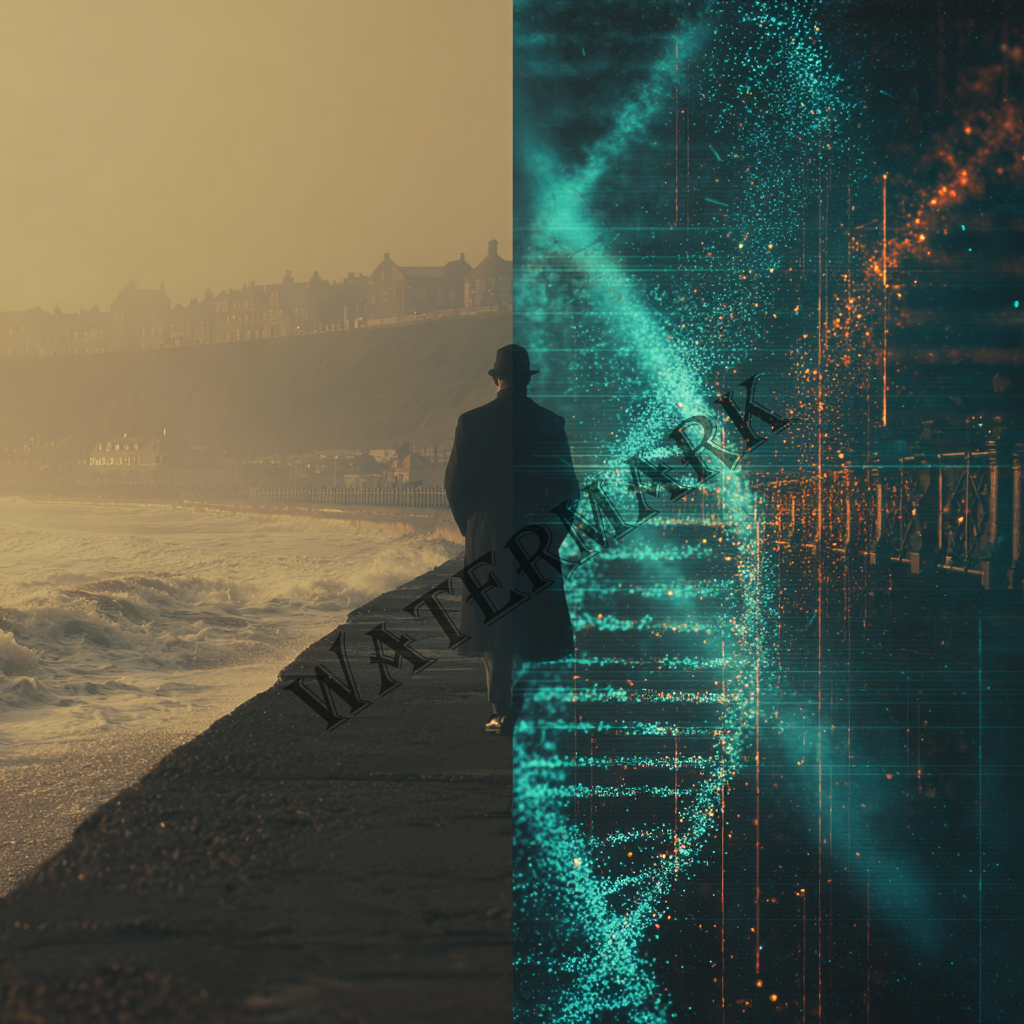
For 74 years, the Somerton Man remained nameless. Then forensic genetic genealogy, DNA databases, and a 4,000-person family tree finally cracked the case.
Prologue: December 1, 1948
Picture this: Two young men training to become jockeys take their morning run along Somerton Beach in Adelaide, Australia. The sun is just creeping over the horizon, painting the sky in shades of amber and rose. They spot what looks like a sleeping man, impeccably dressed in a suit and tie, leaning against the seawall. Perhaps he’d had too much to drink the night before. Perhaps he was just catching the sunrise.
Except he wasn’t sleeping. He was dead. And thus began one of the most confounding mysteries in modern forensic history—a puzzle that would take 74 years, millions of DNA data points, and a family tree containing over 4,000 names to finally solve.
The man had no identification. The labels had been meticulously cut from his clothing. In his pocket was a scrap of paper torn from a rare edition of the Rubáiyát of Omar Khayyam, bearing two words in Persian: “Tamám Shud”—it is ended.
For seven decades, the Somerton Man remained a ghost. Was he a spy caught in the first chill of the Cold War? A jilted lover? The victim of an elaborate murder plot? Theories multiplied like fractal patterns, each more elaborate than the last, but the truth remained elusive. His fingerprints matched no database. His face sparked no recognition. Even his dental work provided no clues. It was as if the man had materialized on that beach fully formed, with no past and no future—just an ending.
And then, in July 2022, an electrical engineer from the University of Adelaide named Derek Abbott, working with renowned American forensic genealogist Colleen Fitzpatrick, finally gave the Somerton Man a name: Carl “Charles” Webb, a 43-year-old electrical engineer and instrument maker from Melbourne.
This is the story of how they did it—and what it reveals about the revolutionary intersection of digital forensics, DNA genealogy databases, and artificial intelligence that’s transforming cold case investigation from educated guesswork into computational certainty.
Chapter One: When Traditional Methods Hit a Wall
Let’s be honest: For most of modern history, cold cases stayed cold because investigators simply ran out of leads. You could dust for fingerprints all you wanted, but if those prints weren’t in the database, you were stuck. You could circulate photographs and dental records, but without someone to recognize them, you might as well be shouting into the void.
The Somerton Man case epitomized this frustrating reality. In 1948, South Australian police did everything right according to the investigative playbook of the era. They took fingerprints and sent them to the FBI—no match. They examined his teeth—distinctive enough (the man had hypodontia, a rare condition affecting only 2% of the population), but no one came forward. They distributed photographs widely—no identification. They analyzed the mysterious encrypted code found in a copy of the Rubáiyát discovered in the back seat of an unlocked car near the beach—still uncracked to this day.
The case attracted obsessives for decades. In 1995, Derek Abbott, then a young professor, came across the case while reading a magazine in a laundromat. Like so many before him, he was hooked. But Abbott had something the earlier investigators didn’t: time on his side. By 2009, when he began his serious investigation, the world of forensic science was on the cusp of a revolution.
“I essentially think about him every day,” Abbott later reflected, describing his decades-long obsession with the case. What started as intellectual curiosity evolved into a personal quest that would eventually intertwine his own life with the mystery in unexpected ways.
Chapter Two: The DNA Revolution and Its Limitations
Here’s where things get technically fascinating. Traditional forensic DNA analysis relies on Short Tandem Repeats (STRs)—specific sequences of DNA that vary between individuals. When a crime scene sample contains enough biological material and hasn’t degraded too badly, investigators can extract these STRs and compare them against CODIS (Combined DNA Index System), the national DNA database containing profiles from convicted offenders and arrestees.
But the Somerton Man presented multiple problems. First, by the time Abbott’s team got serious about extracting DNA in 2009, the body had been buried for 61 years. DNA degrades over time, especially when exposed to moisture and bacteria in soil. Second, even if they could extract usable DNA, CODIS only helps if the person or a close family member is in the database. Carl Webb had no criminal record and no living close relatives in the system.
This is where the computational revolution in genetics becomes crucial. In December 2017, Abbott’s team at the Australian Centre for Ancient DNA extracted mitochondrial DNA from hair samples embedded in the plaster death mask that had been made of the Somerton Man’s face in 1949. They discovered he belonged to haplogroup H4a1a1a—possessed by only 1% of Europeans. Interesting, certainly, but not enough to identify him.
The real breakthrough would require a different approach entirely: not looking for exact matches, but for relatives.
Chapter Three: Enter Forensic Genetic Genealogy
While Abbott was methodically working the Somerton Man case, an entirely new field was emerging in the United States. Colleen Fitzpatrick, a nuclear physicist turned forensic genealogist, had founded Identifinders International and pioneered techniques that combined DNA analysis with traditional genealogical research.
Fitzpatrick’s credentials are formidable. With a PhD in Nuclear Physics from Duke University and 25 years developing high-resolution laser measurement techniques for NASA and the Department of Defense, she brought serious scientific rigor to genealogy. In 2017, she co-founded the DNA Doe Project, a nonprofit dedicated to identifying John and Jane Does through genetic genealogy. She’s worked on some of the highest-profile identification cases in modern forensic science—from the Unknown Child of the Titanic to Northwest Flight 4422 crash victims.
But it was the 2018 Golden State Killer case that proved forensic genetic genealogy could crack cases that had stumped investigators for decades. Law enforcement uploaded crime scene DNA to GEDmatch, a public genealogy database, found distant relatives, and built out a family tree that eventually led to Joseph DeAngelo. The technique worked because it didn’t require a direct match—just enough shared DNA to establish family relationships, which could then be traced through genealogical research.
“It was like working on a Sudoku puzzle with 4,000 elements,” Abbott later described the process of applying these techniques to the Somerton Man case.
In 2014, Abbott enlisted Fitzpatrick’s help. Together, they embarked on what would become an eight-year journey through the labyrinth of genetic data and family trees.
Chapter Four: The Technical Breakthrough—SNPs vs. STRs
Here’s where we need to geek out a bit about the science, because it’s genuinely remarkable. Traditional forensic DNA analysis uses about 20-24 STR markers. That’s enough to identify an individual with high probability if you have a reference sample to compare against. But for genealogical purposes, you need something different: Single Nucleotide Polymorphisms (SNPs).
SNPs are variations at specific positions in the DNA sequence. Consumer genetic testing companies like 23andMe and Ancestry.com analyze hundreds of thousands—or even millions—of SNPs to provide ancestry information and find genetic relatives. This creates vastly more data points for comparison.
Abbott’s team, working with Astrea Forensics, managed to extract, sequence, and genotype approximately 2 million SNPs from a single 5-centimeter rootless hair strand trapped in the plaster death mask. Think about that for a moment: from a 74-year-old hair embedded in plaster, they generated enough genetic data to search across databases containing millions of people.
“We’ve been trying to extract DNA all these years. It’s a very tough problem getting it out of old hair,” Abbott explained to radio 5AA in 2022. “But the technology has improved dramatically over the years.”
This massive SNP profile was then uploaded to GEDmatch PRO, an online genealogical database. The system uses algorithms to identify segments of DNA shared between individuals—called identity-by-descent (IBD) segments—that indicate common ancestors. The closer the match, the more recent the common ancestor.
Chapter Five: Building the Tree—4,000 Names and Counting
The closest match Abbott and Fitzpatrick found was a rather distant relative in Victoria, Australia. From there, the real detective work began.
This is where forensic genetic genealogy becomes as much art as science. Fitzpatrick and Abbott didn’t just rely on algorithms—they combined computational analysis with painstaking traditional genealogy research. They scoured birth records, death certificates, marriage licenses, census data, obituaries, and newspaper archives. They built out family trees in multiple directions, tracking descendants and ancestors across continents and centuries.
By March 2022, their family tree contained approximately 4,000 individuals. Somewhere in that massive genealogical web was a name: Carl Webb.
“We had 4,000 people and there was this name, Carl Webb, somewhere in that group of 4,000 people which we had our suspicions about,” Abbott explained. “We had that name on the tree quite early on, around March, but we had no proof that this was the Somerton man.”
The computational power required for this kind of analysis is staggering. Modern genealogy software must handle millions of genetic data points, complex probability calculations about degree of relationship, and the messy reality of human family trees—adoptions, name changes, record-keeping errors, illegitimate children. Machine learning algorithms help identify likely matches and rank them by probability, but human expertise remains essential for interpreting results and tracking down historical records.
Chapter Six: Confirmation and Revelation
On July 23, 2022, the final pieces fell into place. Abbott and Fitzpatrick matched the DNA from the hair to DNA tests taken by Webb’s distant relatives. The maternal and paternal lines both matched. It was him.
“By filling out this tree, we managed to find a first cousin three times removed on his mother’s side,” Abbott announced.
Carl “Charles” Webb was born in Melbourne in 1905. He was an electrical engineer and instrument maker—skilled, educated, a professional. A 1921 photograph of the Swinburne College football team showed a young Webb, which explained the athletic condition of his body when found. Newspaper clippings revealed he participated in various sports. He had no recorded death, which made sense—because he’d died unidentified on a beach 1,300 kilometers from home.
The exhumation of the Somerton Man’s body in May 2021 eventually provided additional DNA samples that confirmed Abbott’s findings, though South Australia Police initially declined to verify the identification. The case demonstrates a crucial reality about modern cold case investigation: official verification often lags behind scientific certainty.
Chapter Seven: The Computational Arsenal—AI and Machine Learning in Action
While the Somerton Man case relied primarily on SNP analysis and genealogical research, the broader field of cold case investigation is being transformed by a suite of AI-powered tools that would have seemed like science fiction just a decade ago.
Facial Reconstruction Technology: Modern AI systems can now create lifelike facial reconstructions from skeletal remains. Daniel Voshart, a designer who works on Star Trek movies, used AI tools to create a reconstruction of Charles Webb’s appearance from the distorted death mask. These systems use Generative Adversarial Networks (GANs)—two neural networks that compete against each other to generate increasingly realistic images. One network generates images while the other evaluates them, forcing continuous improvement.
Age Progression Algorithms: Machine learning models can analyze facial features and predict how a person’s appearance might change over decades. This proves invaluable in cases where suspects have evaded capture for years, or when searching for missing persons who disappeared long ago. The algorithms study thousands of real faces at different ages to learn typical aging patterns, then apply those patterns to generate updated images.
Pattern Recognition in Degraded DNA: AI systems are getting better at working with compromised samples—DNA that’s degraded, contaminated, or mixed with multiple contributors. Machine learning algorithms can identify patterns that human analysts might miss, helping extract usable profiles from evidence previously considered too poor quality for analysis.
Automated Relationship Calculation: When forensic genetic genealogy systems identify potential relatives in databases, AI algorithms calculate the probability of different relationship types (third cousin, second cousin twice removed, etc.) based on the amount and distribution of shared DNA. These calculations involve complex statistical models that account for population genetics, random genetic inheritance patterns, and database-specific factors.
Chapter Eight: The Ethical Minefield—Privacy, Consent, and the Fourth Amendment
Here’s where celebration collides with caution. Forensic genetic genealogy has solved hundreds of cold cases since 2018, bringing closure to families and justice to victims. As of December 2023, the technique had solved 651 criminal cases, identifying 318 perpetrators and 464 decedents.
But it’s also raised profound ethical and legal questions that society is still grappling with.
The core dilemma is this: When you upload your DNA to a genealogy website, you’re not just exposing your own genetic information—you’re potentially exposing all your relatives, including people who never consented to participate. Your third cousin’s decision to learn about their ancestry might lead police to your door.
“Police genealogy shows how one person’s decision about their genetic data can impact not only close relatives, but distant ones,” notes Dr. Caitlin Curtis, a genomic research fellow at the University of Queensland.
The Fourth Amendment prohibits unreasonable searches and seizures, but its application to genetic genealogy databases remains legally murky. Some legal scholars argue that people have no reasonable expectation of privacy in data voluntarily uploaded to third-party websites—the so-called “third-party doctrine.” Others contend that genetic data is so uniquely personal and revealing that it deserves special protection, even when shared with commercial services.
The Supreme Court’s 2018 Carpenter v. United States decision suggested a more nuanced approach to digital privacy, holding that cell phone location data deserves Fourth Amendment protection despite being shared with cell phone companies. Some scholars believe this reasoning should extend to genetic data, but the courts haven’t definitively ruled.
Privacy advocates point out additional concerns: the possibility of false matches leading to wrongful accusations, the potential for genetic discrimination, and the risk that law enforcement might use the technique beyond its stated purpose of solving violent crimes. In 2019, GEDmatch responded to privacy backlash by requiring users to opt-in for law enforcement searches, dramatically reducing the searchable database from 1 million to about 200,000 profiles.
Barry C. Scheck, co-founder of The Innocence Project, advocates for judicial oversight of forensic genetic genealogy. “Let’s not screw it up and bring ourselves down a road of displaying everybody’s DNA and all that that means in terms of privacy violations,” he warns. “Let’s put this under judicial supervision.”
Maryland became the first state to regulate the practice in 2021, requiring law enforcement to obtain approval before using forensic genetic genealogy and limiting its use to violent felonies and unidentified remains. Montana and Utah have since passed similar legislation.
Chapter Nine: The Paradox of Closure
On July 26, 2022, when Derek Abbott announced Webb’s identification to the world, you might have expected that to be the end of the story. Case closed. Mystery solved. Everyone goes home satisfied.
Except that’s not really how these things work, is it?
Abbott’s journey with the Somerton Man had become deeply personal. In his quest to identify the body, he’d met Rachel Egan, the granddaughter of Jo Thomson—a woman who lived near Somerton Beach and had behaved suspiciously when questioned about the dead man in 1948. Abbott married Egan in 2010, convinced that the Somerton Man might be her grandfather. They have three children together.
The DNA evidence ultimately proved that theory wrong—Webb was not related to the Thomson family. “It was just the tension of not knowing either way,” Abbott reflected. “So it’s a relief just to know the truth.”
But identifying Webb raised as many questions as it answered. Why was he on that beach, 1,300 kilometers from home? How did he die—suicide, murder, natural causes? What was the encrypted code found in the Rubáiyát? Why had his clothing labels been removed? Was Jo Thomson’s evasiveness just coincidence, or did she know something she never revealed?
This is the paradox at the heart of forensic genetic genealogy: It can tell us who, but not necessarily why. It provides names and relationships, but not narratives. It offers the satisfaction of identification without the completeness of understanding.
For families of victims and missing persons, this partial closure is often better than nothing. But it’s important to recognize the technique’s limitations. As powerful as DNA analysis and AI-powered investigation have become, they can’t reconstruct human motivations, untangle complex relationships, or explain the choices people made decades ago.
Chapter Ten: The Future of Cold Case Investigation
So where does this leave us? Standing at the intersection of unprecedented technical capability and profound ethical responsibility.
The computational power available to modern investigators would have seemed like magic to the detectives who first examined the Somerton Man in 1948. We can now extract usable DNA from 74-year-old hair samples. We can search databases containing millions of genetic profiles. We can build family trees containing thousands of individuals and calculate relationship probabilities with remarkable accuracy. We can use AI to reconstruct faces, predict aging, and identify patterns in degraded evidence.
As of 2025, an estimated 60% of Americans of European descent can be identified through forensic genetic genealogy based on their relatives in databases, even if they’ve never taken a DNA test themselves. That percentage is only going to increase as more people participate in consumer genetic testing.
This creates both opportunities and obligations. The opportunity to solve cold cases, identify unknown victims, and bring closure to families who’ve waited decades for answers. The obligation to ensure these powerful techniques are used responsibly, with appropriate safeguards for privacy and civil liberties.
Colleen Fitzpatrick, who’s worked hundreds of cold cases through Identifinders International and the DNA Doe Project, has seen both the power and the responsibility of this work. Her pioneering efforts—including being the first to use forensic genetic genealogy to solve a cold case homicide (the 1992-1993 Phoenix Canal Murders)—have demonstrated what’s possible when cutting-edge science meets dedicated detective work.
But she’s also acutely aware of the ethical dimensions. The field of forensic genetic genealogy exists in a regulatory gray zone, with practices varying widely across jurisdictions. Some agencies use it only for violent felonies after all other methods have failed. Others apply it more broadly. Some obtain warrants or court orders; others rely on voluntary database participation as sufficient authorization.
The technology keeps advancing. Whole genome sequencing provides even more data than SNP analysis. Machine learning algorithms get better at working with degraded samples. AI facial reconstruction becomes more realistic. The computational toolkit for cold case investigation expands year by year.
Epilogue: The Man Behind the Mystery
Carl “Charles” Webb was 43 years old when he died on Somerton Beach. He was educated, skilled, athletic. He’d played football at Swinburne College. He’d worked as an electrical engineer and instrument maker—professions requiring precision and technical knowledge.
And yet, for 74 years, he was nobody. Just the Somerton Man. A mystery. A puzzle. A collection of tantalizing clues that led nowhere.
Derek Abbott gave him his name back. In doing so, Abbott also demonstrated how modern investigative techniques—the marriage of DNA analysis, computational genealogy, and dogged traditional detective work—can pierce through decades of obscurity to retrieve truth from the shadows.
The story of the Somerton Man is ultimately a story about identity and memory. About how we can be lost and then found. About the human need to know who people were, even when we can’t fully understand what happened to them.
It’s also a story about the double-edged nature of technological progress. The same tools that gave Carl Webb his name back rely on databases containing genetic information from millions of people who may not fully understand how that data could be used. The same algorithms that built his family tree could potentially be misused for surveillance or discrimination.
As we stand on the threshold of an era where virtually anyone might be identifiable through their genetic relatives, we face profound questions about the kind of society we want to build. Do we want a world where every cold case can be solved, even at the cost of comprehensive genetic surveillance? Where does individual privacy end and collective responsibility for justice begin? Who decides how these powerful tools should be used, and under what constraints?
These aren’t questions with simple answers. But they’re questions we can’t avoid, because the technology isn’t going away. If anything, it’s accelerating.
Carl Webb’s story teaches us that mystery and revelation are often intertwined. We know his name now, but we may never know why he ended up on that beach with a cryptic message in his pocket and no identification. We’ve gained answers, but questions remain.
Perhaps that’s fitting. Perhaps the most important mysteries aren’t fully solvable—they’re just progressively illuminated, one breakthrough at a time, each revelation casting new light while creating new shadows.
The dead man on the beach finally has a name. And in giving him that name, we’ve opened a conversation about privacy, technology, and justice that will echo long after this particular mystery fades from public attention.
Sometimes the most important question isn’t “whodunit?” It’s “what do we do with what we’ve learned?”
References
- Abbott, D., & Fitzpatrick, C. (2023). How an electrical engineer solved Australia’s most famous cold case. IEEE Spectrum. https://spectrum.ieee.org/somerton-man
- Astrea Forensics. (2024). Somerton Man, Australia’s oldest cold case, solved with DNA from a single hair. https://www.astreaforensics.com/new-blog/somerton-man-australias-oldest-cold-case-solved-with-dna-from-a-single-hair
- Curtis, C. J. (2024). Forensic genetic genealogy and DNA privacy. Genetics in Medicine, 26(3), 215-223.
- Fitzpatrick, C. M. (2023). About Identifinders International. https://identifinders.com/about/
- Greytak, E. M., Moore, C., & Armentrout, S. L. (2019). Genetic genealogy for cold case and active investigations. Forensic Science International, 299, 103-113. https://doi.org/10.1016/j.forsciint.2019.03.039
- Guerrini, C. J., Robinson, J. O., Petersen, D., & McGuire, A. L. (2018). Should police have access to genetic genealogy databases? Capturing the Golden State Killer and other criminals using a controversial new forensic technique. PLoS Biology, 16(10), e2006906. https://doi.org/10.1371/journal.pbio.2006906
- Kling, D., Phillips, C., Kennett, D., & Tillmar, A. (2021). Investigative genetic genealogy: Current methods, knowledge and practice. Forensic Science International: Genetics, 52, 102474. https://doi.org/10.1016/j.fsigen.2021.102474
- Moore, C. (2024). Forensic genealogy: How police are using family trees to solve cold cases. BBC Science Focus Magazine. https://www.sciencefocus.com/the-human-body/forensic-genealogy-how-police-are-using-family-trees-to-solve-cold-cases
- Murphy, H. (2022). Somerton man mystery ‘solved’ as DNA points to man’s identity, professor claims. CNN. https://www.cnn.com/2022/07/26/australia/australia-somerton-man-mystery-solved-claim-intl-hnk-dst/index.html
- Ram, N., Guerrini, C. J., & McGuire, A. L. (2018). Genealogy databases and the future of criminal investigation. Science, 360(6393), 1078-1079. https://doi.org/10.1126/science.aau1083
- Scudder, N., McNevin, D., Kelty, S. F., Walsh, S. J., & Robertson, J. (2018). Massively parallel sequencing and the emergence of forensic genomics: Defining the policy and legal issues for law enforcement. Science & Justice, 58(2), 153-158. https://doi.org/10.1016/j.scijus.2017.11.001
- Scheck, B. C. (2023). A call for judicial oversight of DNA analysis to protect privacy. American Bar Association News. https://www.americanbar.org/news/abanews/aba-news-archives/2023/08/call-for-judicial-oversight-to-protect-privacy/
- University of Adelaide. (2022). Somerton Man identified as Carl Webb. https://www.canberratimes.com.au/story/7836024/mystery-solved-research-reveals-somerton-mans-identity/
- Wagner, J. K. (2022). Forensic genetics in the shadows: The ethics of law enforcement searches of health care genetic data. Journal of Law and the Biosciences, 9(2), lsac032. https://doi.org/10.1093/jlb/lsac032
- WRAL. (2022). Forensic genealogy helps to solve the mystery of the Somerton Man. https://www.wral.com/forensic-genealogy-helps-to-solve-the-mystery-of-the-somerton-man/20517698/
- Zhang, Y., Meng, F., & Xu, C. (2023). Bridging disciplines to form a new one: The emergence of forensic genetic genealogy. Genes, 13(9), 1546. https://doi.org/10.3390/genes13091546
Additional Reading
- Fitzpatrick, C. M., & Yeiser, A. (2005). Forensic Genealogy. Rice Book Press. [The foundational text on forensic genealogy techniques]
- Kennett, D. (2019). Using Genetic Genealogy to Solve Cold Cases. [Comprehensive guide to investigative genetic genealogy methods and ethics]
- Murphy, E. (2021). Inside the Cell: The Dark Side of Forensic DNA. Bold Type Books. [Critical examination of DNA evidence and privacy concerns in criminal justice]
- Scudder, N., & McNevin, D. (2021). Massively parallel sequencing and its impact on forensic DNA profiling. Australian Journal of Forensic Sciences, 53(4), 393-408. [Technical overview of modern DNA sequencing technologies]
- Wagner, J. K., & Royal, C. D. (2020). Field of genes: The politics of science and identity in the Human Genome Diversity Project. Social Studies of Science, 42(6), 895-916. [Broader context on genetic databases and population genetics]
Additional Resources
- DNA Doe Project (https://dnadoeproject.org)
Nonprofit organization using forensic genetic genealogy to identify John and Jane Does. Provides case examples and educational resources about the methodology. - Identifinders International (https://identifinders.com)
Founded by Dr. Colleen Fitzpatrick, offers forensic genetic genealogy services and extensive case studies demonstrating investigative techniques. - International Society of Genetic Genealogy (ISOGG) (https://isogg.org)
Professional organization providing education, standards, and resources for genetic genealogy, including law enforcement applications and ethical guidelines. - National Institute of Justice – Investigative Genetic Genealogy (https://nij.ojp.gov)
U.S. government resource providing research, policy guidance, and best practices for law enforcement use of genetic genealogy. - GEDmatch (https://gedmatch.com)
Public genetic genealogy database (now requires opt-in for law enforcement searches) that has been central to many high-profile cold case identifications.

Leave a Reply