



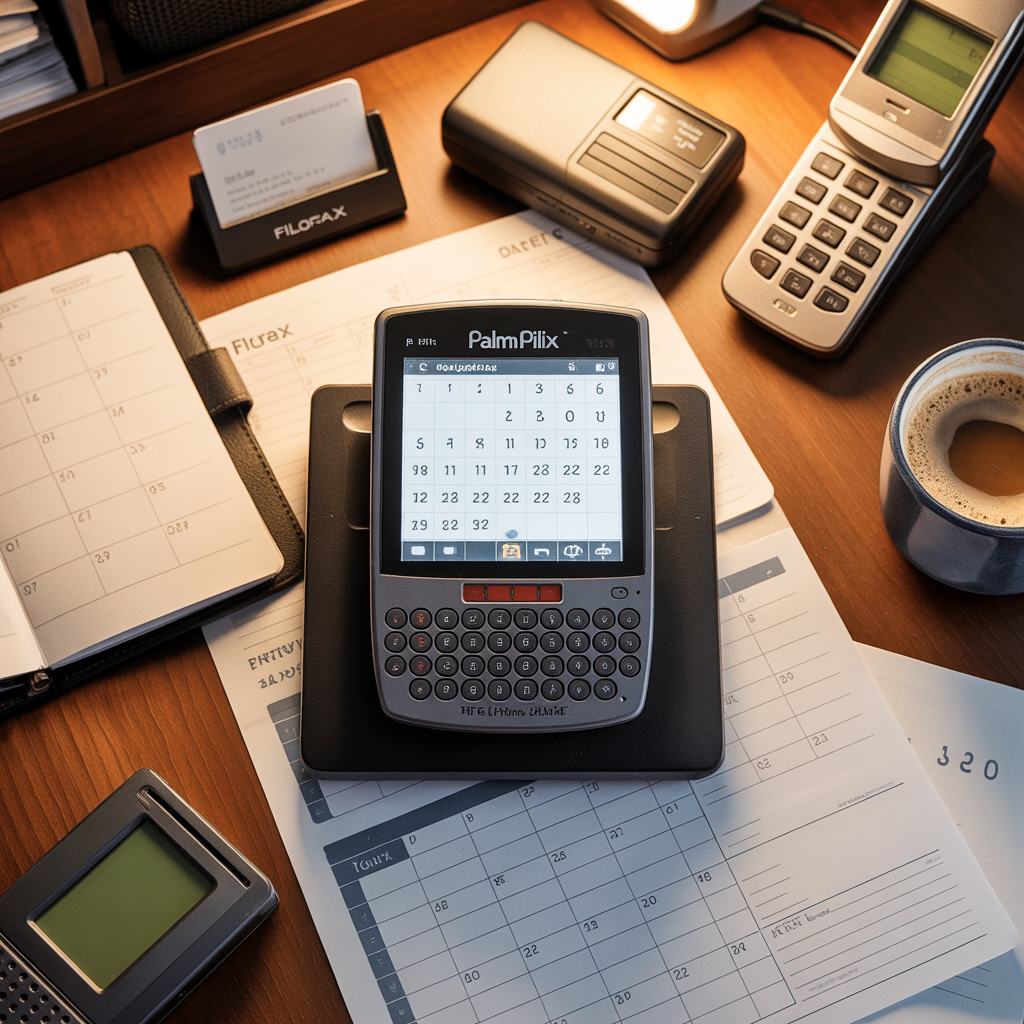
A Deep Dive into the Birth, Brilliance, Battles, and Burial of the Personal Digital Assistant — and Why It Still Matters Today
Previously on AI Innovations Unleashed: We took a nostalgic look at the rise and fall of the Palm Pilot in our earlier post. Now it’s time to go all the way in — the full archaeological dig, the directors’ cut, the extended edition nobody asked for but everyone secretly wanted. Buckle up.
The Rise and Fall of the Palm Pilot: From Digital Dreams to Dusty Drawers
Chapter 1: Before the Palm — The Wilderness Years of Portable Computing
Every great story needs a “before.” Before the iPhone, before Android, before the age of the pocket supercomputer, there was a frantic, hilarious, and surprisingly poignant scramble to figure out what a personal portable computer was even supposed to be.
Imagine the early 1990s. The World Wide Web was barely a gleam in Tim Berners-Lee’s eye. Your most powerful computing tool was probably a beige desktop tower that hummed like a small aircraft. And yet — somewhere in Silicon Valley, Redmond, and Cupertino — designers, engineers, and visionaries were convinced that the future lived in your shirt pocket.
The very concept of the “Personal Digital Assistant,” or PDA, didn’t even have a name yet — until Apple’s then-CEO John Sculley coined the term in January 1992 at the Consumer Electronics Show in Las Vegas (Apple Newton, Macworld, 2013). Sculley wasn’t just launching a product; he was baptizing an entirely new category of computing. The device he teased that day was the Apple Newton MessagePad, and the hype was nothing short of celestial. Apple promised handwriting recognition so flawless it would make notepads obsolete. It promised a pocket-sized intelligence that could take notes, send faxes, manage your calendar, and recognize your scrawl as if it had a Ph.D. in penmanship.
What it delivered, in August 1993, was… less heavenly.
The Newton MessagePad launched in August 1993 at $699 — the equivalent of over $1,100 today — and its much-vaunted handwriting recognition was, to put it charitably, adventurous (McCracken, 2012/Time). It didn’t just misread handwriting; it reimagined it. Garry Trudeau’s legendary Doonesbury comic strip immortalized the Newton’s failures with a week-long arc in which a character’s Newton translated “Catching on?” as “Egg Freckles.” The phrase became shorthand for tech overpromising and underdelivering. Apple’s own Steve Capps, one of the original Newton architects, later admitted: “We were just way ahead of the technology.” (as cited in Ispas & Stroinea, 2018). Apple sold roughly 50,000 units in the Newton’s first three months, far short of the million units the company had projected for its first year (Macworld, 2013).
Apple stuck with the Newton for six years, released seven distinct models, and actually got better — dramatically better — with each iteration. But it could never shake the ghost of “Egg Freckles.” Steve Jobs, upon his return to Apple in 1997, killed the Newton on arrival. The product that had invented the word “PDA” was gone — and its $100 million in development costs became one of the most expensive tuitions Silicon Valley ever paid (Motley Fool, 2013).
But here’s the thing about expensive lessons: they teach someone something. The Newton was a beautiful failure — and in the ruins of its ambitions, a neuroscientist from Cornell was paying very close attention.
Chapter 2: The Wooden Block That Changed Everything
Jeff Hawkins was not, on paper, the typical Silicon Valley founder. He had studied electrical engineering at Cornell, spent years at Intel, then joined GriD Systems in 1982 where he designed the GriDPad — the world’s first commercially successful pen-based computer. It worked. It was also, as Hawkins noted, still too big (Lemelson-MIT, n.d.). He enrolled in Berkeley’s graduate biophysics program in 1986, left after two years to pursue his ideas about machine intelligence, and by 1992 had launched Palm Computing with a deceptively simple mission: build a handheld device that actually fit in your hand.
Here is where the Palm Pilot’s origin story becomes genuinely legendary — and instructive.
Rather than immediately commissioning expensive engineering prototypes, Hawkins retreated to his garage, took a piece of wood, and carved it to the exact dimensions of what he imagined the device should be. He then whittled a chopstick into a stylus. He carried this block of wood in his shirt pocket for months, tapping it, pretending it was a functional device, using paper sleeves to simulate different screen interfaces (Savoia, as cited in LinkedIn, n.d.; company-histories.com, n.d.).
The experiment revealed something profound: Hawkins discovered that he would actually carry such a device everywhere, and that what he needed it to do came down to exactly four things — a calendar, an address book, a to-do list, and a memo pad. Not a hundred features. Not voice recognition or fax capabilities or the ability to order pizza. Four functions. As Alberto Savoia recounted in The Right It, the wooden prototype helped Hawkins validate that his own love of the device was genuine — a threshold many innovators skip entirely.
Palm Computing had previously tried to crack the market with the Zoomer, a collaboration with Casio and Tandy launched in 1993. The Zoomer was everything the eventual Pilot was not: slow, expensive, complicated, and commercially disastrous. It went head-to-head against the Newton and lost just as badly. But the failure crystallized the team’s vision. They learned that the market didn’t want a pocket computer — it wanted a pocket companion. Something fast. Something simple. Something that synchronized with your desktop computer and then got out of the way.
In 1995, U.S. Robotics acquired Palm for $44 million — a purchase that, in hindsight, looks like buying a winning lottery ticket for pocket change. Palm’s founders — Hawkins, Donna Dubinsky, and Ed Colligan — used the backing to build the device Hawkins had been carrying in his pocket as a block of wood for the better part of a year.
The result was the Pilot 1000 and Pilot 5000, launched in spring 1996.
Chapter 3: The Zen of Simplicity — The Palm Pilot Hits Its Stride
The Pilot 1000 was, by any technical measure, an unremarkable piece of hardware. It ran Palm OS 1.0 on a Motorola 68328 CPU at 16 MHz, displayed a 160×160 pixel monochrome screen, and was powered by two AAA batteries that lasted for months. It measured just 4.7 inches long, 3.2 inches wide, and 0.7 inches thick. Its input method, a simplified shorthand alphabet called Graffiti developed by Hawkins himself, required users to learn a slightly modified version of the alphabet — but it worked, and worked reliably (TechSpot, 2020).
At $299 for the base model, it cost exactly half of what an Apple Newton did — and it could hold 500 addresses and 600 appointments (company-histories.com, n.d.). Venture capitalists famously doubted that anyone would pay $299 for a device with so few features. They were spectacularly wrong.
It took about four months for the Pilot to truly catch on. Then it went viral — before viral was even a word. The Pilot appeared on Hollywood sets, in Wall Street boardrooms, in the briefcases of consultants and the pockets of professors. Palm shipped more than one million units in their first year and a half — a faster adoption rate than the Sony Walkman, the pager, or the mobile phone (fundinguniverse.com, n.d.). By the end of 1997, Palm controlled roughly two-thirds of the global handheld market (company-histories.com, n.d.).
What made the Pilot succeed where the Newton had failed wasn’t raw technology. It was philosophy. The Palm Pilot didn’t try to replace your computer; it tried to synchronize with it. The HotSync cradle — that little plastic dock you placed on your desk, connected to your PC — was the Pilot’s secret weapon. Tap a button, and your desktop Outlook contacts, calendar, and notes appeared on your handheld in seconds. No fussing. No learning curve for rocket scientists only.
The Graffiti handwriting system was part of this philosophy too. Rather than trying to recognize your natural handwriting (and failing spectacularly, as the Newton had), Graffiti asked you to meet it halfway: learn a set of simplified, single-stroke characters, and it would recognize them with near-perfect accuracy. It was an elegant compromise between human and machine, and users embraced it enthusiastically — even if it did mean relearning how to write a capital “A.”
The developer ecosystem grew explosively. Independent programmers, remaining intensely loyal to Palm OS over the rival Windows CE platforms, built thousands of applications — games, medical references, Bible readers, scientific calculators, GPS companions (Wall Street Journal, as cited in company-histories.com, n.d.). If the Pilot was a cathedral, these developers were the craftspeople installing the stained-glass windows.
Palm Computing soon became a division of U.S. Robotics, which in June 1997 was itself acquired by 3Com in a deal valued at approximately $6.6 billion — the second-largest merger in tech at the time (TechSpot, 2020). Palm was now nestled inside a networking conglomerate, and with sales of $570 million, Palm accounted for nearly ten percent of 3Com’s revenues in the 1998-99 fiscal year (company-histories.com, n.d.; encyclopedia.com, n.d.).
At its zenith, by late 1999, the Palm OS platform commanded roughly 80% of the U.S. PDA software market — a figure that, when including Palm Inc.’s licensees such as IBM’s WorkPad and the forthcoming Handspring Visor, placed the Palm ecosystem in near-total dominance of U.S. retail handheld sales (International Directory of Company Histories, Vol. 36, 2001). For context, that’s the kind of market dominance that makes economists nervous and antitrust lawyers excited.
1996 – 2000
Chapter 4: The Founders Leave — And the Cracks Begin to Show
Here is where the Palm story gets Shakespearean.
Hawkins, Dubinsky, and Ed Colligan were brilliant founders, but they were not, it turned out, fans of corporate bureaucracy. Their relationship with 3Com became increasingly strained as 3Com refused to spin Palm off as an independent company. In June 1998, all three founders left 3Com in frustration (Computerworld, 2007; TechSpot, 2020).
They didn’t go far. They founded Handspring — and immediately licensed Palm OS to build their own device, the Visor. Launched in September 1999, the Visor was cheaper than Palm’s own devices and featured a springboard expansion slot for adding hardware modules like digital cameras and MP3 players. In what must have been exquisitely painful for 3Com, the founders of the most dominant handheld on earth were now competing directly against it.
3Com responded by taking Palm public. On March 2, 2000, Palm, Inc. went public with a market valuation — on day one — of $53 billion. Its shares, priced at $38, soared to $165 before closing at $95. To put that in perspective, on that single day of trading, Palm was worth more than General Motors, more than McDonald’s, and more than 3Com itself — its own parent company, which still owned 94% of Palm’s stock (company-histories.com, n.d.; fundinguniverse.com, n.d.). It was dot-com mania at its most feverish, and in retrospect, it was also the moment the clock started ticking.
The dot-com bubble burst, and Palm’s shares collapsed. From $95 on IPO day, the stock fell to $6.50 by June 2001 — a 93% decline in just over a year, making it the worst-performing PDA manufacturer on the NASDAQ index at the time (company-histories.com, n.d.). The company that had been valued higher than General Motors was now worth less than a decent-sized shopping mall.
1996 – 2000
Operationally, the fractures were deepening. In January 2002, Palm made what many analysts have described as a catastrophic strategic error: it spun off its software division as an independent company called PalmSource. The logic seemed sound — license Palm OS widely to multiple hardware partners and grow the ecosystem. The execution was a disaster. Palm was now a hardware company without control of its own operating system, and PalmSource was a software company without a guaranteed revenue base. They were competitors as much as partners (Computerworld, 2007).
Meanwhile, Hawkins and the Handspring team were quietly inventing the future. The Treo 600, launched in 2003, was a hybrid device that combined phone, email, internet, and PDA functions in a single unit. It was, by many accounts, the first genuinely successful smartphone — elegant, functional, and ahead of its time. In August 2003, Palm and Handspring merged, with the combined company briefly named PalmOne before reverting to just Palm in 2005 after spending $30 million to buy back its own trademark from PalmSource (Computerworld, 2007).
The corporate saga would be darkly comedic if it weren’t so instructive. Palm split from 3Com. Then acquired its founders’ new company. Then had to buy its own name back. As one Computerworld analysis observed, the company was “a case study in how a company can consistently squander genius” (Computerworld, 2007).
1996 – 2000
Chapter 5: The Barbarians at the Gate — Microsoft, BlackBerry, and the New Competitors
Palm wasn’t standing still, exactly. But while it was reorganizing, renaming, spinning off, and reacquiring itself, competitors were sharpening their swords.
Microsoft, characteristically, spotted a dominant platform and decided to build a rival one. Windows CE 1.0 launched in 1996, aimed at PDAs with tiny QWERTY keyboards. It failed to threaten Palm. Windows CE 2.0, the “Palm PC” (quickly renamed after a trademark lawsuit from Palm), also failed. But Pocket PC, launched in April 2000 with devices from Compaq, HP, and Casio, was a more serious threat — more powerful, with a slicker design and a growing app ecosystem (company-histories.com, n.d.). HP’s iPAQ, which ran Pocket PC OS, shipped 2.4 million units at its peak in 2004 (Tedium, 2019). Palm still led the market, but the gap was narrowing.
Far more dangerous, however, was a device from Waterloo, Ontario that most people initially dismissed as a corporate toy.
Research In Motion’s BlackBerry began as a two-way pager. Its evolution into a wireless email device was methodical, unglamorous, and devastatingly effective. RIM focused relentlessly on corporate customers — Fortune 500 companies, Wall Street firms, government agencies — and its strategy of “wireless email evangelists” who gave devices to executives on a trial basis was guerrilla marketing genius (Rise and Fall of BlackBerry, n.d.). By mid-2001, about 800,000 BlackBerrys had been sold (ibid.). By 2005, the device had earned the nickname “CrackBerry” — a term so widely used that Webster’s New World College Dictionary formally recognized it in 2006 (BlackBerry, Wikipedia, n.d.). At its peak in 2009, RIM held 56% of American smartphone unit sales — a figure cited by IDC and reported in Fortune magazine’s August 2009 feature naming RIM the fastest-growing company in America (BlackBerry, Wikipedia, n.d.).
The BlackBerry’s QWERTY keyboard was its secret weapon: the physical satisfaction of physical keys had a psychological pull that no touchscreen could replicate for years. Executives who carried BlackBerrys didn’t feel like they were using a gadget. They felt like they were conducting business.
Palm tried to answer with the Treo smartphone line. The Treo 600 and later Treo 700 were genuinely compelling devices — powerful, capable, with Palm OS’s legendary ease of use. But Palm was now fighting on two fronts simultaneously: competing with BlackBerry in the enterprise, and trying to retain consumer market share against Windows Mobile devices. It was like fighting off a grizzly bear while also being chased by a pack of wolves.
And then, on January 9, 2007, in the Moscone Center in San Francisco, Steve Jobs stepped onto a stage and detonated a bomb under the entire industry.
Chapter 6: The Finger That Changed Everything
Steve Jobs’s 2007 iPhone announcement is one of the most analyzed keynote presentations in business history. But for the purposes of our story, one specific moment stands above all others. After explaining that Apple had invented a revolutionary new device, Jobs paused to address the question of input. He mock-considered the idea of using a stylus — the very instrument that had been the Palm Pilot’s calling card. Then he delivered the immortal verdict:
“Who wants a stylus? You have to get them and put them away, and you lose them. Yuck. Nobody wants a stylus. So let’s not use a stylus. We’re going to use the best pointing device in the world. We’re going to use a pointing device that we’re all born with — born with ten of them. We’re going to use our fingers.” — Steve Jobs, January 9, 2007 (as cited in European Rhetoric, n.d.)
It was a direct, unmistakable repudiation of the PDA paradigm. The stylus was the symbol of an entire era — of Graffiti handwriting, of tiny tap targets, of an uneasy compromise between human handwriting and machine recognition. Jobs had just buried it with a single word: yuck.
The iPhone was not technically the first smartphone — the Treo had been doing something similar for years, the BlackBerry had corporate America in a stranglehold, and Windows Mobile devices were everywhere. But the iPhone was the first smartphone that made the entire category feel inevitable. It had a capacitive multitouch screen that responded to bare fingers like magic. It ran a full desktop operating system (OS X, as Jobs proudly noted). It put the internet — the real, full internet, not a crippled WAP version — in your pocket. And it had an App Store ecosystem that would, within two years, contain more applications than Palm OS had accumulated in a decade.
Palm CEO Ed Colligan, famously dismissive in a 2006 interview, said that PC companies like Apple “just learning the phone business” weren’t going to “come in here and kill us” (as widely reported at the time). It was one of the great misreadings of competitive threat in tech history. BlackBerry’s co-CEO Mike Lazaridis reportedly watched the iPhone announcement and declared it “an impossibility” because the data networks couldn’t handle it (Medium, 2023).
They were both wrong — spectacularly, historically, memorably wrong.
1996 – 2000
Chapter 7: Palm’s Final Act — The WebOS Swan Song
It would be unfair to Palm to tell this story without lingering on its final, genuinely remarkable chapter.
In late 2008, Palm CEO Ed Colligan announced that the company was exiting the traditional PDA business entirely (Palm, Wikipedia, n.d.). The company went all-in on a new mobile operating system called webOS, built by a team that included designer Matias Duarte (who later went to Google to redesign Android). WebOS was, by most assessments, beautiful and innovative — a true multitasking smartphone OS with card-based task switching, a thoughtful notification system, and an elegant hardware design in the Palm Pre (Palm, Wikipedia, n.d.).
When Palm announced webOS and the Pre at CES in January 2009, the reaction was electric. Hype sent Palm’s stock from $3 to about $18 in early 2009 — a 500% surge (Palm, Wikipedia, n.d.). Tech reviewers called webOS one of the most elegant mobile operating systems ever created.
Then the execution stumbled.
The Pre launched exclusively with Sprint — the smallest of the three major U.S. carriers at the time. With only $250 million in cash left on its balance sheet, Palm simply didn’t have the financial runway to survive a slow carrier ramp-up. Reviews praised the device; sales disappointed. When Hewlett-Packard acquired Palm in July 2010 for $1.2 billion, there was a brief moment of optimism — HP’s resources could give webOS the runway it needed.
HP launched webOS tablets and new phones in 2011. Seven weeks after launch, HP announced it was killing all webOS hardware and effectively ending the Palm brand. After nineteen years, one of the most influential companies in the history of personal computing was gone (Palm, Wikipedia, n.d.).
WebOS still lives — it’s currently used as the operating system in LG’s smart TVs, a strange and bittersweet afterlife for an OS that once seemed destined to rival iOS and Android. Innovation, it turns out, doesn’t always die. Sometimes it just gets reassigned.
Chapter 8: The Philosopher’s Pocket — What Did We Lose, and What Did We Gain?
Here is where we need to pause and ask the uncomfortable question. Not just what happened to the Palm Pilot, but what does it mean that it happened?
The conventional story is one of creative destruction: better technology replaced inferior technology, consumers won, progress marched forward. And there’s truth in that. The iPhone is, by every measurable metric, a more powerful, more capable, and more connected device than any PDA ever dreamed of being.
But there’s a deeper, more troubling dimension to consider.
The Palm Pilot and its PDA contemporaries were, fundamentally, tools for organizing your own life. They were personal. They were offline. They synchronized with your PC on your terms, at your pace, when you placed them in their cradle. The data on your Palm was your data — not in a server farm in Oregon, not monetized by targeted advertising algorithms, not part of a behavioral profile being sold to insurance companies.
The smartphone that replaced the PDA didn’t just add connectivity. It added surveillance. It added distraction engineering. It added ecosystems of apps specifically designed to capture and monetize human attention. The notification badge on your iPhone is not a neutral technology choice; it is a psychological hook, calibrated to trigger dopamine responses and keep you engaged (and revenue-generating) longer.
This is what Clayton Christensen — Harvard Business School’s legendary innovation theorist — might have recognized as a classic case of disruptive innovation where the disruption came with hidden costs that the market didn’t price in. As Christensen described, disruptive innovations often enter markets at the bottom, being “less expensive and more accessible,” before “relentlessly mov[ing] upmarket, eventually displacing established competitors” (Christensen, 2020, as cited in MIT Sloan Management Review). The smartphone didn’t just disrupt the PDA. It disrupted privacy, attention, and the very concept of “unplugged time.”
There’s a philosophical question at the heart of this transition that we rarely ask: When does a more capable tool stop being a tool and start being a master?
The Palm Pilot required your active participation. You had to beam data to another Palm owner to share a contact. You had to physically sit at your cradle to sync. These friction points, which we dismissed as limitations, were also, in retrospect, a kind of protection. They created natural boundaries between digital life and analog life. The smartphone dissolved those boundaries completely.
Dr. Sherry Turkle of MIT, who has spent decades studying how technology shapes human identity, noted in her widely read work Alone Together (2011) that our always-connected devices have created what she calls a culture of “tethering” — where the expectation of constant availability has fundamentally altered how we present ourselves and relate to others. The PDA was an organizer. The smartphone is an identity. And that shift — from tool to identity, from organizer to extension of self — is one of the most profound and underexamined consequences of the transition from Palm to iPhone.
None of this is to argue that the Palm Pilot was better. It was not. But it is to argue that every technological revolution has trade-offs that don’t show up in the product specs — and that the people who loved their Palm Pilots were, perhaps, intuiting something about the value of a bounded tool that we’re only now, a generation later, beginning to articulate.
Chapter 9: The Legacy Nobody Talks About — From Graffiti to Siri
History tends to give the iPhone credit for inventing mobile computing. That’s flattering to Apple but deeply unfair to the truth.
The Graffiti handwriting system — which Hawkins had been developing since the 1980s — was fighting legal battles that themselves tell a story about how seriously the tech world took pen computing. Xerox Corporation, whose Palo Alto Research Center (PARC) had invented Unistrokes in 1993, filed a patent infringement lawsuit against Palm in April 1997, claiming Graffiti violated its patent. The legal battle dragged on for years, eventually forcing Palm to replace Graffiti 1 with Graffiti 2 — a change that, according to many longtime users, made the input system worse (Graffiti 2, Wikipedia, n.d.). Palm ultimately settled with Xerox for $22.5 million in licensing fees (palminfocenter.com, 2006).
But the bigger story is the lineage. The Newton’s Newton Assistant — which allowed users to write natural-language commands to perform system functions like printing and scheduling — is widely cited by technology historians as an early precursor to the kind of natural-language intelligence that Siri later embodied. The Newton OS’s UI principles were baked into the early iOS design DNA (SlashGear, 2022). The Treo, which Hawkins and Handspring developed after leaving 3Com, was essentially a blueprint for the modern smartphone — a touchscreen, phone, email, and internet device in a pocketable form factor — three years before the iPhone.
And Jeff Hawkins himself? After co-founding Numenta in 2005 with Donna Dubinsky, he dedicated himself to a different kind of intelligence — understanding the neocortex and developing machine intelligence based on the principles of the human brain (Dubinsky, Wikipedia, n.d.). In 2024, Numenta launched its open-source Thousand Brains Project, aimed at developing an AI framework modeled on how the brain itself processes information. The man who invented the Palm Pilot is now trying to invent artificial general intelligence — and the through-line from his early handwriting recognition patents to his current neuroscience research is as straight as a stylus stroke.
The PDA era didn’t just give us pocket calendars. It gave us the proof-of-concept for what became the center of modern life. It gave us the App Store’s philosophy (thousands of third-party developers building for a platform they didn’t own). It gave us the HotSync paradigm (data synchronization between devices that would eventually become iCloud, Google Drive, and Dropbox). It gave us the stylus-free touchscreen (the Palm Pre’s gesture area predated many iPhone interactions). It gave us, in some ways, the very idea that computing could be intimate, personal, and always at hand.
Chapter 10: Why the Lifecycle of the Palm Pilot Is the Lifecycle of Everything
If you want to understand how technologies rise and fall — how industries are built, dominated, disrupted, and dissolved — the Palm Pilot is as instructive a case study as you will find.
It teaches us that simplicity is a feature, not a limitation. The Pilot’s refusal to do everything was its superpower. Jeff Hawkins carried a block of wood in his shirt pocket for months to ensure the device would be something he’d actually use. In an industry perpetually seduced by feature bloat, that constraint was revolutionary.
It teaches us that corporate structure matters as much as product quality. Palm had a dominant product, a loyal developer ecosystem, and enormous brand recognition. What it didn’t have was organizational coherence. The split from 3Com, the spinoff of PalmSource, the re-acquisition of Handspring, the buying-back of its own trademark — these were not just strategic missteps. They were symptoms of a company that had separated from the founders who had given it its soul.
It teaches us that disruptive technology often arrives from unexpected directions. Palm expected to be disrupted by Microsoft. It was disrupted by a phone company from Cupertino.
And most poignantly, it teaches us what Clayton Christensen observed at the heart of his disruptive innovation theory: that established companies are often “held captive by their customers” — so focused on serving existing users well that they miss the emerging market entirely (Harvard Magazine, 2014). Palm’s existing customers loved the stylus, loved Graffiti, loved the classic PDA form factor. Serving them well meant, ultimately, not being ready for customers who wanted something entirely different.
As Christensen himself wrote in The Innovator’s Dilemma (1997), the most dangerous moments for any company come not when it is failing, but when it is succeeding — when its processes, values, and resource allocation are all optimized for a reality that is about to change.
1996 – 2000
Epilogue: The Dusty Drawer and the Dusty Road Ahead
Somewhere, in a drawer in a home office or a box in a garage attic, there’s a Palm Pilot. Its batteries are long dead. Its screen is cracked, or perhaps perfectly preserved under a scratch-free plastic cover that the owner affixed with great care in 1999. Its contacts are frozen in amber — an old phone number for a colleague who has since retired, a former address, a to-do list item that was never completed.
Pick it up. Tap the screen with your finger and feel nothing happen — because it needs a stylus.
That sensation — the reaching for something that isn’t there — is, in some ways, the perfect metaphor for the entire PDA era. It was always reaching for a future it could only partially grasp. It knew that computing should be personal and portable and immediately at hand. It knew that your life could be organized by a device small enough to slip into your pocket. It just didn’t yet have the processor, the battery technology, the wireless networks, or the multitouch screen to fully realize that vision.
The smartphone realized it. The smartphone also complicated it, monetized it, gamified it, and occasionally colonized it.
The question for the next chapter — for AI assistants, for augmented reality glasses, for whatever ambient computing becomes — is whether we can recover something of what the Palm Pilot had that we lost: the sense of a tool that works for you, rather than a device that harvests you while pretending to serve you.
Jeff Hawkins carved a block of wood to figure out what a computer should be. The next generation of technologists would do well to find their own block of wood — and carry it for a while before they build anything.
Reference List
- Blackberry. (n.d.). Wikipedia. Retrieved February 2026, from https://en.wikipedia.org/wiki/BlackBerry
- Christensen, C. M. (1997). The innovator’s dilemma: When new technologies cause great firms to fail. Harvard Business School Press.
- Christensen, C. M. (2020, February 4). Disruption 2020: An interview with Clayton M. Christensen. MIT Sloan Management Review. https://sloanreview.mit.edu/article/an-interview-with-clayton-m-christensen/
- Computerworld. (2007, February 23). The decline and fall of the Palm empire. https://www.computerworld.com/article/1641078/the-decline-and-fall-of-the-palm-empire.html
- Dubinsky, D. (n.d.). Wikipedia. Retrieved February 2026, from https://en.wikipedia.org/wiki/Donna_Dubinsky
- European Rhetoric. (n.d.). Transcript: iPhone keynote 2007. https://www.european-rhetoric.com/analyses/ikeynote-analysis-iphone/transcript-2007/
- FundingUniverse. (n.d.). History of Palm, Inc. http://www.fundinguniverse.com/company-histories/palm-inc-history/
- Graffiti 2. (n.d.). Wikipedia. Retrieved February 2026, from https://en.wikipedia.org/wiki/Graffiti_2
- Harvard Magazine. (2014, June). Disruptive genius. https://www.harvardmagazine.com/2014/06/disruptive-genius
- Ispas, A., & Stroinea, C. (2018). Apple’s handheld evolution: From the Newton MessagePad to the iPhone. The Market for Ideas. https://www.themarketforideas.com/apples-handheld-evolution-from-the-newton-messagepad-to-the-iphone-minds-that-filled-the-gaps-ii-a514/
- Lemelson-MIT. (n.d.). Jeff Hawkins. https://lemelson.mit.edu/resources/jeff-hawkins
- Macworld. (2013, August 2). Remembering the Newton MessagePad, 20 years later. https://www.macworld.com/article/221736/remembering-the-newton-messagepad-20-years-later.html
- McCracken, H. (2012, June 1). Newton reconsidered. Time. https://time.com/archive/7235122/newton-reconsidered/
- Motley Fool. (2013, August 2). Why the first tablet failed. https://www.fool.com/investing/general/2013/08/02/why-the-first-tablet-failed.aspx
- Palm, Inc. (n.d.). Wikipedia. Retrieved February 2026, from https://en.wikipedia.org/wiki/Palm,_Inc.
- PalmInfoCenter. (2006). Palm and Xerox settle Graffiti dispute. http://www.palminfocenter.com/news/8696/palm-and-xerox-settle-graffiti-dispute/
- SlashGear. (2022, March 2). How the Apple Newton’s failure led to the iPhone. https://www.slashgear.com/785859/how-the-apple-newtons-failure-led-to-the-iphone/
- Tedium. (2019, June 6). iPAQ origins: The many lives of one weird tech brand. https://tedium.co/2019/06/06/compaq-ipaq-history/
- TechSpot. (2020, September 3). Palm: Gone but not forgotten. https://www.techspot.com/article/2083-palm/
- Turkle, S. (2011). Alone together: Why we expect more from technology and less from each other. Basic Books.
Additional Reading List
1. Isaacson, W. (2011). Steve Jobs. Simon & Schuster. — Contains detailed accounts of Jobs’ role in killing the Newton and building the iPhone, including his views on the stylus.
2. Dubinsky, D. (2007, September 27). Harvard Business School Alumni Achievement Award acceptance. Harvard Business School. — Context on the founders’ philosophy behind the original Palm devices.
3. Christensen, C. M. (1997). The innovator’s dilemma: When new technologies cause great firms to fail. Harvard Business School Press. — The essential framework for understanding why dominant companies lose to disruptive challengers.
4. Turkle, S. (2011). Alone together: Why we expect more from technology and less from each other. Basic Books. — Explores the psychological and social consequences of the always-connected devices that replaced PDAs.
5. Hawkins, J. (2021). A thousand brains: A new theory of intelligence. Basic Books. — Hawkins’s current work on machine intelligence, tracing the intellectual through-line from his Palm days to AI.
Additional Resources
1. Christensen Institute — The nonprofit think tank that continues to develop and apply Christensen’s theory of disruptive innovation: https://www.christenseninstitute.org/theory/disruptive-innovation/
2. Computer History Museum — Archives on early PDAs, the Palm Pilot, and the evolution of mobile computing: https://computerhistory.org
3. Lemelson-MIT Program — Features a profile of Jeff Hawkins and his innovations: https://lemelson.mit.edu/resources/jeff-hawkins
4. Numenta / Thousand Brains Project — Hawkins and Dubinsky’s ongoing work on AI and neuroscience: https://numenta.com
5. MIT Media Lab / Sherry Turkle’s Research Group — Research on technology and human identity, including the effects of always-connected devices: https://www.media.mit.edu

Leave a Reply