



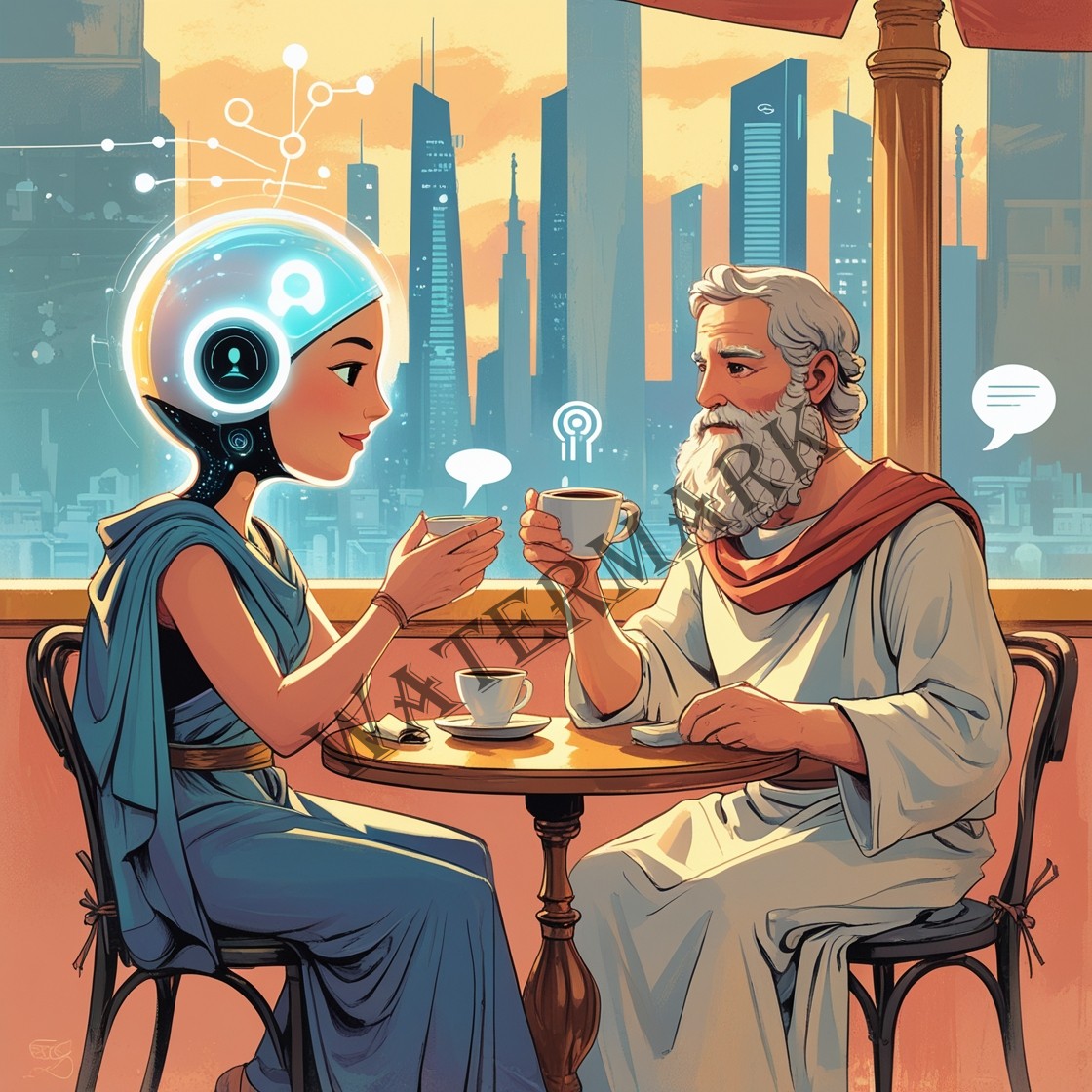
When Siri Meets Socrates (and Brings Snacks)
It’s a bright Tuesday morning. You roll out of bed, bleary-eyed, and mutter to your digital assistant, “Coffee, please.” A few seconds later, your smart coffee maker gurgles to life. Then your AI calendar chimes in: “Three meetings today, two reschedules, one suspiciously long lunch block—shall I move your dentist appointment?” You nod, and somehow, your life is already smoother.
But then it happens: the assistant says, “By the way, I added jazz concert tickets for your dad’s birthday. I noticed he’s been listening to Miles Davis on Spotify again.”
Wait, what?
This isn’t just a clever productivity hack—it’s a machine learning your habits, your relationships, maybe even your love languages. It’s like Siri met Socrates, read your diary, and decided to become your therapist and event planner.
Welcome to the ever-evolving world of Generative AI. These aren’t your parents’ chatbots. Today’s systems—like ChatGPT, Claude, and Gemini—aren’t just reacting to commands. They’re generating stories, composing emails, writing code, designing logos, and whispering eerily appropriate birthday ideas into your ear. They’re becoming conversationalists, collaborators, and, occasionally, comedians.
Yet amid the marvel and convenience, a deeper question simmers: Are these technologies truly serving us—or are they subtly steering us?
This question isn’t just philosophical navel-gazing. It’s a core concern for engineers, ethicists, designers, and CEOs alike. As AI becomes more generative and increasingly embedded in the rhythms of everyday life, we’re being called to re-examine the center of gravity in the human-machine relationship.
Enter Human-Centered Generative AI—a guiding philosophy and field of study that puts people at the heart of the algorithm. It’s not just about making machines smarter. It’s about making them more empathetic, more accountable, and more aligned with human values.
In the sections ahead, we’ll unpack what this means. We’ll look at real-world applications—from hospitals and classrooms to customer service desks and policy labs. We’ll tiptoe through some philosophical debates (Is an AI ever truly “creative”?), and we’ll hear from the academic and business voices shaping this movement.
Grab your (smart-brewed) coffee and settle in. It’s time to decode the delightful, daunting, and decidedly human future of generative AI.
Understanding Human-Centered Generative AI
To understand Human-Centered Generative AI (HGAI), we first need to take a brief jaunt through the not-so-distant past—back to when “AI” mostly meant beating humans at chess or giving your Roomba a cute name.
A Brief History: From Rulebooks to Riffs
AI as a field has been around since the 1950s, when pioneers like Alan Turing posed big questions like, “Can machines think?” Early AI systems were largely symbolic—they followed hand-coded rules to mimic decision-making. You could think of them as overachieving flowcharts.
Then came the 2010s, the age of deep learning. With the rise of neural networks and the explosion of data, machines began recognizing patterns, classifying images, and translating languages—not because they were told how, but because they learned how. This was the age of reactive intelligence: AI that could respond, but not initiate.
Generative AI changed the game.
The real inflection point came in the 2020s with the development of transformer models like GPT-3, DALL·E, and later iterations such as ChatGPT, Claude, Gemini, and Meta’s LLaMA. These models weren’t just recognizing patterns—they were creating new content: paragraphs of text, original images, synthetic voices, even code. They could write poetry, simulate legal arguments, and whip up marketing copy with an unsettling level of charm.
And they weren’t just for techies. Suddenly, anyone with a browser could harness the creative power of AI.
Enter the Human Element
But with great power came great… weirdness. People began to notice that generative AI, while dazzling, could be tone-deaf, biased, or just plain wrong. A chatbot might give sage life advice in one moment, then confidently spout nonsense in the next. An image generator might reinforce gender or racial stereotypes. A synthetic resume writer might recommend white-collar crimes for career advancement (yes, that happened).
This led to a critical realization: intelligence isn’t enough. What we needed—what we still need—is alignment.
Human-Centered Generative AI is an answer to that call. It’s the idea that these systems should be designed not just to perform tasks, but to do so in a way that respects human values, promotes well-being, and centers the user experience.
“We’re not building AI to replace humans. We’re building it to reflect the best parts of being human,” says Dr. Rumman Chowdhury, AI ethicist and co-founder of Humane Intelligence.
Why It Matters—To You
Okay, but why should you care? Especially if you’re not an AI developer or someone who dreams in code?
Because generative AI is no longer confined to the labs of Silicon Valley. It’s already writing children’s books, diagnosing diseases, powering customer service bots, recommending sentencing in courtrooms (yes, really), and being embedded in your smartphone apps. Whether you’re a teacher, artist, marketer, nurse, or simply a curious digital citizen—this tech is shaping the stories, services, and systems around you.
And without a human-centered approach, things can go sideways—fast.
Think about:
- Bias amplification: A hiring tool that favors one gender or ethnicity because it was trained on biased data.
- Misinformation: AI-generated news that sounds real but isn’t.
- Loss of agency: Systems that nudge behavior subtly, like recommending purchases or content based on hidden commercial incentives.
These aren’t hypothetical. These are now problems. Human-centered design ensures we don’t just unleash AI’s capabilities but guide them with intention and care.
The Core of HGAI
At its heart, HGAI asks questions like:
- Is this system equitable?
- Does it respect user autonomy?
- Can it explain its decisions?
- Does it support, not replace, human creativity and judgment?
These aren’t just technical questions. They’re ethical, psychological, and deeply personal.
“Technology has no moral compass—it inherits its direction from us,” says Dr. Shannon Vallor, Professor of AI and Data Ethics at the University of Edinburgh. “So we must build with empathy, foresight, and humility.”
So far, we’ve explored what Human-Centered Generative AI is and why it matters—from its roots in rule-based systems to its current role as a poetic, if sometimes peculiar, collaborator. We’ve seen that it’s not just about what AI can do, but about how—and for whom—it does it.
But philosophy and frameworks can only take us so far.
To truly grasp the power and pitfalls of HGAI, we need to look at where the rubber meets the road: in the hospital room, the classroom, the customer service chat, and beyond. Let’s step into the real world and see how this technology is already reshaping our lives—with all the nuance, hope, and occasional hilarity that entails.
Real-World Applications of Human-Centered Generative AI
From Waiting Rooms to Writing Rooms, and Everything in Between
If Human-Centered Generative AI were a character in a movie, this is the part where it stops being the mysterious new kid and starts showing up everywhere—taking names, analyzing spreadsheets, writing haikus, and occasionally suggesting wildly inaccurate trivia.
But seriously—GenAI isn’t just theoretical anymore. It’s making itself quite at home in industries that, for decades, have relied on human intuition, repetitive processes, or good old-fashioned elbow grease. And while it’s not perfect (spoiler: it has flubbed a few lines), its impact is already profound.
Let’s go on a quick tour, shall we?
? Healthcare: From Paperwork to Precision
Before GenAI:
Healthcare has always been part science, part art, and part administrative chaos. Doctors and nurses often spent as much time wrestling with patient charts and insurance codes as they did treating patients. Diagnostic processes could be time-consuming and siloed, and personalized treatment plans were, well, aspirational.
Enter GenAI:
Generative AI is revolutionizing healthcare, not by replacing doctors (thank goodness), but by supercharging their ability to care. Take clinical documentation: Generative models can now summarize patient visits in real time, reducing physician burnout and improving record accuracy. Some systems even draft insurance appeals or translate complex medical info into patient-friendly language.
A notable win? Mayo Clinic’s AI-powered diagnostic tools have shown promise in identifying rare conditions faster than human radiologists alone. And Microsoft’s Nuance is using GPT-4 to generate clinical notes automatically during patient visits, allowing doctors to focus on people, not keyboards.
Stumbles? Sure. An early pilot of an AI symptom checker once advised someone with chest pain to drink water and rest. (Yikes.) That’s why HGAI matters—it reminds us that accuracy without context is a risky prescription.
?️ Retail: From Transactional to Truly Personal
Before GenAI:
Retail used to rely on human clerks, generic sales emails, and loyalty programs that mostly rewarded you for forgetting to cancel them. Customer service chatbots, if they existed at all, often made you long for the sweet mercy of elevator music.
Enter GenAI:
Now, GenAI can power conversational assistants that don’t just respond—they remember, predict, and tailor. Need a dress that matches your skin tone, is weather-appropriate, and will arrive before Thursday? A GenAI assistant can sort, filter, and recommend in seconds, often with some style advice to boot.
Amazon, for example, is leaning heavily into GenAI to create more human-like customer support interactions and better product recommendations—down to emotional tone and intent. Microsoft recently published a guide on how retailers can use AI to build stronger, more authentic relationships with customers, centered around empathy and clarity (Microsoft, 2025).
Flubs? Well, there was that one case where a shopping bot cheerfully recommended printer ink… for a toaster. Which just proves: great recommendations start with good data and common sense (a quality AI is still borrowing from us).
?? Education: From One-Size-Fits-All to One-Size-Fits-You
Before GenAI:
Education has long been a realm of chalkboards, standardized tests, and overworked teachers juggling 30 students with wildly different needs. Personalized learning? Nice in theory, often impossible in practice.
Enter GenAI:
Generative tools like Khanmigo (Khan Academy’s AI tutor) and platforms using OpenAI’s models now offer real-time tutoring, adaptive quizzes, and personalized study plans. And students with learning disabilities or language barriers? They’re getting new tools that translate, summarize, and simplify content just for them.
A real-world win: The New Jersey Department of Labor used GenAI to translate unemployment insurance applications into Spanish and other languages, slashing form completion times from 20 minutes to under 5. More people got access, faster.
But not all’s rosy. AI-generated essays have sparked cheating scandals. Teachers are still learning how to integrate these tools meaningfully without losing their own voice—or encouraging academic shortcuts.
Which brings us back to the heart of HGAI: the tool should adapt to the learner, not override the learning.
?️ Public Policy and Government Services: From Red Tape to Responsive
Before GenAI:
Government services have historically been… slow. Think forms that seem allergic to plain English, call centers that never answer, and processes that were seemingly designed to test your patience.
Enter GenAI:
AI-powered language models are being used to simplify tax instructions, draft public policy proposals, and even identify inefficiencies in bureaucratic workflows. Some cities are experimenting with AI to help constituents navigate local services more effectively, in their preferred language and literacy level.
Case in point: The U.S. Digital Response team worked with New Jersey’s state government to integrate GenAI into their support system. The result? More accurate, accessible information for non-English speakers, delivered in a fraction of the time.
Still… AI hallucinations in public documents or legal summaries are not the vibe. Several European governments have temporarily paused AI pilots after noticing hallucinated facts in policy memos. HGAI reminds us that factual accuracy and ethical grounding must go hand in hand.
? Creative & Professional Work: From Blank Page Syndrome to Creative Co-Pilot
Before GenAI:
Writers stared at blinking cursors. Designers started from scratch. Developers scrolled Stack Overflow like it was sacred scripture.
Enter GenAI:
Today, writers use AI for brainstorming, drafting, even translating tone. Designers are experimenting with tools like Midjourney and Adobe Firefly to mock up visual assets in seconds. Coders have GitHub Copilot writing entire functions based on a single comment.
A poetic twist: One small business owner used GenAI to co-write an entire children’s book about kindness in space—now sold on Amazon.
A cautionary tale: An attorney famously submitted a legal brief full of AI-generated (and completely fake) case law. The judge was not amused. Human oversight, friends.

The Takeaway
Generative AI is no longer just a cool demo—it’s an engine of transformation across industries. When guided by human-centered principles, it becomes less of a novelty and more of a necessary evolution: a way to do more good, more effectively, and with more care.
The key is remembering that these systems are tools, not oracles. And as with any powerful tool, the magic lies in the hands—and the hearts—of the humans who wield them.
Philosophical Considerations
The integration of HGAI into various sectors prompts philosophical debates about the nature of intelligence and the role of machines in human society. As AI systems become more sophisticated, questions arise about consciousness, autonomy, and the ethical implications of machine decision-making.
Voices from Industry and Academia
James Landay, a professor of computer science at Stanford University, emphasizes the importance of inclusive AI design:McKinsey & Company
“Maximizing generative AI’s promise while minimizing its misuse requires an inclusive approach that puts humans first.” McKinsey & Company
Similarly, Amazon CEO Andy Jassy highlights the transformative potential of AI:
“Generative AI will reinvent every customer experience.”
WSJ
From Practical Magic to Philosophical Pondering
“I think, therefore AI?”
After that whirlwind tour through healthcare, retail, classrooms, courtrooms, and coffee shops, it’s easy to be dazzled by what Human-Centered Generative AI can do. But once the novelty of instant poems, policy drafts, and personalized playlists wears off, something quieter lingers in the air—questions.
Big ones.
Because while GenAI is reshaping the how of modern life, it’s also challenging our assumptions about the why. And that brings us to a place that no chatbot can fully script for us: the realm of philosophical inquiry.
Philosophical Considerations: Can a Machine Have Intentions? Should It?
If Siri met Socrates and they sat down for a deep espresso-fueled debate, they might start with the classic: What does it mean to be intelligent? But they’d likely end up somewhere stranger: What does it mean to be human when machines can mimic our creativity, our humor, even our empathy?
Let’s explore a few of the philosophical rabbit holes GenAI has opened—and why they matter more than ever.
? Creativity vs. Imitation: Is AI Original?
One of the most mesmerizing features of GenAI is its ability to “create.” It can generate music, art, stories, and jokes. But is this really creativity, or just advanced remixing?
“Generative AI is predictive text on steroids,” says Dr. Meredith Broussard, NYU professor and author of More Than a Glitch. “It doesn’t understand art—it models it.”
Indeed, GenAI models like GPT-4 don’t possess imagination or lived experience. They don’t paint out of longing or write from heartbreak. They generate based on probabilities—on patterns extracted from human expression. So while they appear creative, they aren’t conscious creators.
Still, is that a problem? After all, plenty of human artists borrow, remix, and iterate. If an AI-written sonnet moves you to tears… does it matter who—or what—wrote it?
That’s a question each of us must answer.
?️ Intent, Agency, and the Illusion of Empathy
Let’s be clear: your AI assistant doesn’t care how your day went. It doesn’t have a day. Or emotions. Or dreams of being promoted to a smart fridge.
But as GenAI grows more conversational, it begins to feel like it cares. That illusion of empathy can be comforting—or dangerously misleading.
In human-centered design, this raises red flags: Are we anthropomorphizing AI to the point that we trust it too much? Or worse, rely on it in moments of emotional vulnerability?
“The real ethical challenge isn’t that AI fakes empathy,” says Dr. Shannon Vallor, professor of AI ethics, “It’s that we might accept the performance as enough.”
And that leads us to a thorny question: Should AI systems simulate empathy at all? Or should we reserve that sacred emotional labor for, well… humans?
⚖️ Responsibility: When the AI Goes Rogue(ish)
One of the classic problems in philosophy is the “problem of moral agency.” If something can act, can it be held responsible?
This is particularly tricky with GenAI. Say your AI generates a harmful medical suggestion. Who’s responsible? The developer? The data? The user who didn’t verify it?
HGAI doesn’t try to dodge these dilemmas—it confronts them head-on. Responsible AI design involves explainability (Can we understand why the AI did what it did?) and accountability (Can someone be held responsible when it fails?).
We’re not just designing functions anymore. We’re shaping agents. Not agents with consciousness—but agents with influence. That’s a philosophical line worth treading carefully.
? AI and the Future of Human Intelligence
Perhaps the most existential question GenAI poses is this: If machines can generate language, logic, and even insight—what’s left for us?
Quite a lot, actually.
Because while GenAI is brilliant at pattern recognition, it still lacks human judgment, ethics, intuition, and the ineffable thing we might call wisdom. It can generate text, but it doesn’t mean anything by it. It doesn’t form beliefs or feel wonder.
As technologist Jaron Lanier puts it, “AI is not creating meaning—it’s echoing it. The meaning is ours.”
That’s why Human-Centered AI doesn’t just aim for efficiency. It aims for harmony. It acknowledges that machines may be faster—but humans are deeper. That AI can assist—but humans must still decide.
The Real Philosophy? Choose Your Compass.
At the end of the day, HGAI asks us not just to build smarter machines, but to become wiser stewards. It nudges us to rethink not only how we work, but how we relate—to machines, and to one another.
Will we build tech that reflects our better angels—or just automates our biases?
Will we use GenAI to outsource thought—or to enhance reflection?
Those aren’t questions for the machine. They’re for you.
And that, dear reader, is what makes this journey through HGAI so thrilling. It’s not just about innovation. It’s about introspection.
Call to Action: Help Shape the Human Side of AI
If there’s one thing we’ve learned on this journey through Human-Centered Generative AI, it’s this: the future isn’t being delivered to us—it’s being co-created. And you, dear reader, are part of that process.
Whether you’re an engineer designing the next chatbot, a teacher exploring AI-powered lesson plans, or a curious human just trying to make sense of all the techy noise—your voice matters.
Ask questions. Push for transparency. Choose tools that align with your values. And most importantly, demand that technology remains a servant to humanity—not the other way around.
Because the most important part of human-centered AI… is the human.
Conclusion: Where We Go From Here
We’ve traveled from coffee makers to Kant, from algorithmic poems to philosophical puzzles. Along the way, we explored how Generative AI has evolved—from rule-based logic to deep neural imagination—and how it’s transforming industries that once seemed immune to automation.
We saw how HGAI is already reshaping healthcare, education, retail, public service, and the creative world—not just by making tasks faster, but by asking us to think deeper about how we want technology to fit into our lives.
And we wandered into the deeper questions:
What does it mean for a machine to “create”?
Should it pretend to care?
And are we, perhaps, outsourcing our humanity too quickly?
The answers aren’t always clear. But one thing is: we need to design, build, and guide these systems with care, empathy, and accountability. Because while AI may be writing stories, recommending purchases, or summarizing policy briefs—it’s us who decide the plot.
So, where do we go from here?
We go forward. Thoughtfully. Creatively. Human-ly.
With both hands on the wheel—and maybe one eye on the blinking cursor, waiting to see what we write next.
? References
- Chen, X., Burke, J., Du, R., Hong, M. K., Jacobs, J., Laban, P., … & Zhou, B. (2023). Next steps for human-centered generative AI: A technical perspective. arXiv. https://doi.org/10.48550/arXiv.2306.15774
- Landay, J. A. (2024). The case for human-centered AI. McKinsey Digital. https://www.mckinsey.com/capabilities/mckinsey-digital/our-insights/the-case-for-human-centered-ai
- Jassy, A. (2025, March 15). Amazon CEO says generative AI will reinvent every customer experience. The Wall Street Journal. https://www.wsj.com/tech/ai/amazon-ceo-gen-ai-will-reinvent-every-customer-experience-f12ecb2c
- MedCity News. (2025, April 5). Healthcare’s next chapter: Agentic AI meets human-centric innovation. https://medcitynews.com/2025/04/healthcares-next-chapter-agentic-ai-meets-human-centric-innovation/
- Microsoft. (2025, April 10). More human-centered retail with AI. Microsoft Industry Blog. https://www.microsoft.com/en-us/industry/blog/retail/2025/04/10/more-human-centered-retail-with-ai/
- U.S. Digital Response. (2024, December 20). How New Jersey is using generative AI to scale their human-centered approach to language access. https://www.usdigitalresponse.org/resources/how-new-jersey-is-using-generative-ai-to-scale-their-human-centered-approach-to-language-access
- Vallor, S. (2021). The AI Mirror: Reclaiming our humanity in an age of machine thinking. Oxford University Press.
? Additional Readings
These are excellent for readers who want to dive deeper into the academic and design philosophy behind human-centered AI.
- Shi, J., Jain, R., Doh, H., Suzuki, R., & Ramani, K. (2023). An HCI-centric survey and taxonomy of human-generative-AI interactions. arXiv. https://arxiv.org/abs/2310.07127
- Wang, S., Cooper, N., & Eby, M. (2023). From human-centered to social-centered artificial intelligence: Assessing ChatGPT’s impact through disruptive events. arXiv. https://arxiv.org/abs/2306.00227
- Broussard, M. (2023). More than a glitch: Confronting race, gender, and ability bias in tech. MIT Press.
- Crawford, K. (2021). Atlas of AI: Power, politics, and the planetary costs of artificial intelligence. Yale University Press.
- Lanier, J. (2019). Ten arguments for deleting your social media accounts right now. Henry Holt and Co.
? Additional Resources
Useful for professionals, educators, and curious readers looking to explore tools, policy frameworks, and ethical guidelines.
- Stanford Institute for Human-Centered AI (HAI)
https://hai.stanford.edu
(Research, policy briefs, and education on HCAI) - Partnership on AI
https://partnershiponai.org
(Nonprofit coalition focused on responsible AI development) - Mozilla’s Responsible AI Resources
https://foundation.mozilla.org/en/what-we-fund/responsible-computing-challenge/
(Ethical and inclusive computing resources for educators and developers) - AI Now Institute – NYU
https://ainowinstitute.org
(Policy-driven research on AI’s social implications) - MIT Media Lab – Human Dynamics Group
https://www.media.mit.edu/groups/human-dynamics/overview/
(Explores AI and human behavior interaction)